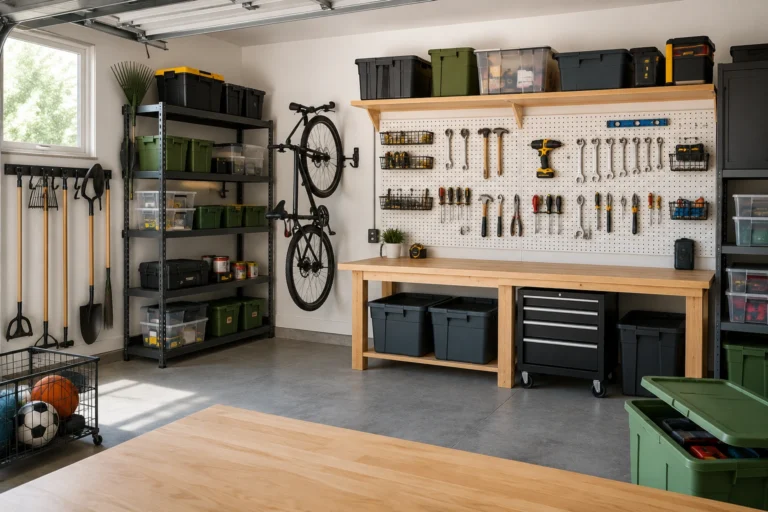
18 Brilliant Garage Mudroom Storage Ideas for Busy Families
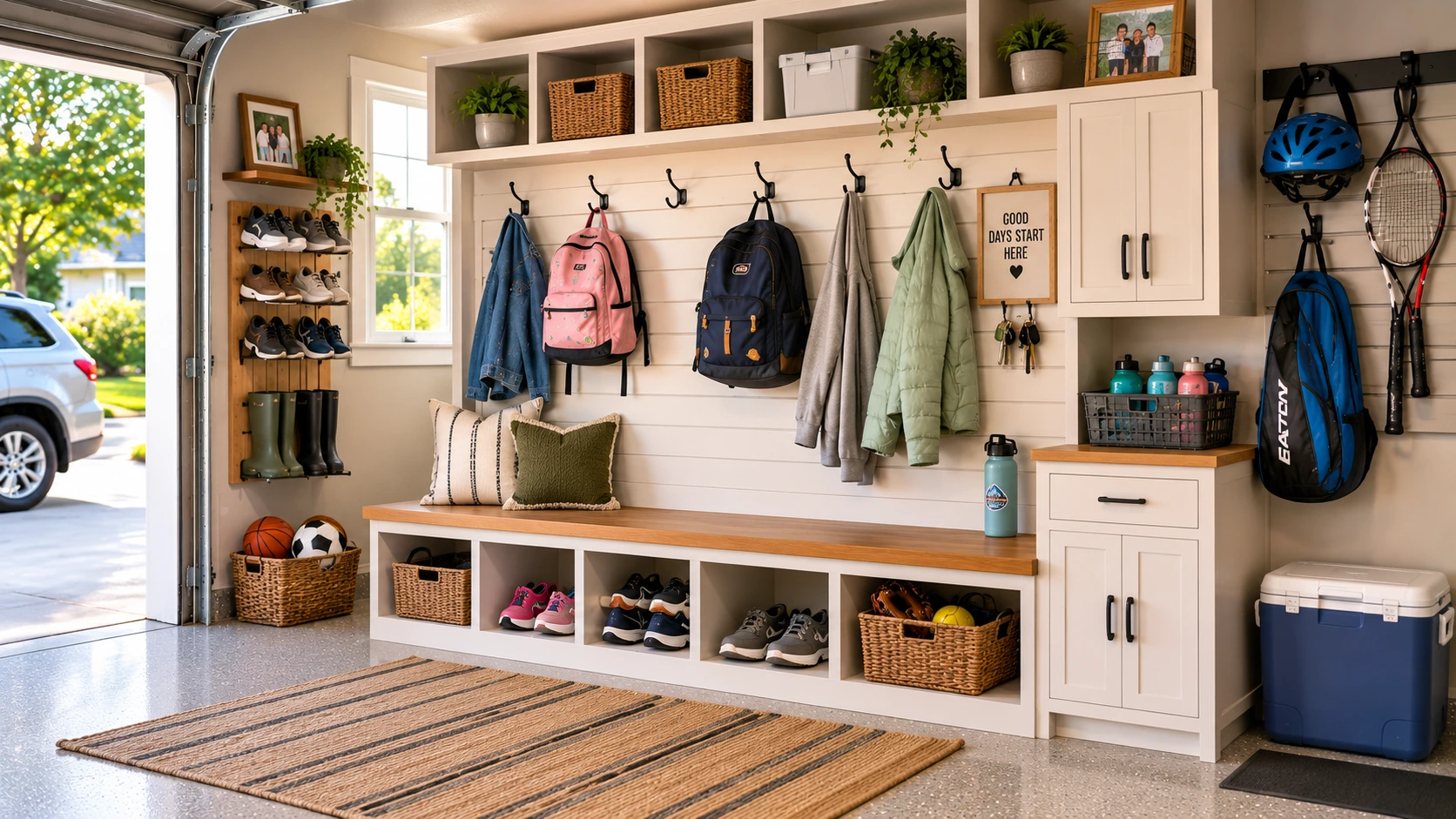
The garage entry can become a family’s unofficial drop zone surprisingly quickly.
Shoes get kicked off by the door. Backpacks land on the floor. Jackets end up on a workbench. Sports bags lean against the wall, and small things like keys, hats, and gloves seem to disappear exactly when someone is already running late.
A dedicated garage mudroom can bring some order to that daily chaos without requiring a large room or a full built-in renovation.
The trick is to design the area around how your family actually uses the garage. Frequently used items should be easy to reach, each person should have a clear place for their belongings, and storage shouldn’t interfere with vehicles or the main walking path.
These garage mudroom storage ideas will help you turn an unused section of garage wall or entryway into a practical drop zone for shoes, coats, backpacks, sports equipment, and everyday family gear.
Before Adding Garage Mudroom Storage, Check These 7 Things
You don’t need to measure every inch of the garage before getting started, but a few quick checks can prevent an attractive storage setup from becoming an inconvenient one.
1. Available wall width: Measure the section you actually intend to use.
2. Walking space: Make sure people can comfortably pass through the area.
3. Vehicle clearance: Check that storage won’t interfere with car doors, mirrors, or getting in and out of the vehicle.
4. Door movement: Account for the swing of the garage entry door and any nearby doors.
5. Daily-use items: Identify what your family drops or grabs every day.
6. Open versus closed storage: Decide which belongings should stay visible and which you’d rather hide behind doors or inside baskets.
7. Wall construction: Before mounting shelves, cabinets, or heavy hooks, confirm that the wall and mounting hardware can safely support the intended load.
A little planning here can save you from installing storage twice.
1. Create a Dedicated Garage Mudroom Zone
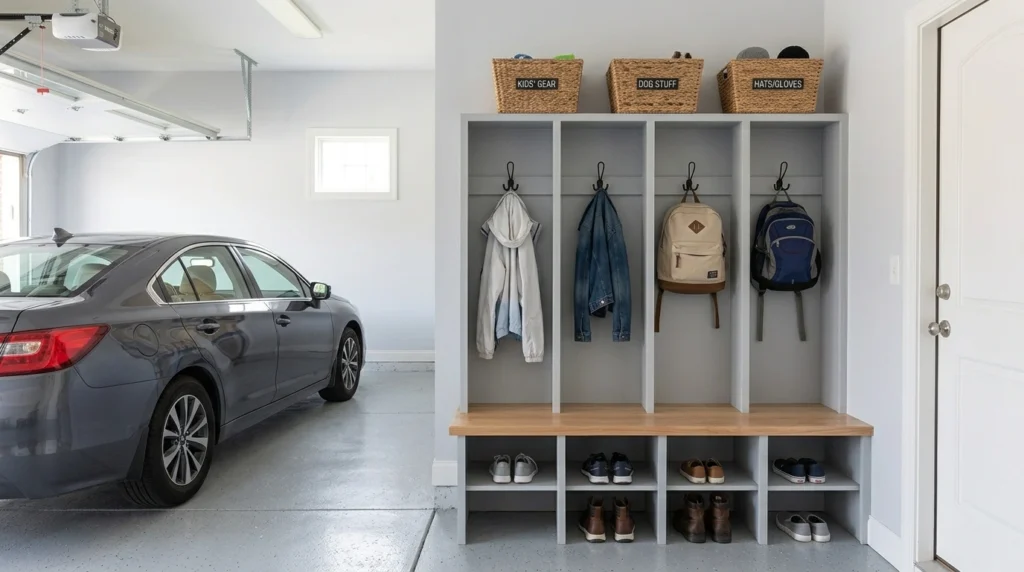
Start by giving the garage entry a defined purpose.
Choose one section near the interior door or another convenient entrance and treat it as your family’s garage mudroom rather than general-purpose garage storage.
The zone might be only a few feet wide. What matters is that everything inside it supports the arrival-and-departure routine.
A simple arrangement could include hooks for jackets and backpacks, a bench for shoes, and a shelf or cabinet above for less frequently used items.
The biggest benefit is psychological as much as practical: once a particular area becomes the designated drop zone, family members have a clear place to put things instead of using the nearest available surface.
These garage mudroom storage ideas work especially well when you need to create a clear transition between the garage and the rest of the home.
2. Install Wall Hooks for Coats and Jackets
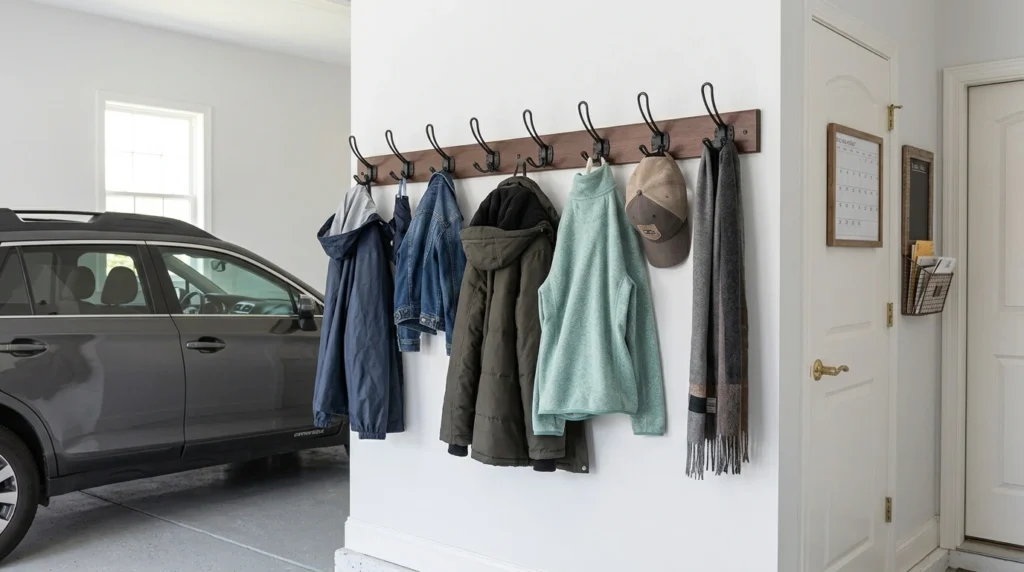
A row of sturdy wall hooks can eliminate one of the most common entryway problems: jackets being tossed wherever there happens to be space.
Give each family member one or two hooks for everyday outerwear. If children use the garage entrance, install some hooks low enough for them to reach comfortably.
Hooks are also useful for hats, lightweight bags, umbrellas, and other accessories.
For heavier coats or bags, choose hooks and mounting hardware appropriate for the load. Don’t rely on drywall alone for a storage setup that will regularly carry substantial weight.
A hook rail can be especially useful if you want to adjust the arrangement later without having to install every hook individually.
3. Add a Bench With Shoe Storage Underneath
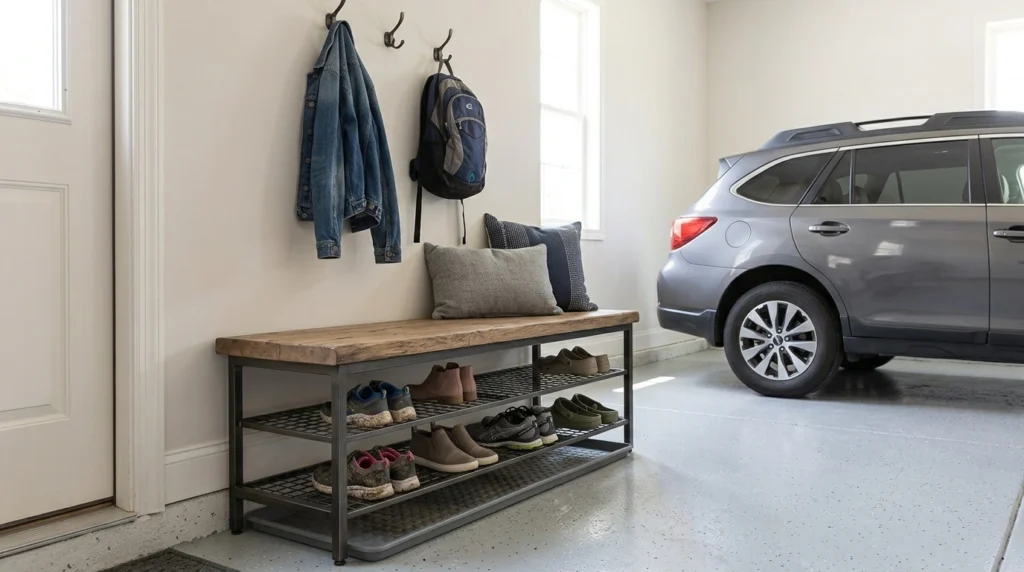
A bench can become the anchor of a compact garage mudroom.
It gives family members somewhere to sit while putting on shoes while the space underneath becomes dedicated shoe storage.
Open cubbies work well for everyday footwear because everyone can see what belongs there. A low shoe rack or baskets can provide a similar solution.
For muddy or wet shoes, consider using a washable tray underneath. Open storage also allows wet footwear to dry more easily than tightly packed closed compartments.
Keep the bench far enough from parked vehicles and walking paths that it doesn’t create a daily obstacle.
If your garage is narrow, a shallow bench can provide the function you need without taking over valuable floor space.
4. Give Each Family Member an Individual Cubby
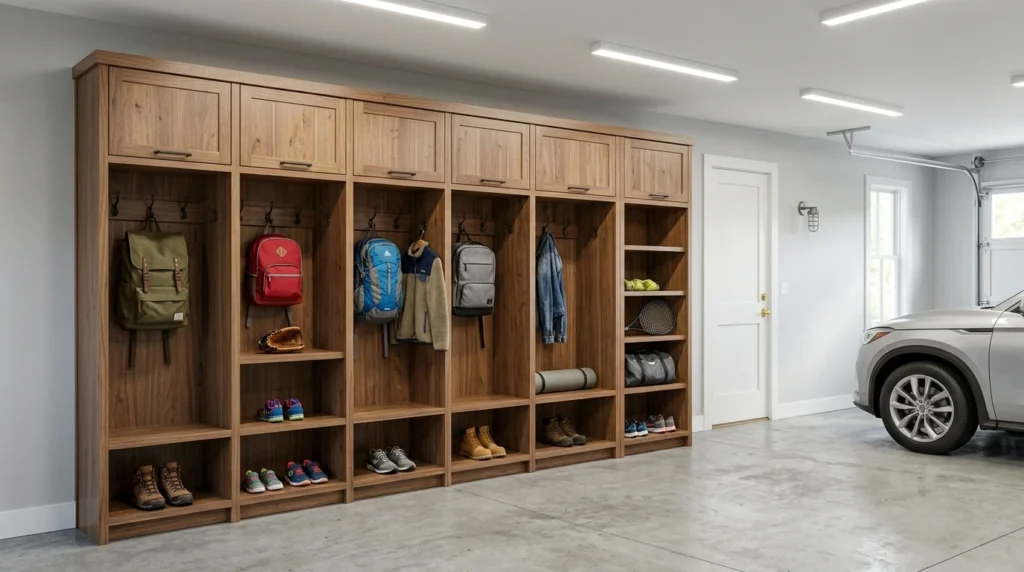
Shared storage tends to become messy when nobody knows which space belongs to whom.
Individual cubbies solve that problem by creating a defined home for each person’s everyday belongings.
One cubby might hold a child’s backpack and shoes, while another holds a work bag, jacket, and frequently used accessories.
You can use a freestanding cubby unit, modular shelving, or a built-in system depending on the available space.
Labels can make the system even easier for children to follow.
The goal isn’t to create a storage compartment for every possession. Keep the cubbies focused on the items family members actually need when leaving or returning home.
5. Give Every Backpack Its Own Hook
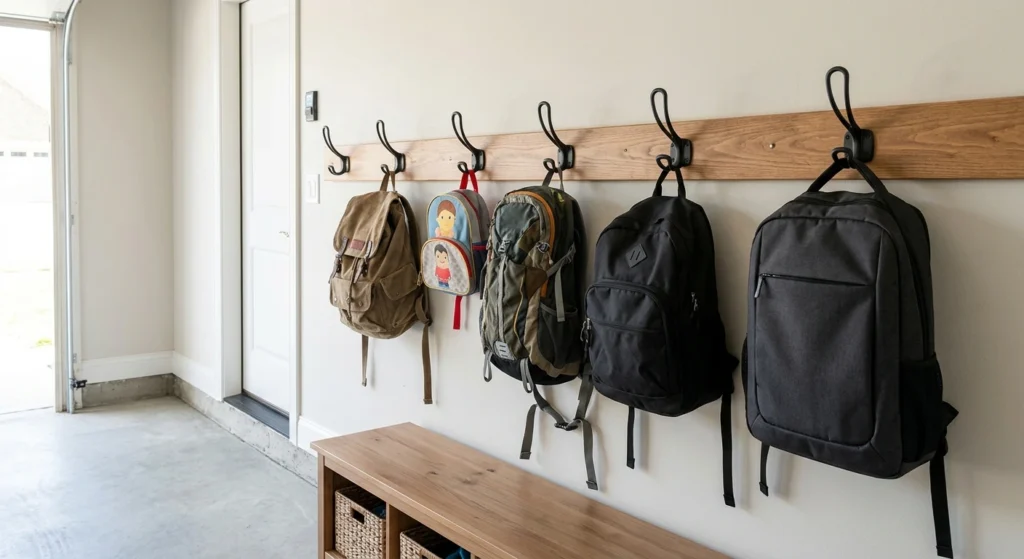
Backpacks deserve their own storage because they are usually too bulky for a small shelf and too frequently used to justify hiding them inside a cabinet.
Mount dedicated hooks near the garage entry and assign one to each family member.
This works especially well for school bags, work bags, activity bags, and smaller sports bags.
Keep the hooks high enough that bags stay off the floor but low enough for the people who use them to reach comfortably.
If your family has several types of bags, separate everyday backpacks from larger sports or travel bags so the smaller drop zone doesn’t become overloaded.
6. Create a Simple Shoe Organization Station
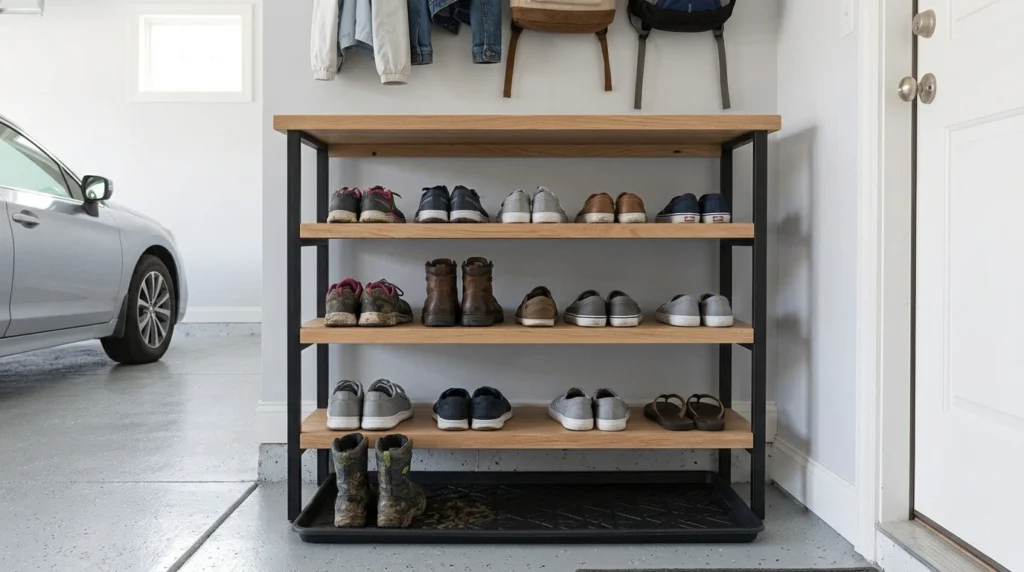
Shoes are often the first thing that makes a garage entryway look messy.
Instead of letting them collect beside the door, give footwear a specific home with open shelving, cubbies, a shoe rack, or storage beneath a bench.
Keep frequently worn shoes in this zone and move seasonal or rarely used footwear elsewhere.
For families dealing with mud, rain, or snow, leave enough space between pairs for air circulation and consider placing a durable tray underneath the storage area.
The objective isn’t to display every pair of shoes in the house. It’s to make the everyday pairs easy to put away and easy to grab again.
7. Add a Shelf Above the Hooks
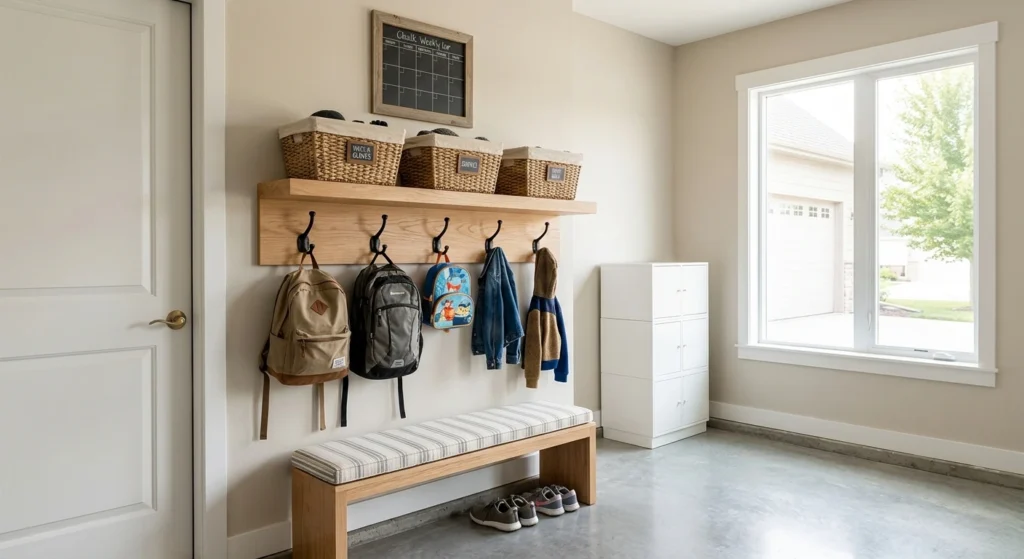
Once coats and backpacks are hanging on the wall, the space above them can provide another layer of storage.
A shelf above the hooks can hold labeled baskets containing gloves, hats, scarves, seasonal accessories, or other items that don’t need to be reached constantly.
This is a simple way to take advantage of vertical garage storage without using additional floor space. If your garage mudroom also needs better use of vertical space, these garage wall storage ideas can help you make the most of unused walls.
Keep frequently accessed items lower and reserve the highest shelf space for belongings that are used less often.
As with any wall-mounted shelf, use appropriate hardware and consider the weight of the items you’ll be storing.
A few matching baskets can also make open shelving look much less cluttered.
8. Use Labeled Baskets for Family Essentials
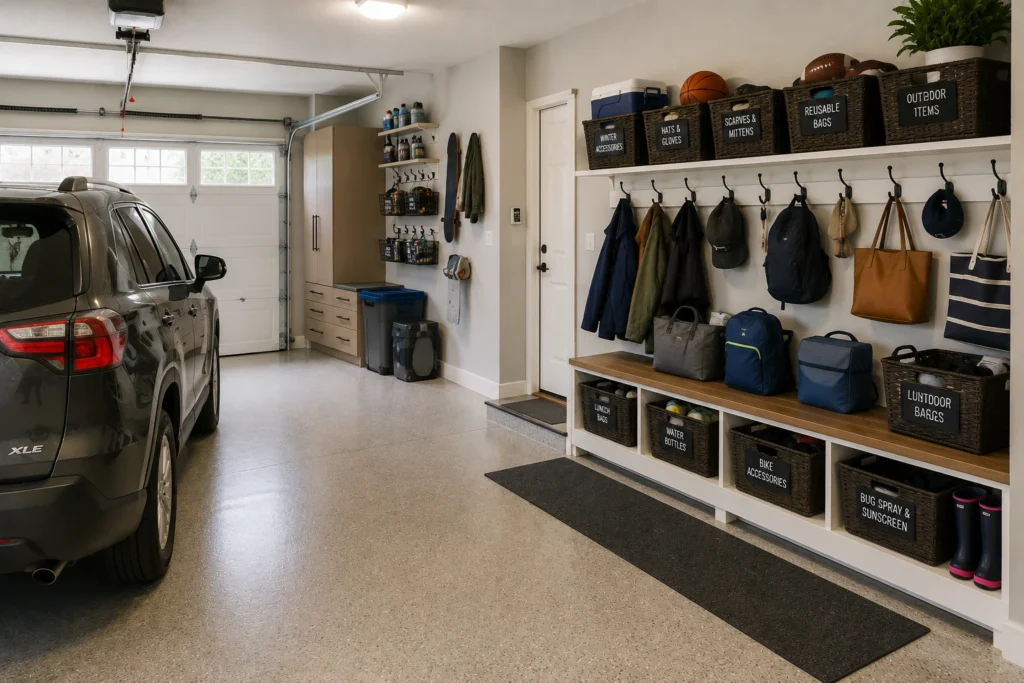
Small accessories can create a disproportionate amount of clutter.
A few labeled baskets can give these items a place to go without requiring a complicated storage system.
You might use one basket for winter accessories, another for reusable shopping bags, and another for outdoor items that are regularly used.
The labels matter because a basket without a defined purpose can quickly become a miscellaneous container.
Choose baskets that are easy to lift and carry. If someone has to move several containers just to put away one hat, the system probably needs simplifying.
9. Create a Sports Gear Drop Zone
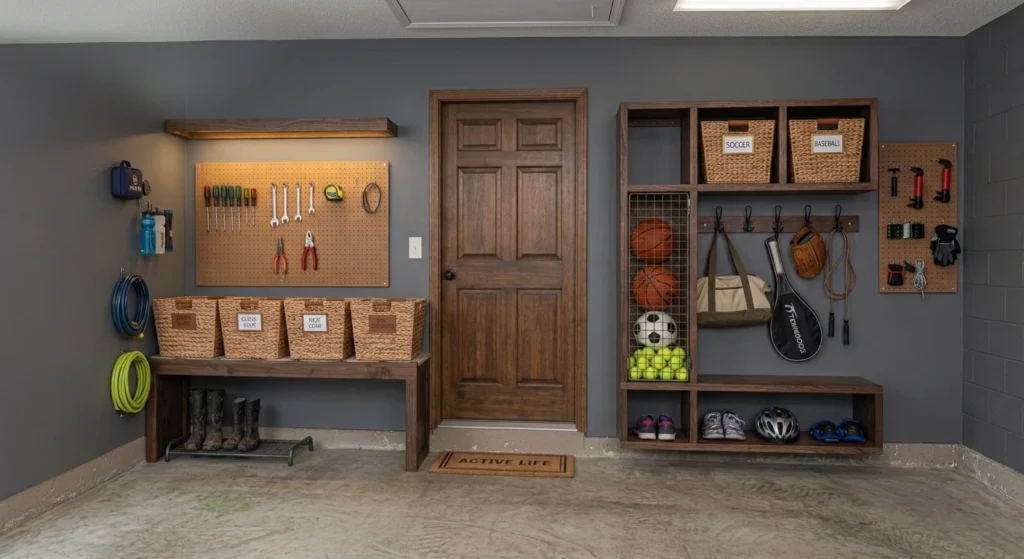
For active families, sports equipment can quickly take over a garage mudroom.
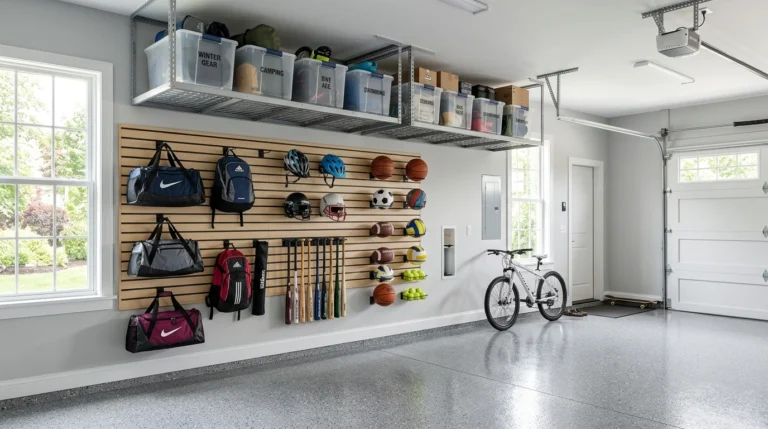
Instead of allowing sports bags, helmets, balls, and other equipment to collect near the entry, create a dedicated sports gear section.
Wall hooks can hold bags and helmets. Baskets can contain balls and smaller pieces of equipment, while specialized racks can handle longer items such as bats or sticks.
Keep the gear that is used regularly near the entry and move seasonal equipment to another part of the garage.
This creates a useful distinction between a mudroom drop zone and general sports storage.
10. Install a Narrow Vertical Organizer
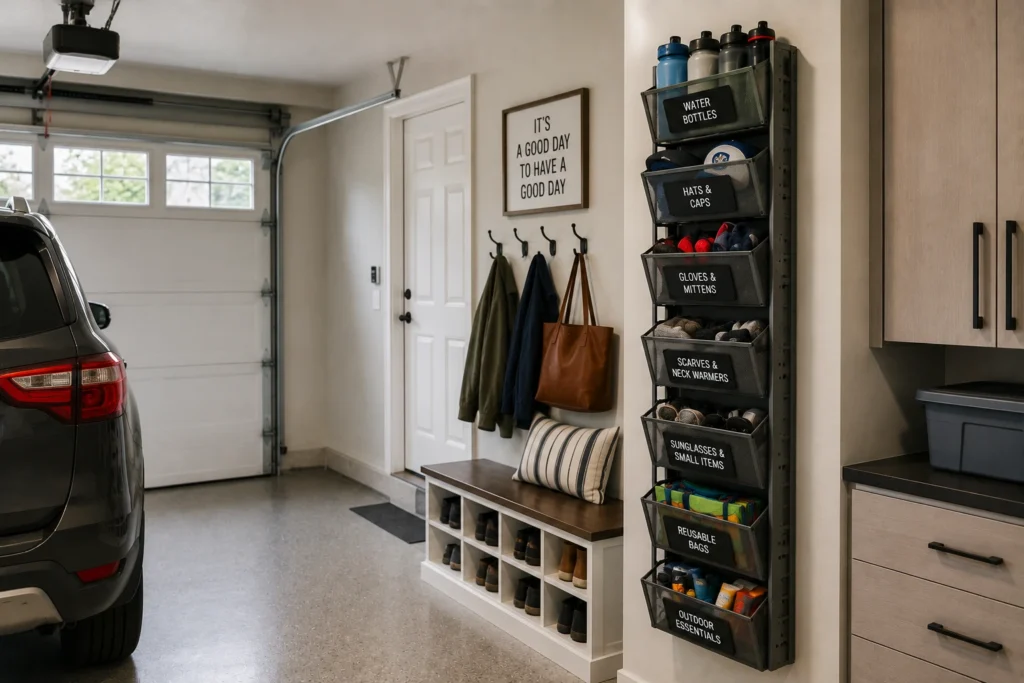
Not every garage has enough floor space for a deep cabinet or large shelving unit.
A narrow vertical organizer can make better use of a small wall section while still providing several storage levels.
This can work particularly well beside a garage entry door or in a narrow area between other fixtures.
Use the lower sections for items that children or shorter family members need to access and reserve higher sections for less frequently used belongings.
Before installing one, check the organizer’s depth carefully. Even a relatively shallow unit can become an obstruction if it reduces the walking path too much.
11. Turn an Unused Corner Into a Mudroom Extension
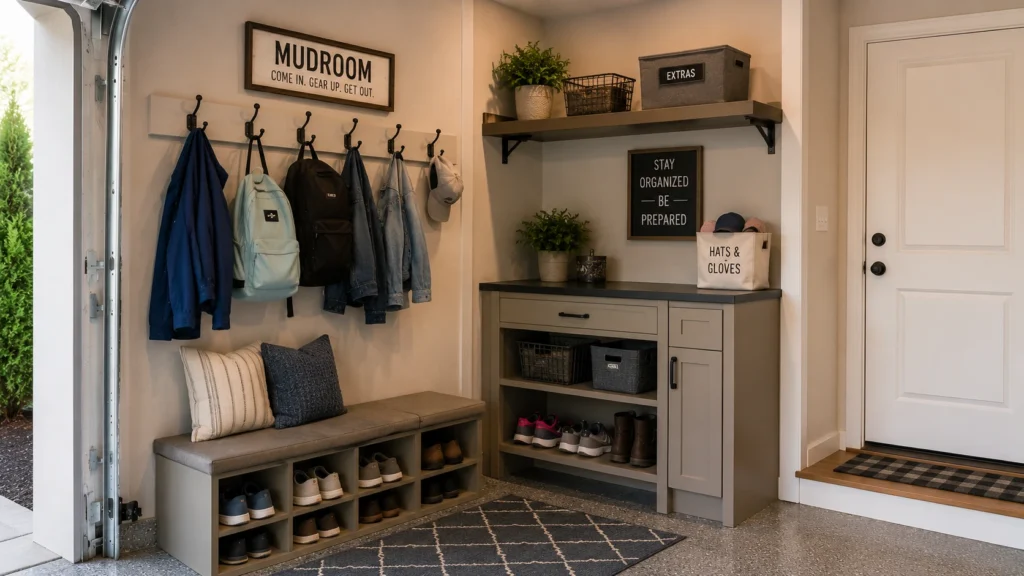
Garage corners are easy to overlook because many storage products are designed for straight walls.
But a corner can provide useful overflow space for a small mudroom.
One wall might hold hooks while the adjacent wall contains a narrow shelf, shoe organizer, or cabinet.
This can be especially effective when there isn’t enough uninterrupted wall length for a traditional mudroom arrangement.
Keep the purpose of the corner specific. If it becomes the place where miscellaneous boxes are dumped, the mudroom system will gradually lose its function.
12. Create a Small Family Command Center
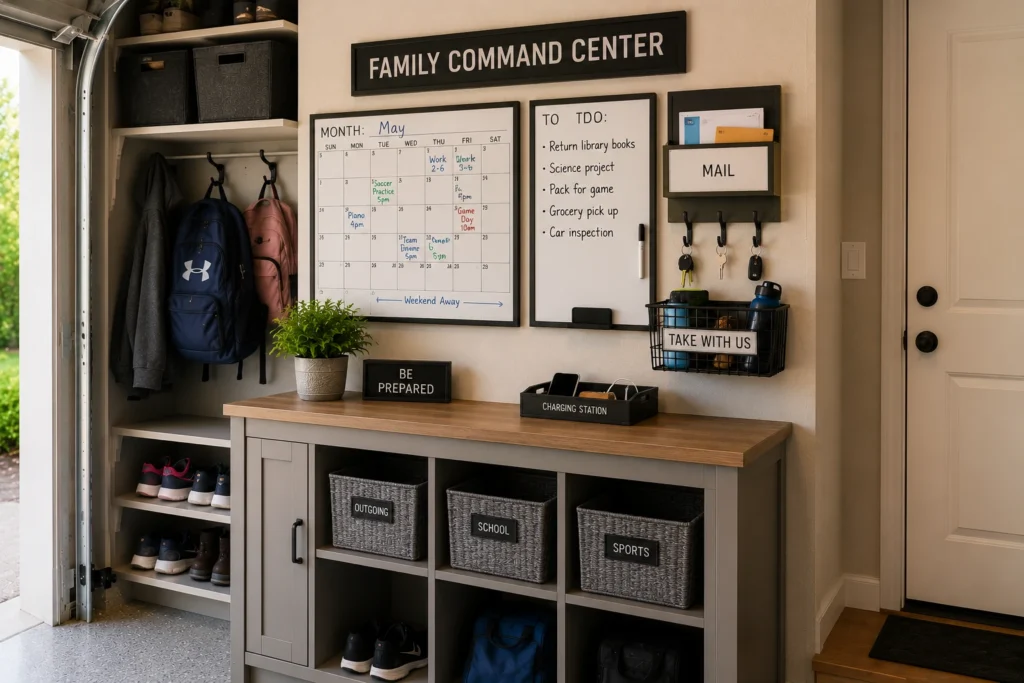
A garage mudroom can also help manage the things that need to leave the house, not just the things people wear.
A small wall-mounted command center could include a calendar, dry-erase board, mail organizer, or basket for items that need to be taken along on the next trip out.
This can be useful for busy households where school schedules, work commitments, practices, appointments, and errands overlap.
Keep paperwork and delicate items away from areas where they could be exposed to moisture or temperature extremes.
The command center doesn’t need to become a full office. A small, clearly defined area is often enough.
13. Use a Slatwall for Flexible Family Storage
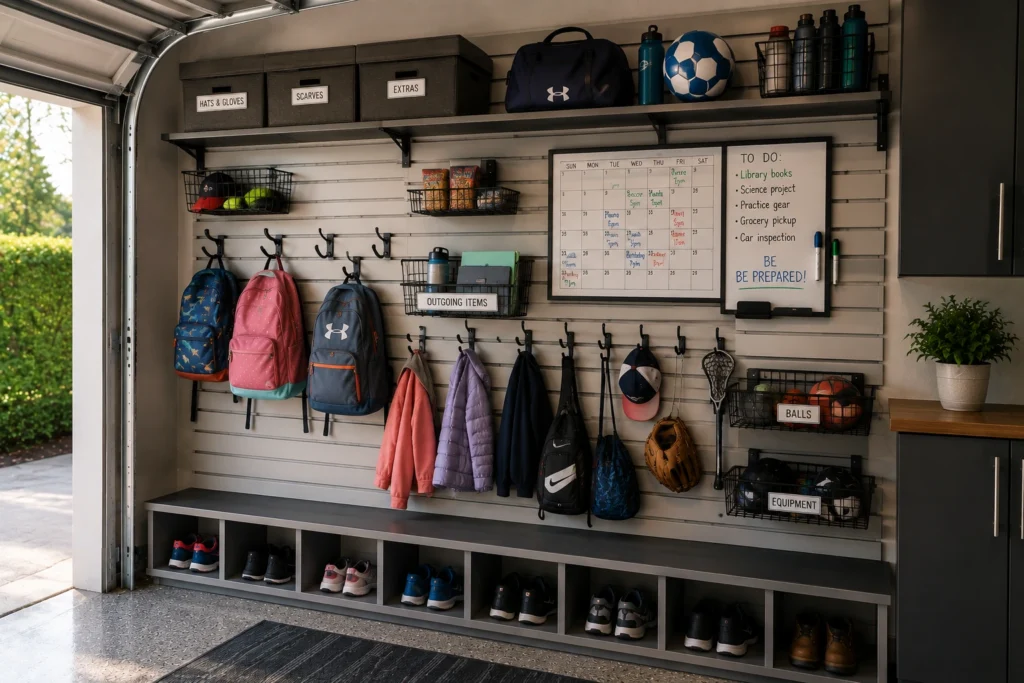
A slatwall system can be useful when you know your family’s storage needs will change over time.
Unlike fixed hooks, a slatwall setup can allow accessories such as hooks, shelves, and baskets to be repositioned as needs change.
That flexibility can be particularly useful for growing families.
A younger child’s backpack storage might eventually become sports-bag storage. Hooks that once held small jackets may later be used for heavier equipment.
If you choose this approach, make sure the panels and accessories are compatible and follow the manufacturer’s installation requirements.
Check the intended load capacity rather than assuming every accessory can hold the same amount of weight.
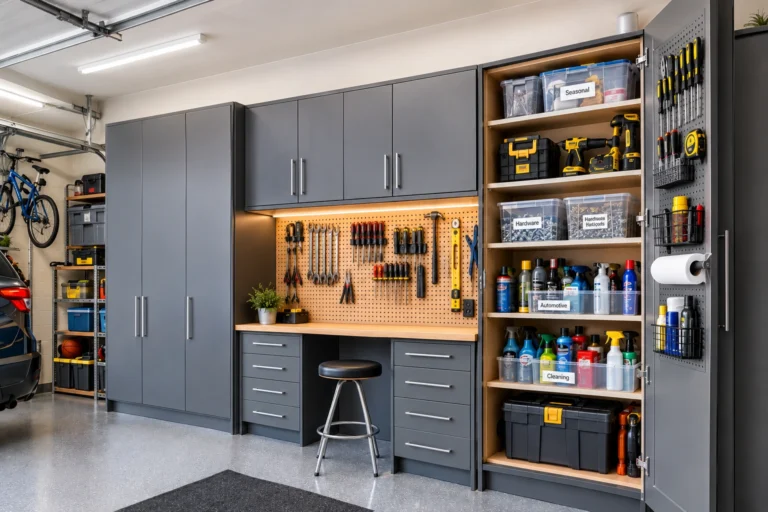
14. Add a Small Cabinet for Hidden Storage
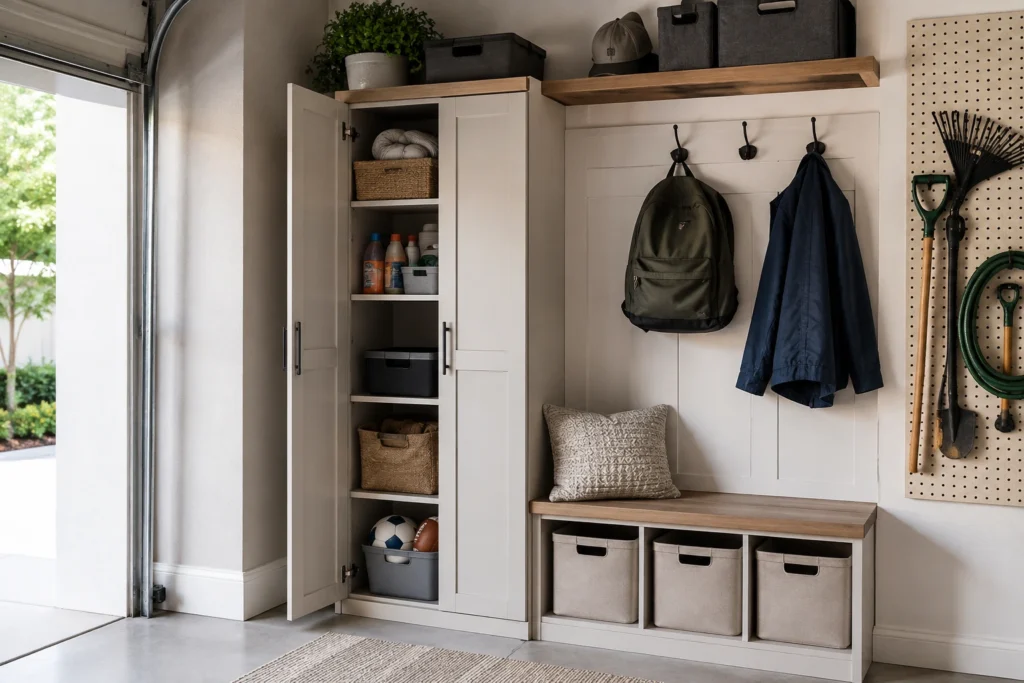
Open shelves and hooks are convenient, but they can also make a busy garage entrance look visually crowded.
A small wall-mounted cabinet provides a place to hide items that still need to be close at hand.
Extra hats, gloves, small accessories, seasonal items, and miscellaneous family gear can be stored behind closed doors.
Closed storage is particularly useful when you want the garage mudroom to look tidy even when several people have just come home.
Don’t automatically put everyday essentials inside the cabinet, though. If something is used constantly, easy access is usually more valuable than a perfectly clean appearance.
15. Create a Designated Place for Cleaning Gear
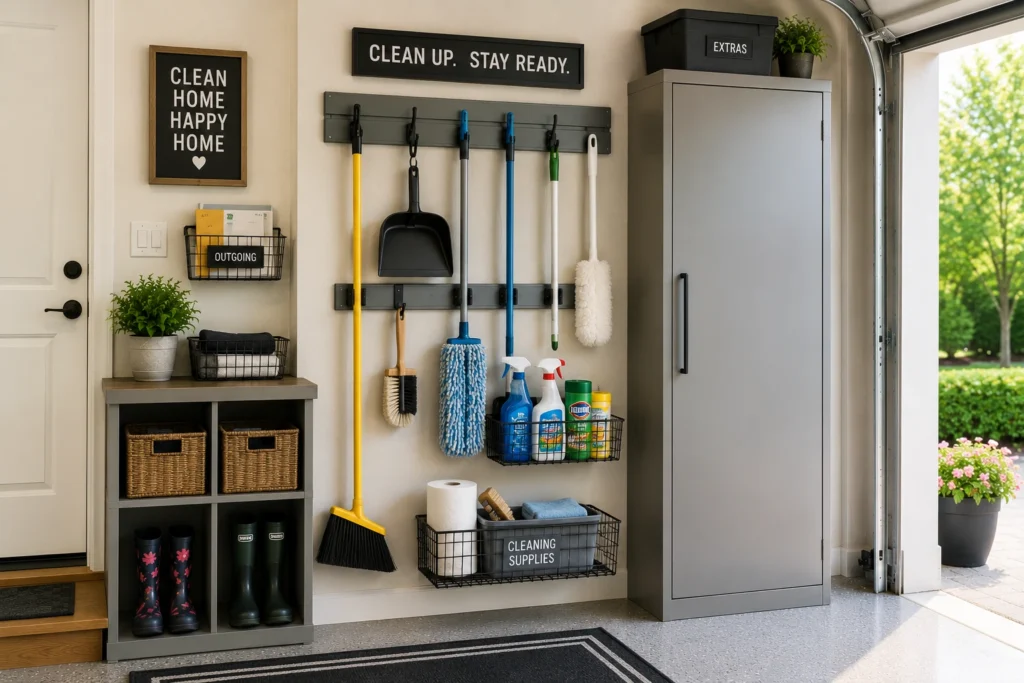
Mudrooms and garages naturally encounter dirt, mud, and wet conditions, so cleaning tools often end up nearby.
Instead of leaning a broom against the wall or leaving a dustpan on the floor, use a wall-mounted organizer or tool holders to keep cleaning equipment together.
Brooms, dustpans, brushes, and similar tools can often be stored vertically with very little wall space.
Keep cleaning chemicals in their original containers and store them safely, particularly if children can access the garage.
The goal is to keep cleanup tools available without allowing them to become another source of visual clutter.
16. Create a Small Drop Zone for Keys and Everyday Essentials
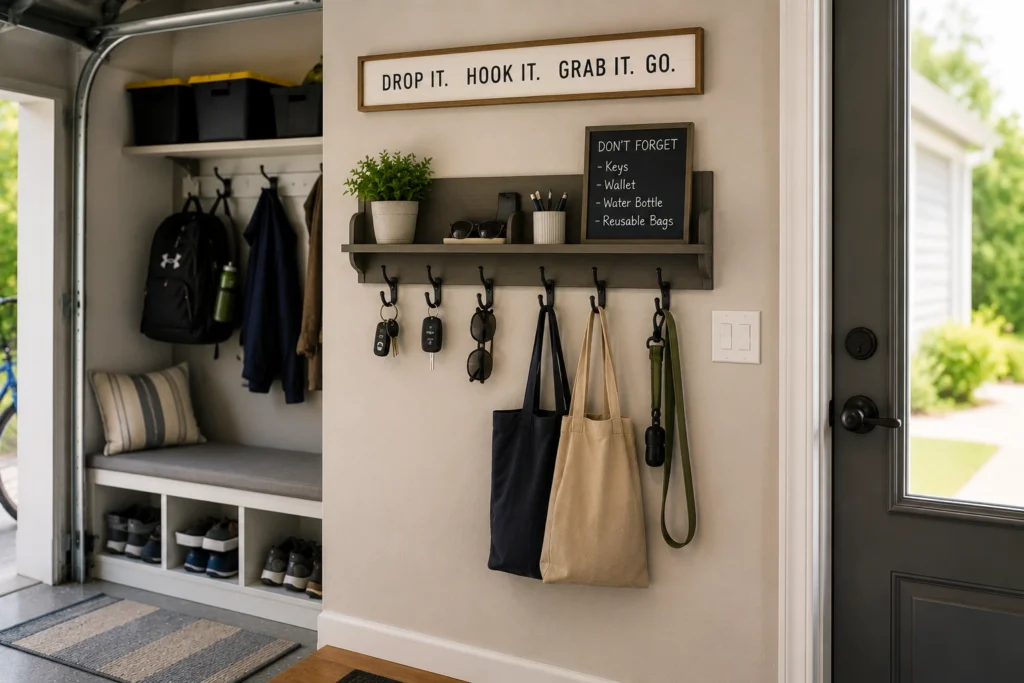
Large belongings aren’t the only things that need a home.
A compact organizer near the garage entry can hold keys, sunglasses, reusable bags, dog-walking accessories, or other small items that frequently travel in and out of the house.
This can be as simple as a few hooks and small compartments.
Location is more important than complexity. Put the organizer where people naturally reach for or drop these items.
If the system is positioned several steps away from the entry routine, family members are much more likely to ignore it.
17. Separate Everyday Items From Seasonal Gear
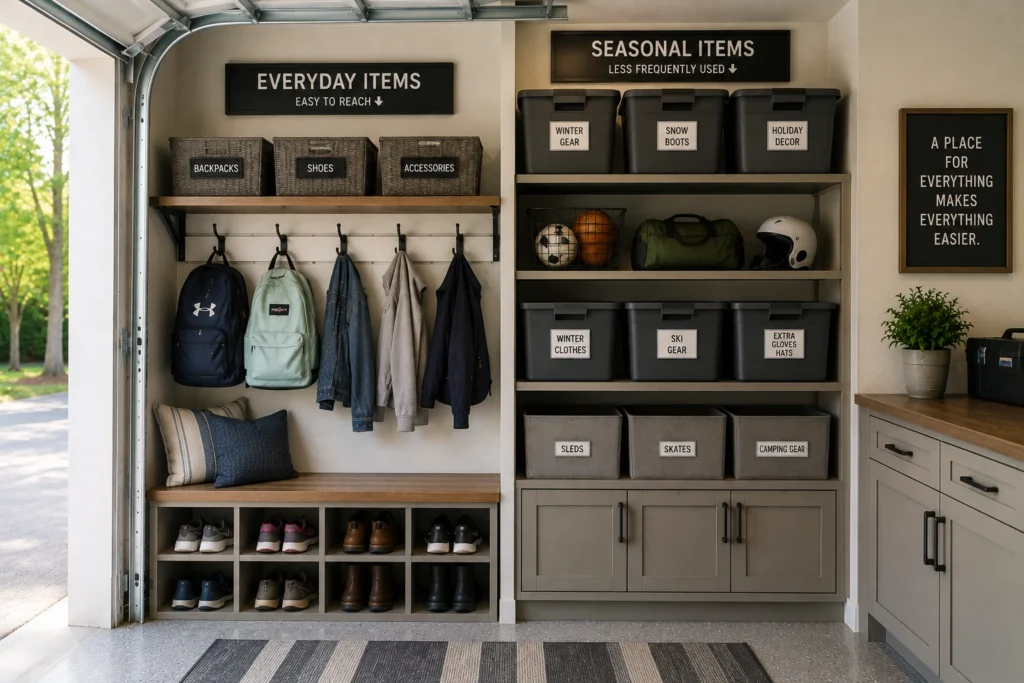
One of the simplest ways to make a garage mudroom feel crowded is to keep everything accessible all year.
Instead, divide your storage into two groups.
Everyday items: backpacks, current shoes, frequently worn jackets, sports bags, and regularly used accessories.
Seasonal items: winter gear, seasonal sports equipment, rarely used accessories, and belongings that don’t need daily access.
Everyday items should occupy the easiest-to-reach areas.
Seasonal items can move to higher shelves, labeled bins, cabinets, or another part of the garage.
This approach doesn’t necessarily require more storage. It simply makes better use of the storage you already have.
18. Build a Modular Mudroom Wall That Can Grow With Your Family
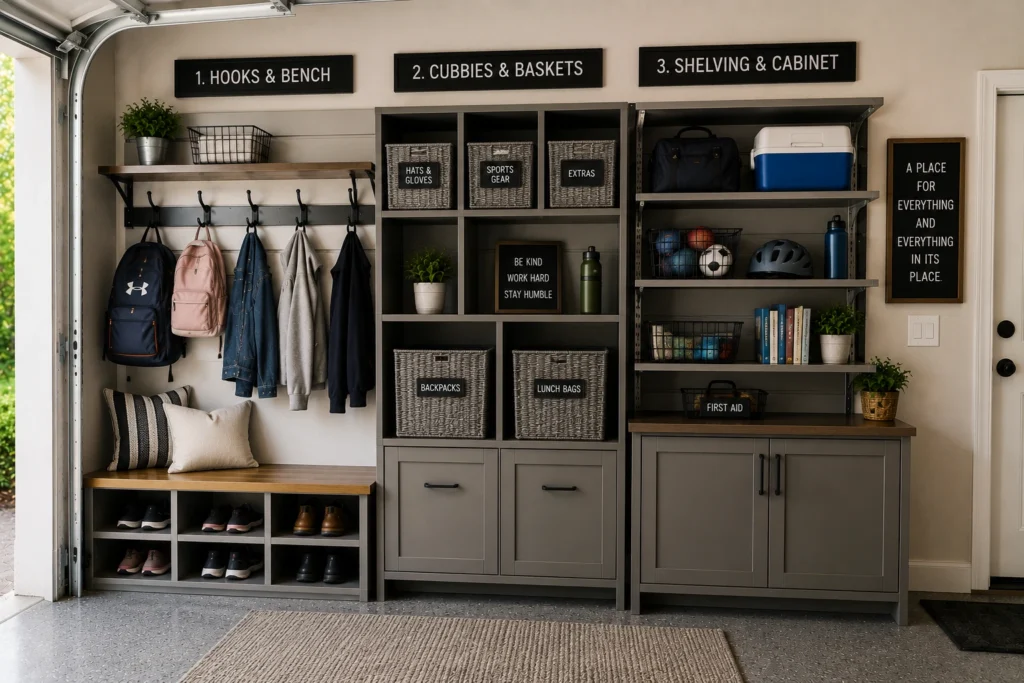
If you’re creating the entire garage mudroom from scratch, consider combining several storage types instead of committing the entire wall to one solution.
For example, one section could have hooks and a bench, another could contain cubbies and baskets, and a third could use adjustable shelving or a small cabinet.
This creates a more adaptable storage system.
Flexible garage mudroom storage ideas can also make it easier to adapt the space as your family’s needs change. Children grow, sports interests change, bags get replaced, and the items that need to stay near the garage entrance can change from year to year.
A modular setup makes it easier to reposition or replace individual components instead of rebuilding the entire wall.
When comparing systems, prioritize secure mounting, adjustability, durability, accessibility, and appropriate weight capacity over appearance alone.
How to Make Garage Mudroom Storage Work for a Busy Family
The best garage mudroom isn’t necessarily the one with the most shelves, hooks, or cabinets.
It’s the one that fits the family’s routine.
Think about what happens during the busiest five minutes of the day.
Someone comes home with a backpack. Another person kicks off muddy shoes. A jacket needs to be hung up. A sports bag needs to come off the floor. Keys need to go somewhere before they disappear.
Your storage should make those actions almost automatic.
A useful arrangement is often:
Garage entry → hooks → bench → shoes → baskets or cubbies
The exact layout can vary, but the principle stays the same: put the easiest storage closest to the action.
Items used every day should generally be between comfortable waist and eye level. Seasonal belongings can move higher or into closed storage.
And because this is a garage, don’t forget about vehicle access. Leave enough room for people to walk comfortably and for vehicle doors to open without hitting benches, cabinets, hooks, or other fixtures.
A beautiful mudroom that makes it difficult to get into the car isn’t a very practical mudroom.
How to Create a Garage Mudroom in a Small Space
You don’t need a large garage to create a useful entry zone.
Start with the wall rather than the floor.
A narrow combination of wall hooks + shallow shelf + small shoe rack can provide surprisingly useful storage.
If you have a little more room, add a slim bench underneath the hooks.
For extremely tight spaces, prioritize the items that cause the most daily clutter. If shoes are the problem, start with shoe storage. If backpacks are constantly on the floor, start with hooks.
Avoid trying to create a miniature version of a large built-in mudroom.
A small, well-planned drop zone that your family actually uses is more valuable than an elaborate setup that takes up too much garage space.
Which Garage Mudroom Storage Ideas Are Best for Your Family?
The best starting point depends on what is currently causing the most frustration.
| Your biggest problem | A good place to start |
| Shoes scattered near the door | Shoe rack, cubbies, or bench storage |
| Backpacks on the floor | Individual wall hooks |
| Coats piling up | Wall-mounted hooks or a rail |
| Sports gear taking over | Dedicated sports gear drop zone |
| Small accessories disappearing | Labeled baskets |
| Very little floor space | Narrow vertical storage |
| Seasonal gear creating clutter | Labeled bins or higher storage |
| Storage needs change frequently | Slatwall or modular storage |
| Too much visual clutter | Closed cabinet storage |
| Family forgets what needs to leave | Small command center |
Don’t try to install all 18 ideas at once.
Start with the problem your family encounters every day. Once that part of the routine is working, add the next storage element.
FAQ
What should be stored in a garage mudroom?
A garage mudroom is best suited to items your family regularly grabs when leaving or arriving home. This can include shoes, jackets, backpacks, bags, hats, sports equipment, and outdoor accessories.
How do you organize a small garage mudroom?
Use vertical wall space whenever possible. Wall hooks, shallow shelves, narrow organizers, cubbies, baskets, and wall-mounted cabinets can provide useful storage while preserving valuable floor and vehicle space.
Are garage mudroom cubbies worth it?
Cubbies can be particularly useful for families because they give each person a defined area for everyday belongings. They’re a good fit for shoes, backpacks, jackets, bags, and small accessories.
Should shoes be stored in a garage mudroom?
Frequently worn shoes can work very well in a garage mudroom. Open racks, cubbies, shelving, and bench storage make them easy to access. For wet or muddy footwear, allow adequate ventilation and use a tray to contain dirt and moisture.
How do I keep a garage mudroom from becoming cluttered?
Give frequently used items a specific home and avoid filling the mudroom with belongings that aren’t needed every day. Separating everyday items from seasonal gear can also keep the area much easier to maintain.
What type of storage works best for a growing family?
Adjustable and modular systems can be useful because hooks, shelves, baskets, and other components can be repositioned as your family’s needs change.
Conclusion
A functional garage mudroom doesn’t have to be large or complicated. The best garage mudroom storage ideas are the ones that fit your family’s daily routine while keeping frequently used items easy to access. Start with the storage problems you deal with most often, then build the space gradually around them.
Hooks can handle coats and backpacks, a bench can create a natural shoe station, baskets can contain smaller accessories, and cabinets or higher shelves can take care of less frequently used belongings.
Most importantly, keep the system compatible with the garage itself. Wall space, vehicle clearance, walking room, accessibility, weight capacity, and future flexibility all matter.
When storage follows your family’s actual routine, putting things away becomes much easier—and the garage entry has a much better chance of staying organized.