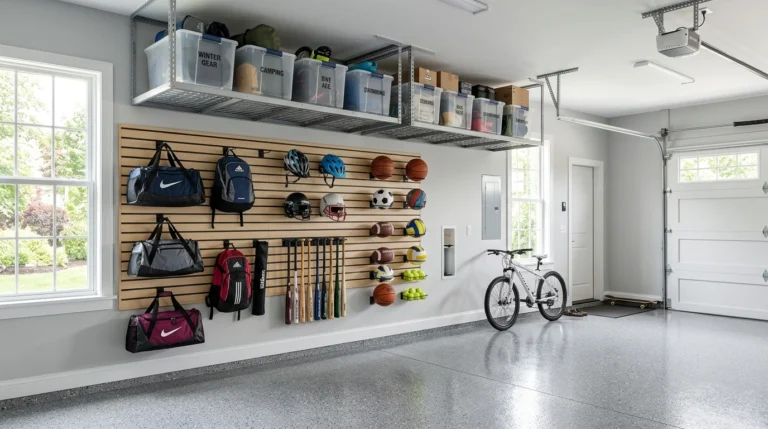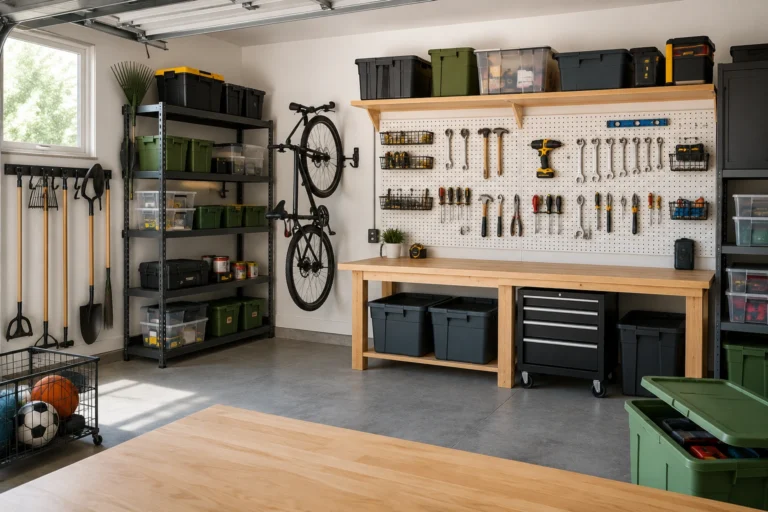
How to Organize a Garage Without Losing Parking Space
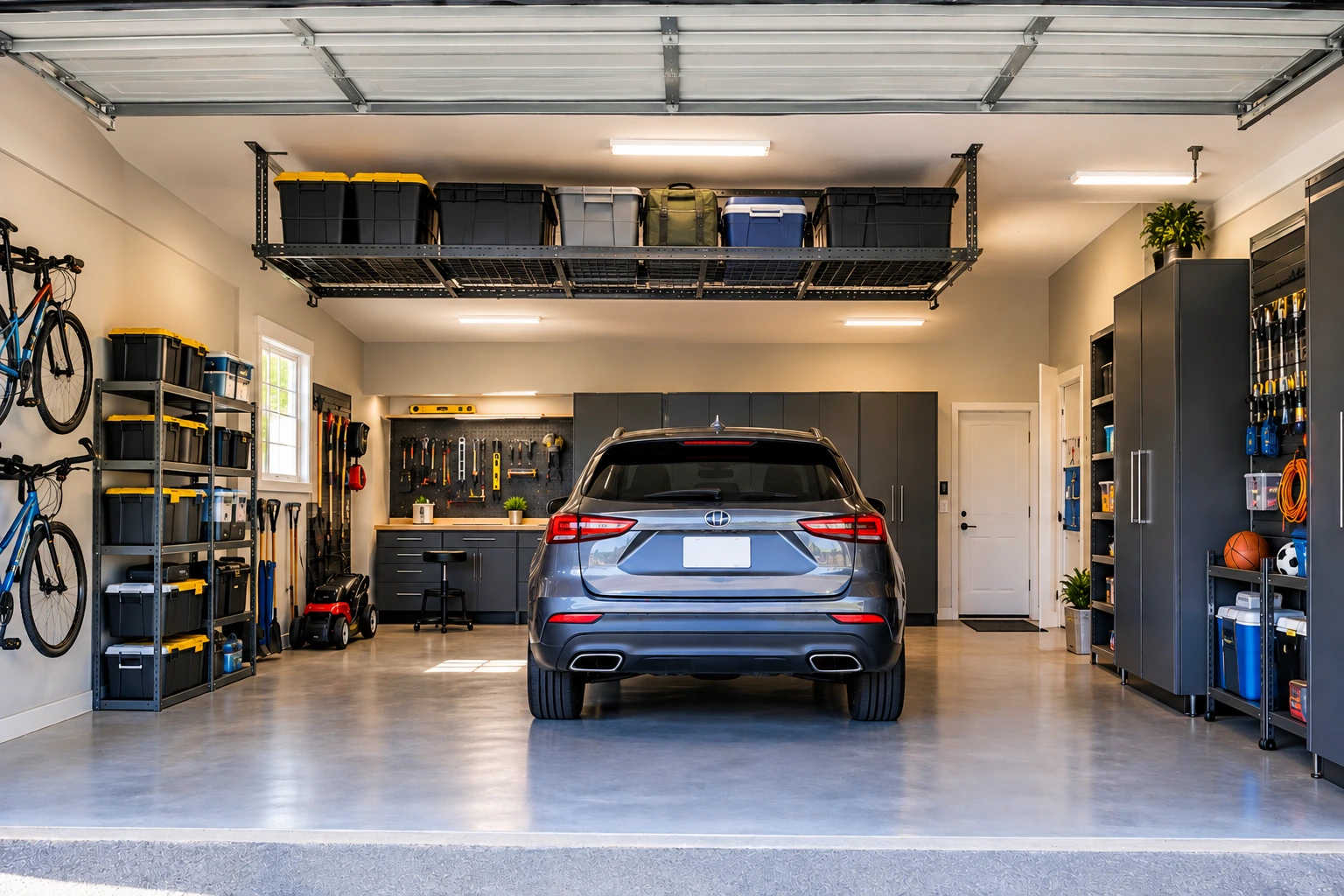
If your garage is so full that your car has to stay in the driveway, adding more storage is not the first step. The first step is protecting the parking space you already need.
The smartest way to organize a garage without losing parking space is to treat the vehicle area as a fixed zone, then move storage outward and upward—onto walls, into corners, above the garage door, and into carefully planned cabinets and shelving.
This approach works whether you have a one-car garage packed with tools and boxes or a two-car garage that needs to accommodate bikes, sports equipment, gardening supplies, and a workbench.
The goal isn’t to fit more things into the garage. It’s to create a storage system that keeps the floor usable, everyday items accessible, and enough room around the vehicle for comfortable parking. Here is how to do it.
Before You Organize Your Garage, Protect Your Parking Space
Before moving a single shelf or buying a storage system, decide exactly where the vehicle needs to go. Park your car inside the garage exactly as you normally would.
Open the driver and passenger doors. Walk around the vehicle. Open the trunk or rear hatch. Walk from the garage entry door to the car. This gives you a much better understanding of your usable parking footprint than simply measuring the garage walls.
Use painter’s tape to mark the approximate boundary of the vehicle’s working space. That boundary becomes your first rule:
The parking zone should remain clear of permanent storage whenever possible.
Once that space is protected, the remaining perimeter becomes your storage-planning area.
Before Buying Anything, Do a Garage Parking-Space Audit
It’s tempting to start shopping for cabinets, shelves, racks, and bins as soon as garage clutter becomes frustrating. Don’t. First, test the garage with your actual vehicle.
Your parking audit should include:
- Park the vehicle normally.
- Open both front doors.
- Walk around the vehicle.
- Open the trunk or rear hatch.
- Walk between the vehicle and the garage walls.
- Check the garage entry door.
- Check where bikes, tools, and equipment currently interfere.
- Identify unused wall and corner space.
- Check the ceiling for possible storage.
- Mark the vehicle’s practical clearance area with painter’s tape.
The result should be a simple visual distinction between:
Protected vehicle space and Potential storage space
That distinction makes every storage decision that follows easier.
Measure This Before You Install Storage
Don’t measure only the wall. Measure the things that actually affect how the garage functions.
| What to Measure | Why It Matters |
| Vehicle width | Protects parking clearance |
| Vehicle length | Protects front and rear space |
| Door-opening clearance | Prevents walls or cabinets from interfering |
| Trunk/hatch clearance | Keeps rear access usable |
| Walking path | Prevents narrow or blocked routes |
| Cabinet depth | Determines how far storage projects into the garage |
| Shelf depth | Helps protect vehicle clearance |
| Ceiling height | Determines suitable overhead-storage options |
| Garage-door travel | Prevents overhead conflicts |
| Opener and rail position | Helps avoid installation interference |
| Garage entry-door swing | Prevents storage from blocking access |
You don’t need to create an architectural drawing.
A simple tape measure, painter’s tape, and a few notes can prevent a surprisingly expensive storage mistake.
The 3-Zone Rule for a Parking-Friendly Garage
Once you’ve measured the garage, divide it into three functional zones.
Zone 1: Vehicle Zone
This is the protected parking area. Keep it as clear as possible. Don’t let boxes, tools, sports equipment, or temporary projects gradually migrate into this space.
Zone 2: Active Storage Zone
This is where frequently used storage belongs. Examples include:
- Hand tools
- Cleaning supplies
- Everyday household items
- Frequently used sports equipment
- Workbench supplies
- Bike accessories
Use walls, cabinets, pegboards, shelving, and other accessible systems.
Zone 3: Deep Storage Zone
This is for items you don’t need regularly. Examples include:
- Holiday decorations
- Seasonal equipment
- Camping supplies
- Extra luggage
- Rarely used sports equipment
Higher shelves and appropriate overhead storage can work well here. A simple rule is:
Daily or weekly use → accessible storage
Seasonal or rare use → higher/deeper storage
Vehicle → protected floor zone
This prevents your most valuable floor space from becoming general-purpose storage.
Don’t Buy Garage Storage Until You Answer These 6 Questions
Before purchasing anything, ask:
- What absolutely needs to stay on the floor?
- What can move onto the wall?
- What can safely move overhead?
- What do I use every week?
- What do I use only a few times a year?
- How much clearance does my vehicle actually need?
This changes the way you shop. Instead of asking: “What storage product should I buy?”
you’re asking: “What specific storage problem am I trying to solve?”
The goal isn’t to buy the maximum amount of storage. It’s to buy the smallest practical system that solves the problem while preserving your parking space.
1. Move Garage Storage to the Walls
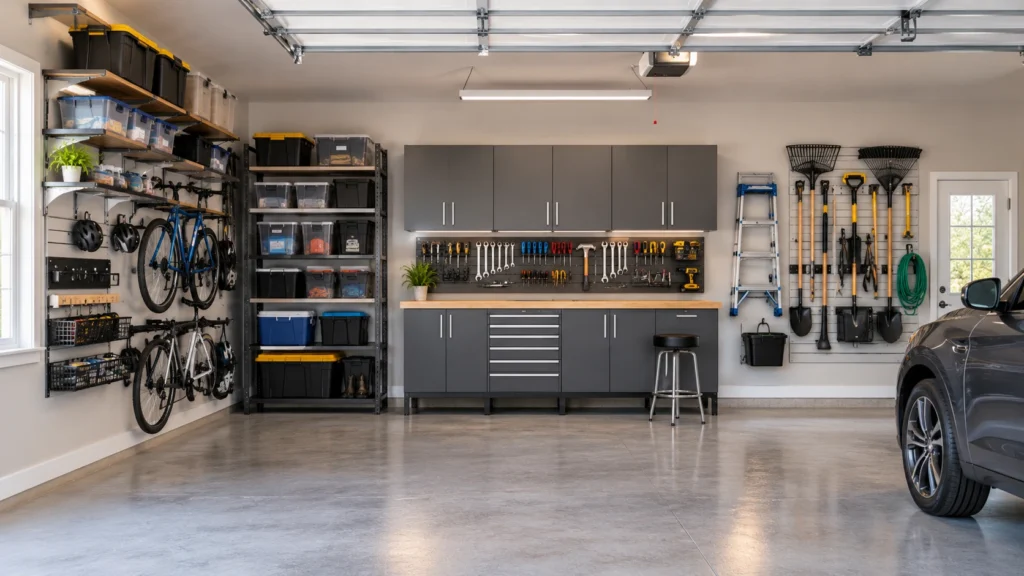
When floor space is limited, your walls become one of your most valuable storage resources. Instead of allowing tools, bins, equipment, and household supplies to spread across the floor, move suitable items vertically.
Depending on your garage, this could include:
- Wall-mounted shelves
- Cabinets
- Pegboards
- Slatwall systems
- Tool racks
- Hooks
- Bike racks
- Broom holders
- Garden-tool storage
You don’t need to cover every wall. Create dedicated zones so each section has a purpose. Read more about garage wall storage ideas.
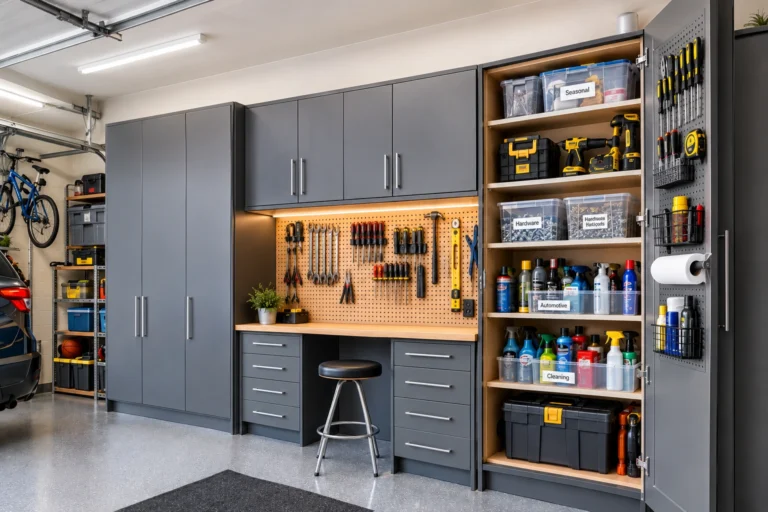
2. Install Cabinets Along a Side Wall
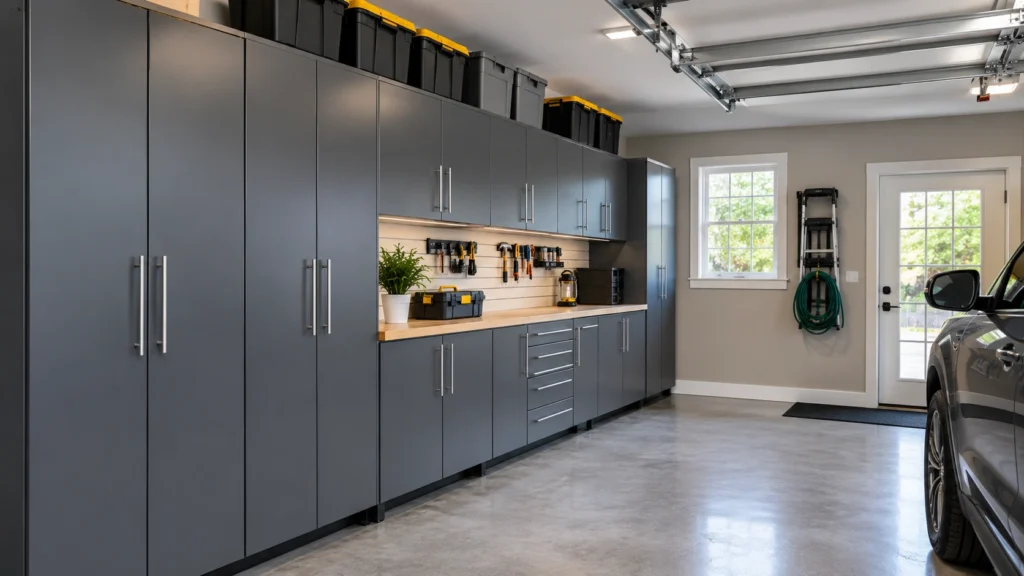
Cabinets can provide substantial enclosed storage while keeping loose items off the floor. They are particularly useful for:
- Tools
- Automotive supplies
- Cleaning products
- Hardware
- Batteries
- Workshop accessories
- Household supplies
For a parking-focused garage, cabinet depth matters. A deep cabinet may hold more items, but it also extends farther into the garage. Choose cabinet depth based on your actual parking clearance rather than simply buying the largest cabinet available.
If cabinets are your preferred solution, organization inside them matters just as much as the cabinet itself.
Pay Attention to Storage Depth, Not Just Width
One of the easiest garage-storage mistakes is focusing on how much wall width a system uses while ignoring how far it projects into the garage.
Imagine two storage systems occupying the same section of wall. One is 12 inches deep. The other is 24 inches deep. They may have similar width, but the deeper system can significantly reduce the usable space beside your vehicle.
For a garage where parking clearance is tight, shallow storage can sometimes be more valuable than maximum-capacity storage. Think about it this way:
Limited vehicle clearance → prioritize shallower storage
More available clearance → deeper cabinets or shelves may work
Very limited floor space → move suitable storage higher
This is why storage should be selected based on the garage’s actual layout, not just the product’s advertised capacity.
3. Use Vertical Shelving Instead of Wide Storage
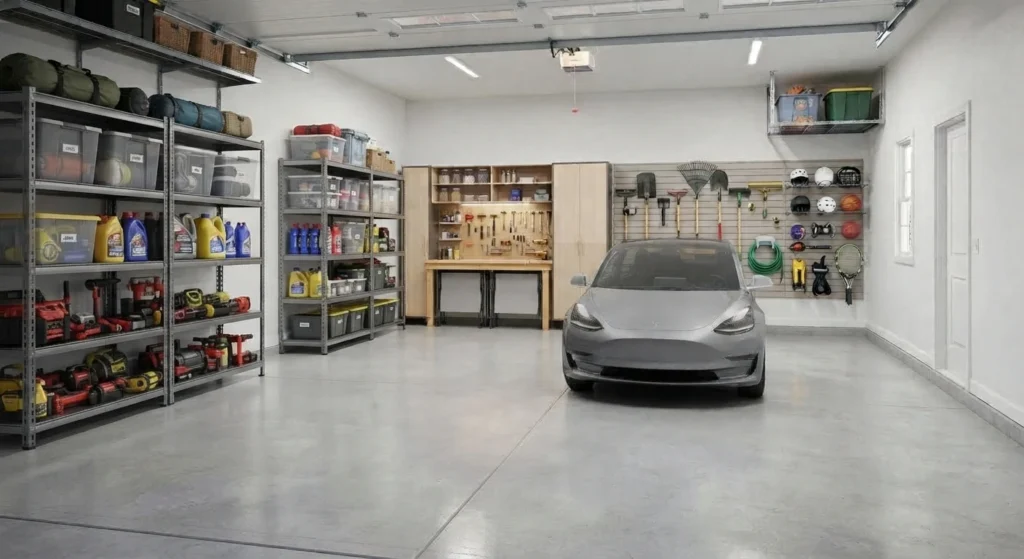
When floor space is limited, think upward. A tall, narrow shelving unit can provide several levels of storage without taking up as much floor width as a wide shelf. Use the levels according to access frequency.
Eye level: Everyday items
Middle shelves: Weekly-use supplies
Lower shelves: Heavy containers
Upper shelves: Seasonal items
Avoid turning open shelving into a random pile of boxes. Give each shelf or section a specific purpose. A narrow vertical system can provide useful storage while leaving more room available for your vehicle.
4. Get Bikes Off the Garage Floor
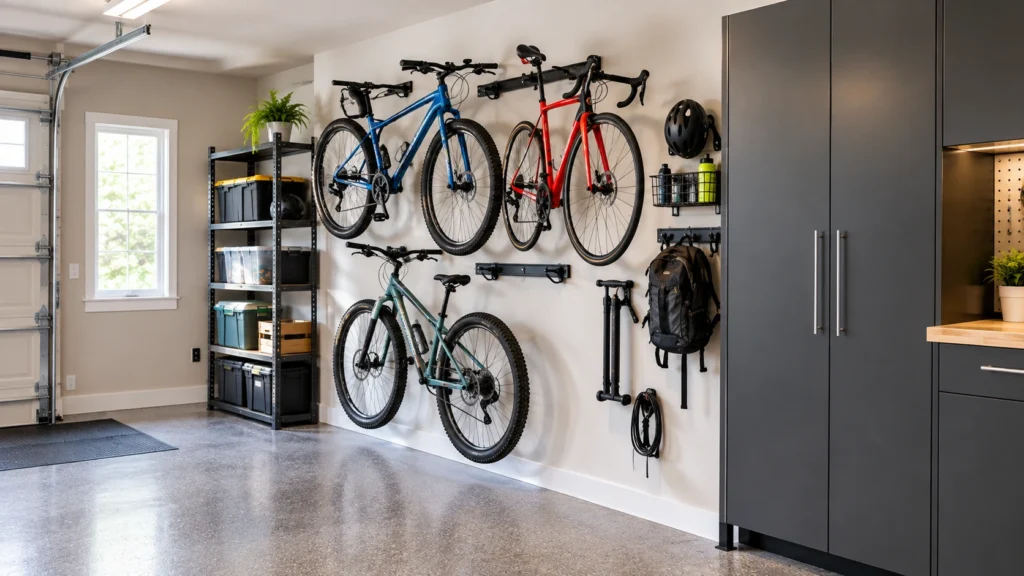
Bicycles are one of the easiest ways to lose parking space. A single bike leaning against the wall may seem harmless, but several bikes can quickly create a large obstacle. Consider:
- Vertical bike hooks
- Wall-mounted bike racks
- Horizontal bike racks
- Ceiling-mounted bike systems
- Vertical freestanding racks
If you own multiple bikes, keep them in one dedicated zone. Position them so vehicle doors can still open comfortably and you can walk around the vehicle without squeezing through a narrow gap.
5. Use the Garage Ceiling for Seasonal Storage
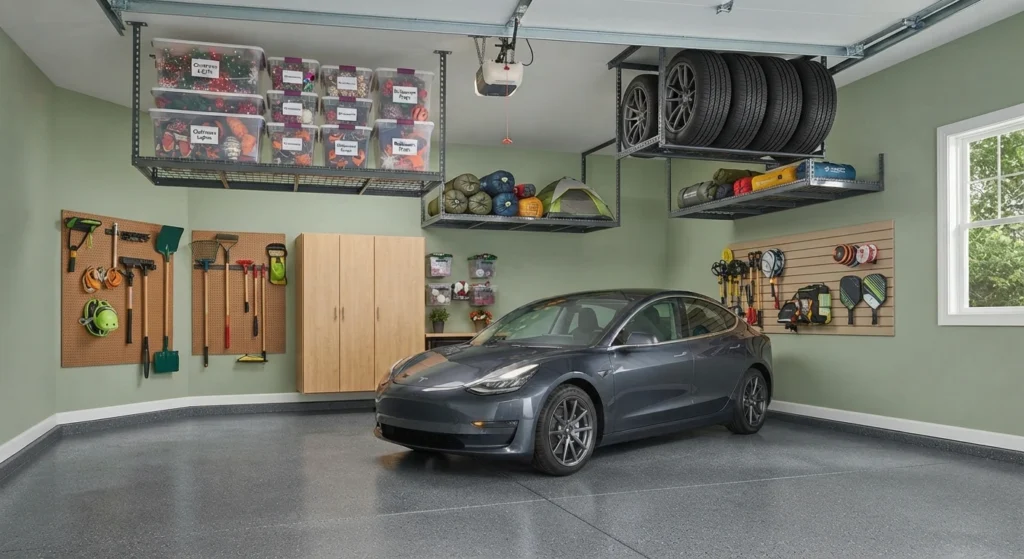
The ceiling can provide storage without consuming normal parking-floor space. This makes overhead storage useful for belongings you rarely need.
Good candidates include:
- Holiday decorations
- Seasonal clothing
- Camping gear
- Extra luggage
- Infrequently used sports equipment
- Backup household supplies
But don’t treat every empty area of the ceiling as storage space. Check the garage door’s travel path, opener, rails, lighting, vehicle height, and other obstructions first. Heavy or frequently used items should not automatically be moved overhead simply to save floor space.
6. Turn an Unused Corner Into a Storage Zone
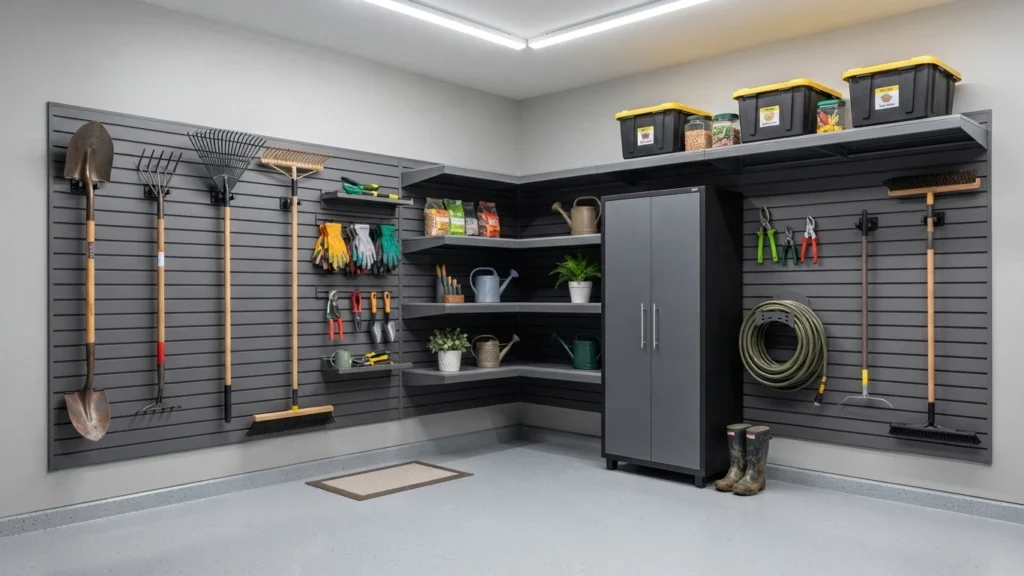
Garage corners are often difficult to use with ordinary furniture, but they can become valuable storage areas. A corner can accommodate:
- Tall cabinets
- Narrow shelving
- Corner shelves
- Garden equipment
- Cleaning supplies
- Sports equipment
- A compact workbench
Choose one purpose for the corner rather than allowing unrelated items to accumulate there. For example, a gardening corner might contain a narrow cabinet, wall hooks, and a small shelf for gloves and accessories. Keeping bulky items contained in one corner helps prevent them from spreading into the parking area.
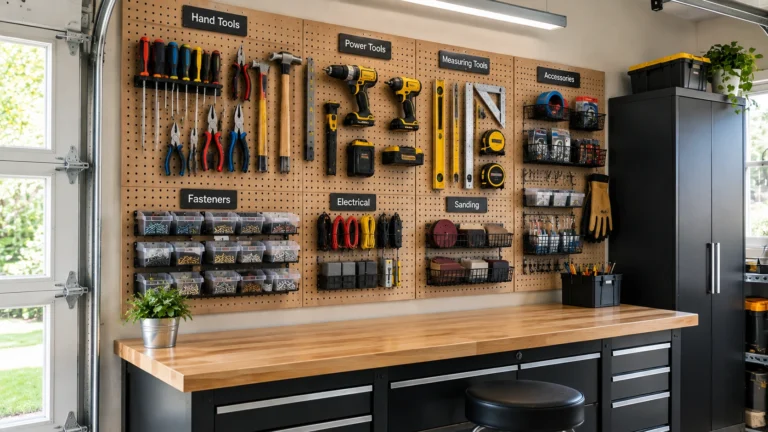
7. Store Tools Above the Workbench
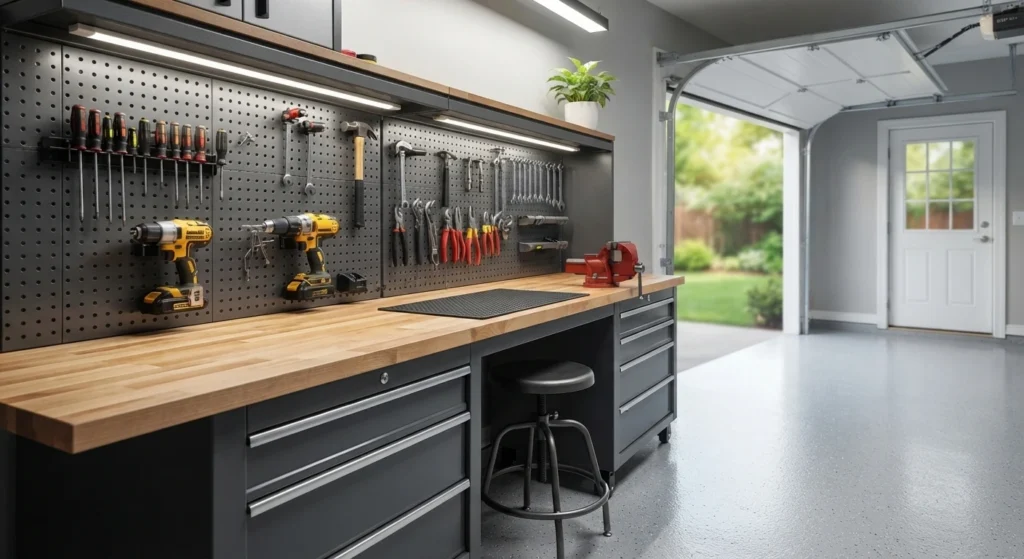
If you already have a workbench, make the wall above it part of the workstation. A pegboard, slatwall, cabinet, or combination system can keep tools close without using additional floor space. Keep your most frequently used tools within easy reach.
Less frequently used equipment can move into drawers, cabinets, or higher storage. This creates a defined workshop zone instead of allowing tools and project supplies to migrate across the garage floor.
8. Use Pegboard for Frequently Used Tools
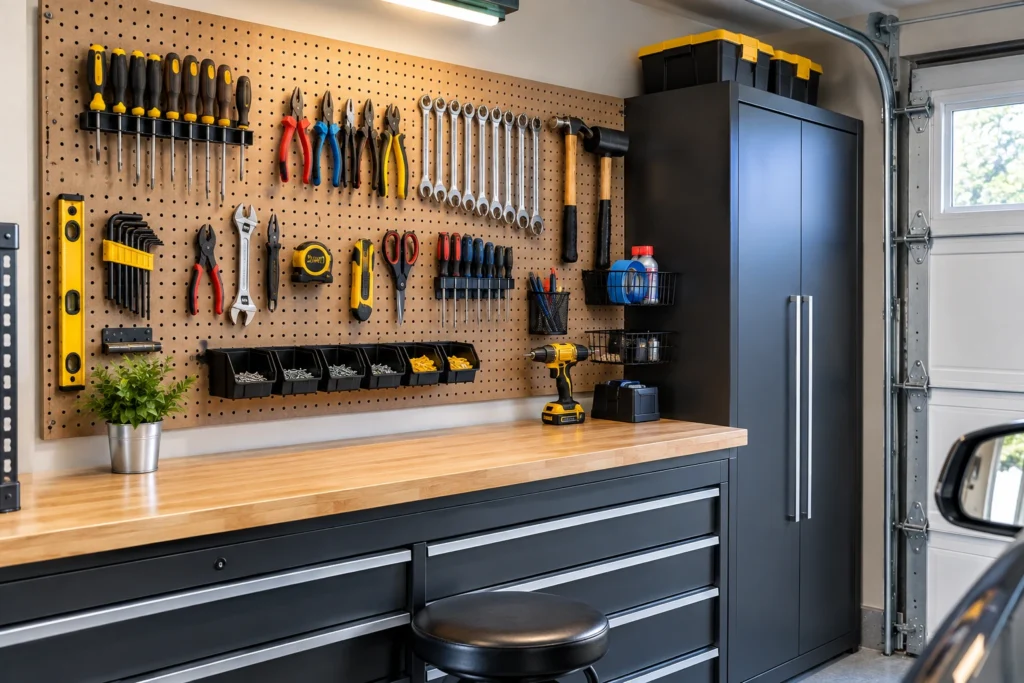
Pegboard is useful when you want tools visible and accessible while keeping the floor clear. It can hold:
- Screwdrivers
- Pliers
- Wrenches
- Hammers
- Measuring tools
- Small workshop accessories
Arrange tools according to frequency of use. The items you reach for constantly should be easiest to access. Less frequently used tools can move farther away from your primary work area. Read more about garage pegboard ideas for tool storage.
9. Keep Small Items Inside Labeled Bins
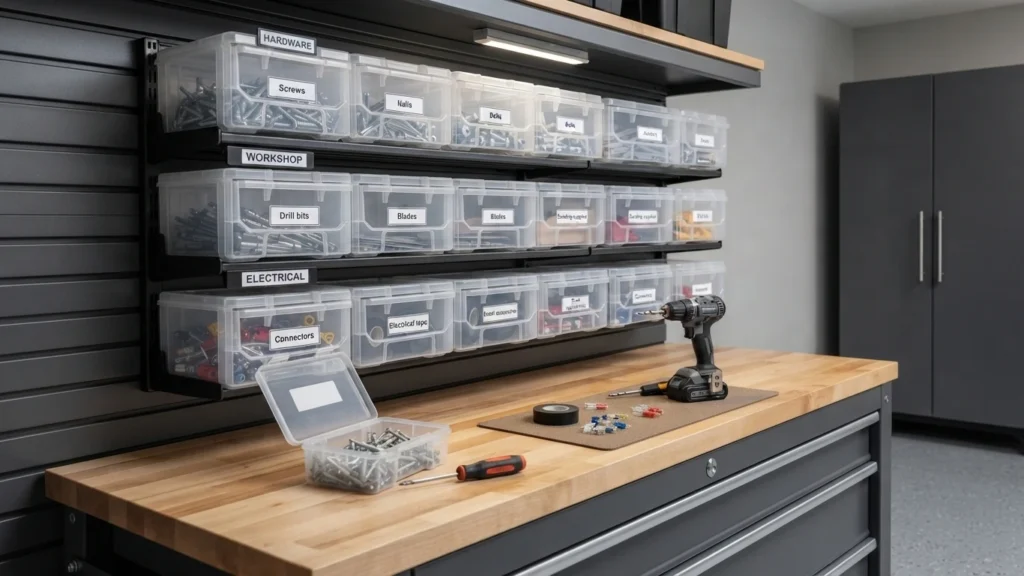
Small hardware can create a disproportionate amount of garage clutter. Screws, nails, anchors, drill bits, connectors, batteries, and other small parts are difficult to manage when scattered across shelves. Use clear containers or small bins and give each category a dedicated home. For example:
Hardware
- Screws
- Nails
- Bolts
- Anchors
Workshop
- Drill bits
- Blades
- Sanding supplies
Electrical
- Connectors
- Electrical tape
- Small accessories
Clear containers make it easier to see what you already have without opening every box.
10. Use the Back of Cabinet Doors
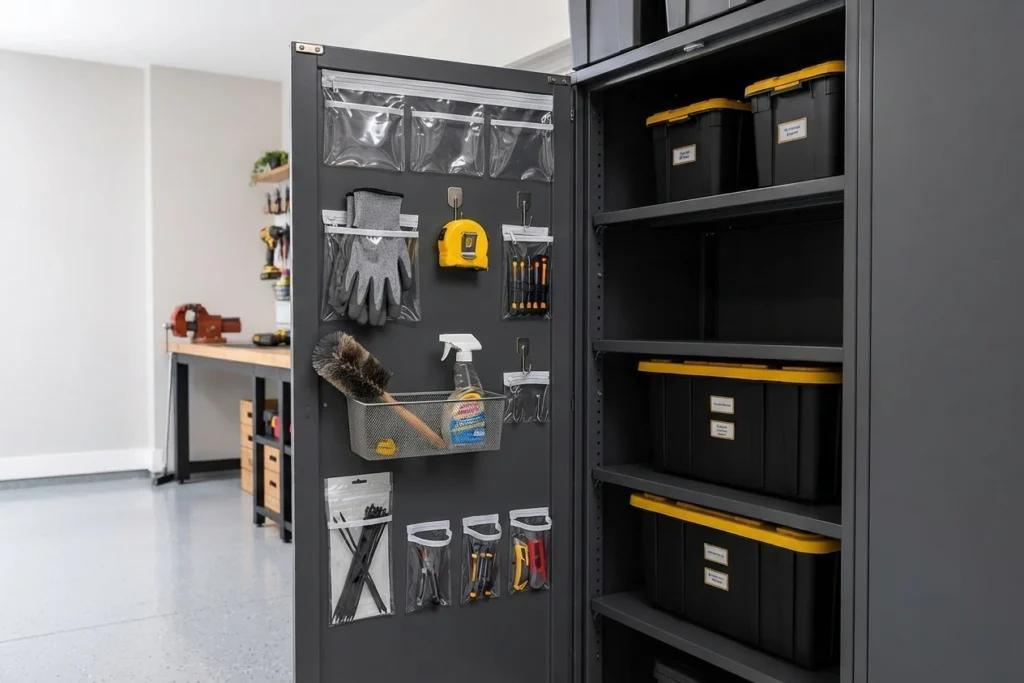
Cabinet doors are often overlooked storage surfaces. Depending on the cabinet, the inside of a door can hold lightweight items such as:
- Gloves
- Measuring tapes
- Small tools
- Brushes
- Cleaning accessories
- Frequently used supplies
This provides additional storage without increasing the cabinet’s floor footprint. Just make sure the added organizer doesn’t interfere with shelves or prevent the door from closing properly.
11. Create a Dedicated Cleaning Supply Station
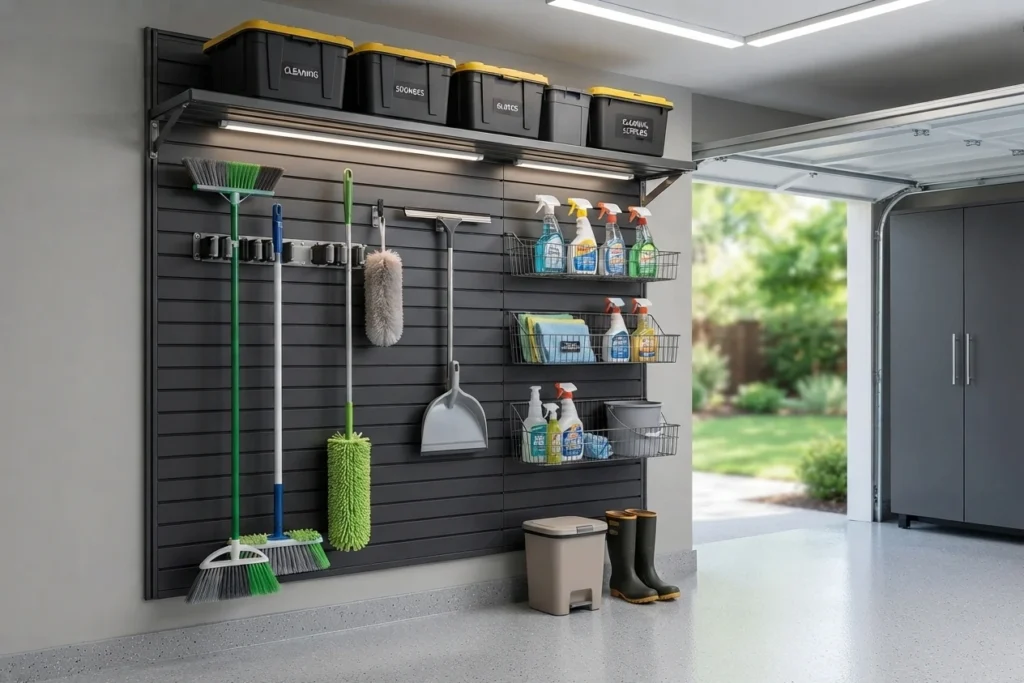
Brooms, mops, dustpans, brushes, and cleaning equipment can easily consume valuable floor space. Instead of leaning everything against a wall, create one cleaning station.
A wall-mounted holder can keep long-handled equipment organized vertically. Cleaning products can go inside a suitable cabinet or storage container. This keeps the equipment together and prevents individual items from being left beside the vehicle.
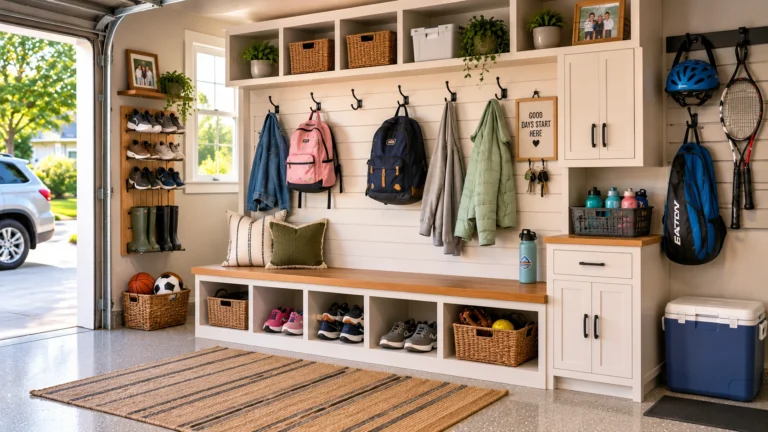
12. Use the Space Beside the Garage Entry Door
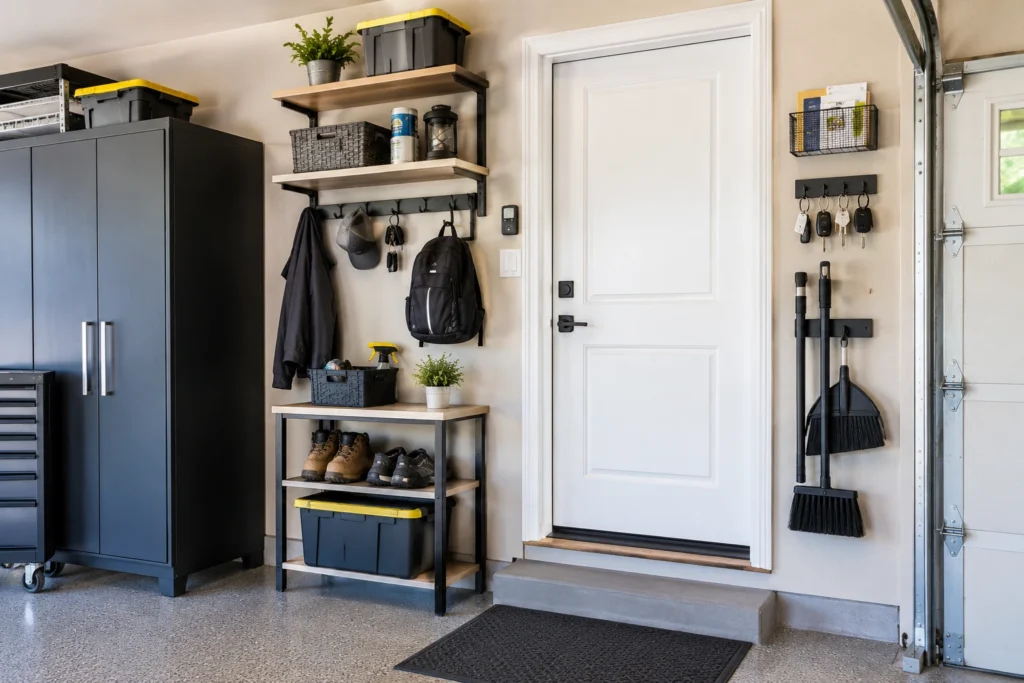
The wall beside the garage entry door can become useful storage for frequently carried items. Depending on available clearance, consider storing:
- Shoes or boots
- Reusable bags
- Small household tools
- Cleaning supplies
- Outdoor accessories
A narrow wall organizer or compact cabinet can work well here. Measure the door swing first. A storage unit that blocks the doorway or makes the walking path uncomfortable is not a good use of space.
13. Store Heavy Items Low and Bulky Items Strategically
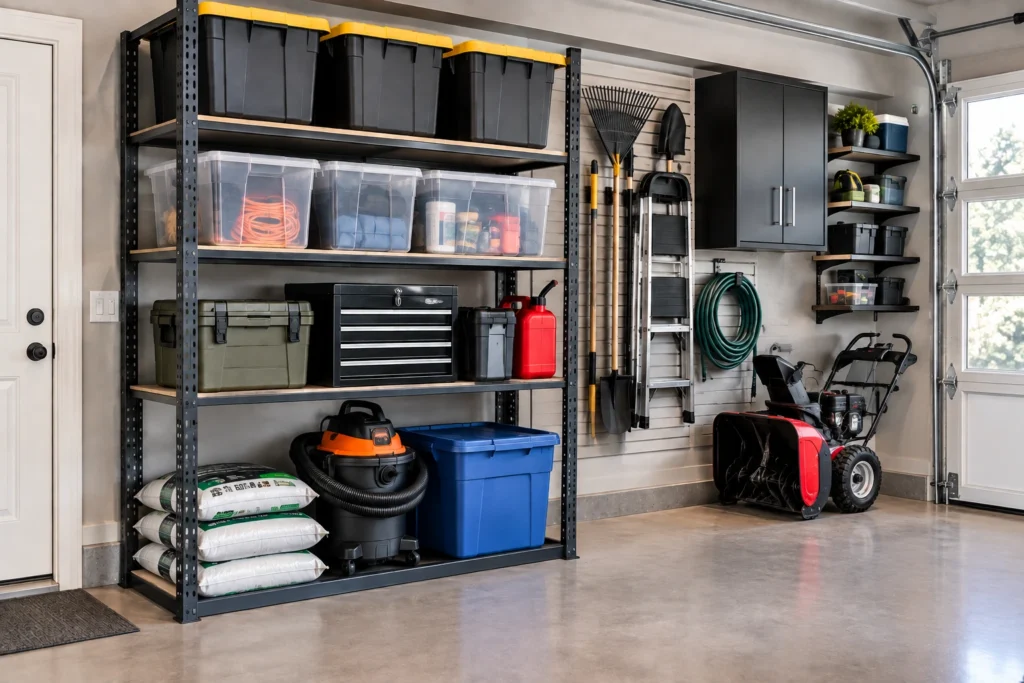
Saving floor space doesn’t mean putting everything overhead. Heavy containers, large tools, and bulky equipment should be stored where they can be handled safely.
Use lower shelves or cabinets for heavy items and reserve higher storage for lighter belongings that you rarely need. For bulky equipment, ask yourself whether it actually needs to remain in the garage.
If something is used once a year, it may deserve a less accessible storage location.
14. Create a Dedicated Sports Equipment Zone
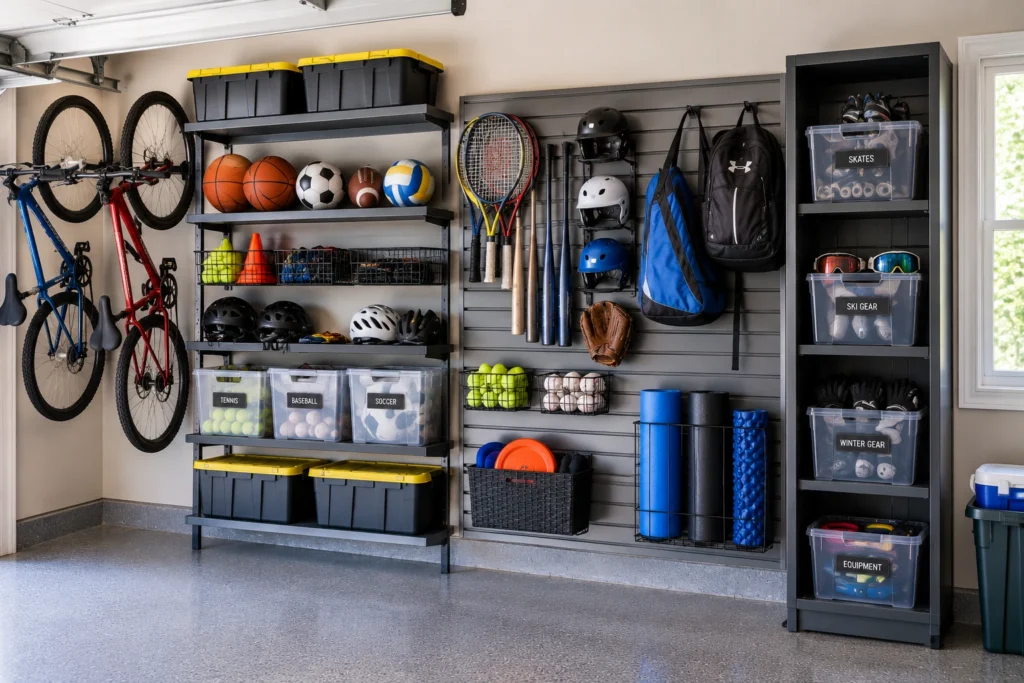
Sports equipment can quickly spread across a garage because balls, bats, helmets, scooters, and other gear all have different shapes. Instead of allowing equipment to occupy random floor space, create one dedicated sports zone. Useful options include:
- Ball baskets
- Wall racks
- Hooks
- Shelves
- Vertical racks
- Storage bins
Keep everyday equipment accessible and seasonal equipment higher up. If your garage also stores fishing gear, bikes, or camping equipment, separate the categories so each hobby has a predictable home.
15. Use a Slatwall System When Your Storage Needs Change
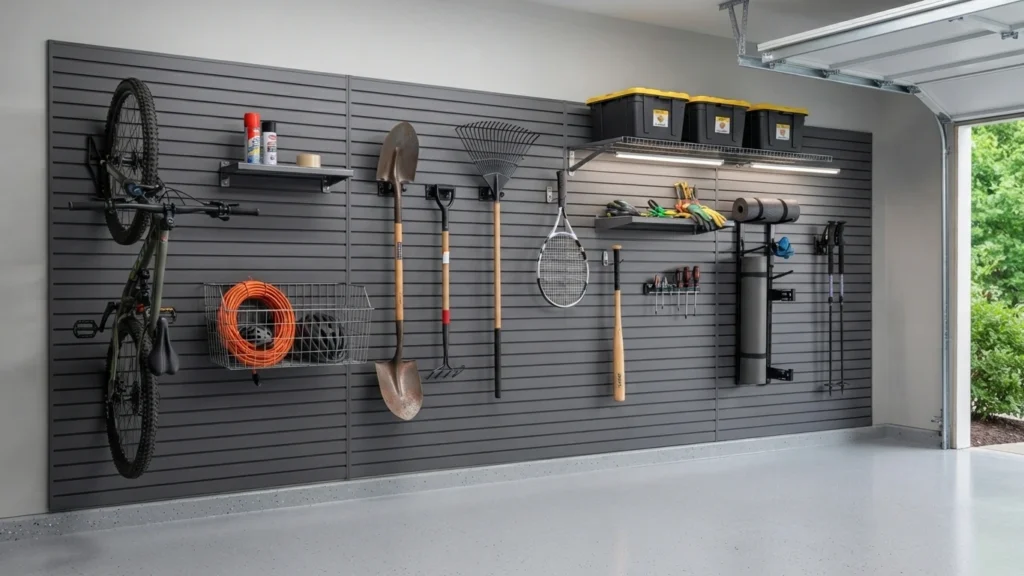
A slatwall system can be useful if your garage storage requirements are constantly changing. Different hooks, baskets, shelves, and racks can be moved as your equipment collection changes. This can work especially well for:
- Bikes
- Tools
- Garden equipment
- Sports gear
- Bins
- Extension cords
Instead of treating each hook as a permanent decision, treat the wall as a flexible storage system. That flexibility can help you adapt without taking additional floor space.
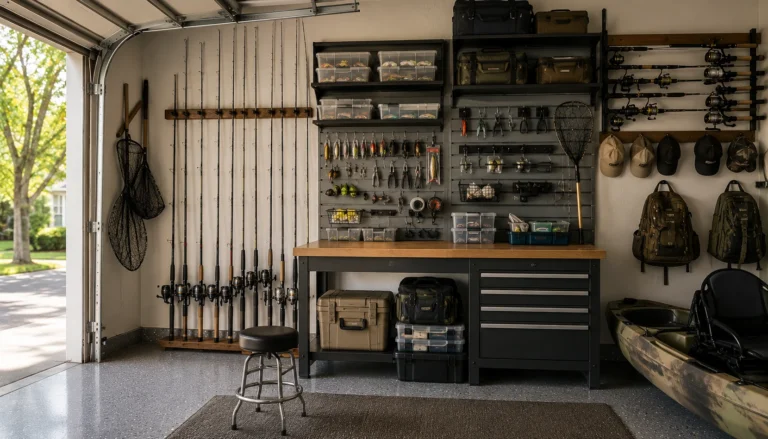
16. Create a Dedicated Fishing Gear Storage Area
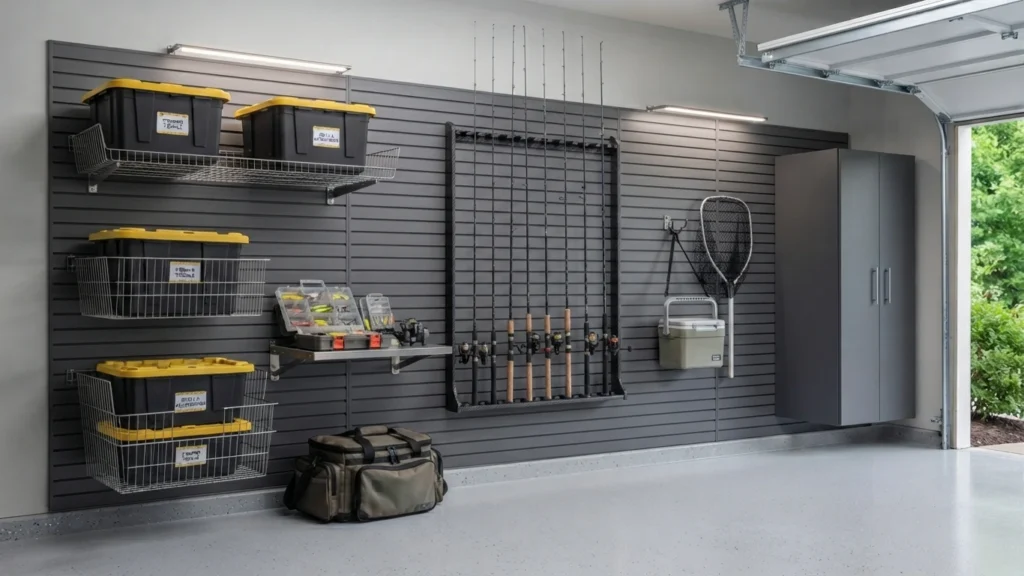
Fishing rods are awkward to store because their length doesn’t work well with ordinary shelves or cabinets. A dedicated wall or ceiling storage system can keep rods organized while preserving parking space.
Store tackle boxes, reels, and accessories nearby so the entire hobby has one defined area. Seek assistance from 15 smart fishing rod storage ideas to create a dedicated fishing gear storage area.
17. Use Rolling Storage Only Where It Makes Sense
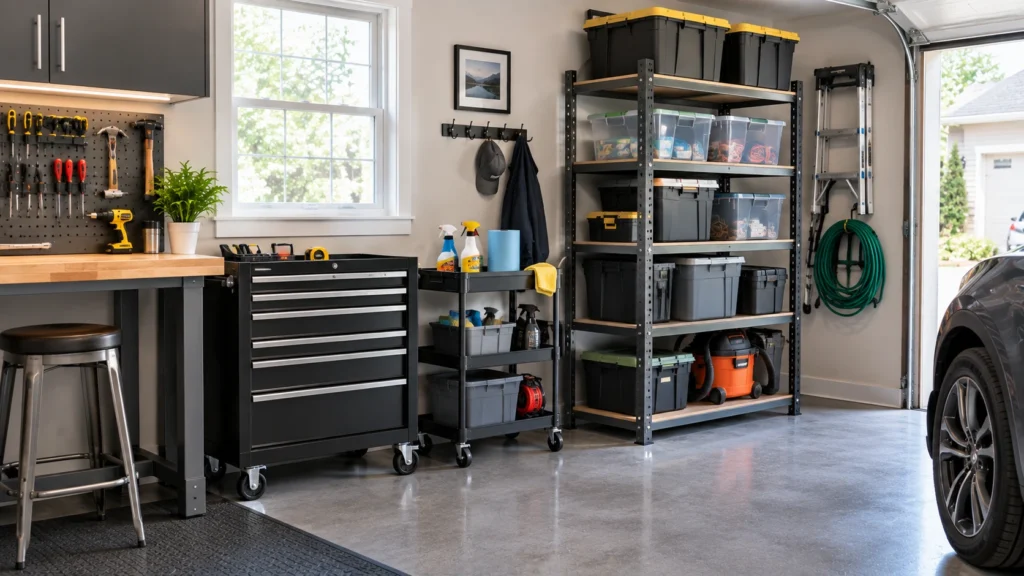
Rolling cabinets and mobile carts can be useful in a garage workshop. You can move them toward your work area while working and return them against a wall afterward. The problem starts when mobile storage becomes permanent floor clutter.
Create a designated parking position for the cart or cabinet. Use it, move it when necessary, and return it afterward. The same parking principle that applies to your vehicle can apply to mobile storage.
18. Give Large Floor Items Their Own “Parking Spots”
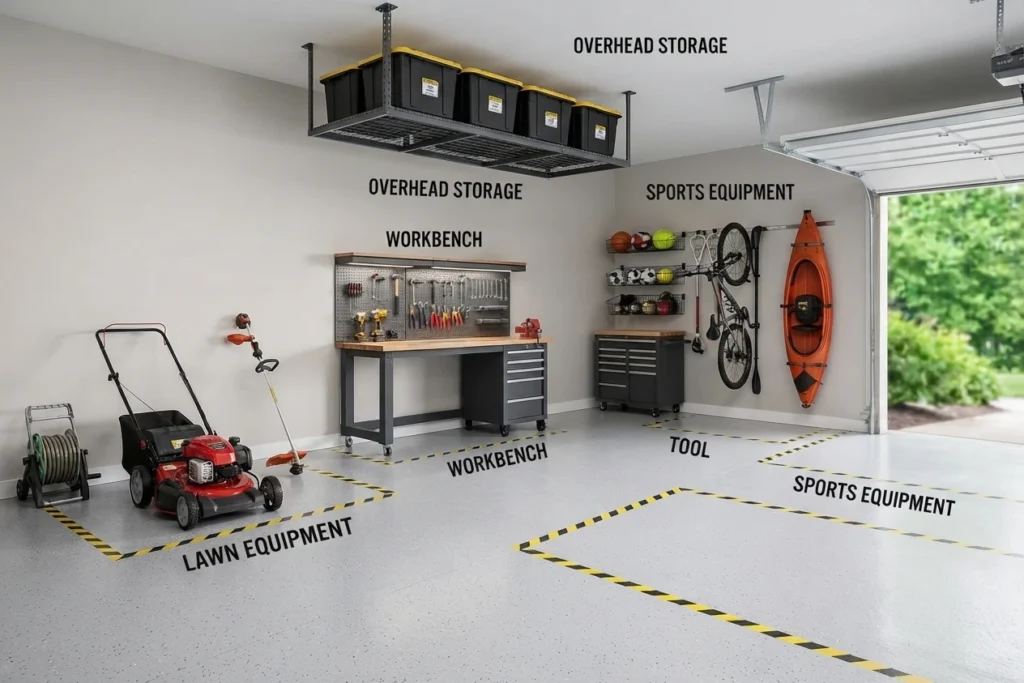
Some garage equipment genuinely needs to stay on the floor. A lawn mower, shop vacuum, large cooler, toolbox, or bulky recreational item may not fit conveniently on a wall. Instead of trying to eliminate all floor storage, give each large item a defined position. For example:
Left corner: Lawn equipment
Back wall: Workbench
Right wall: Sports equipment
Side wall: Tools
Ceiling: Seasonal storage
When every large object has a designated parking position, random floor clutter becomes much less likely.
19. Organize by Category, Frequency, and Location
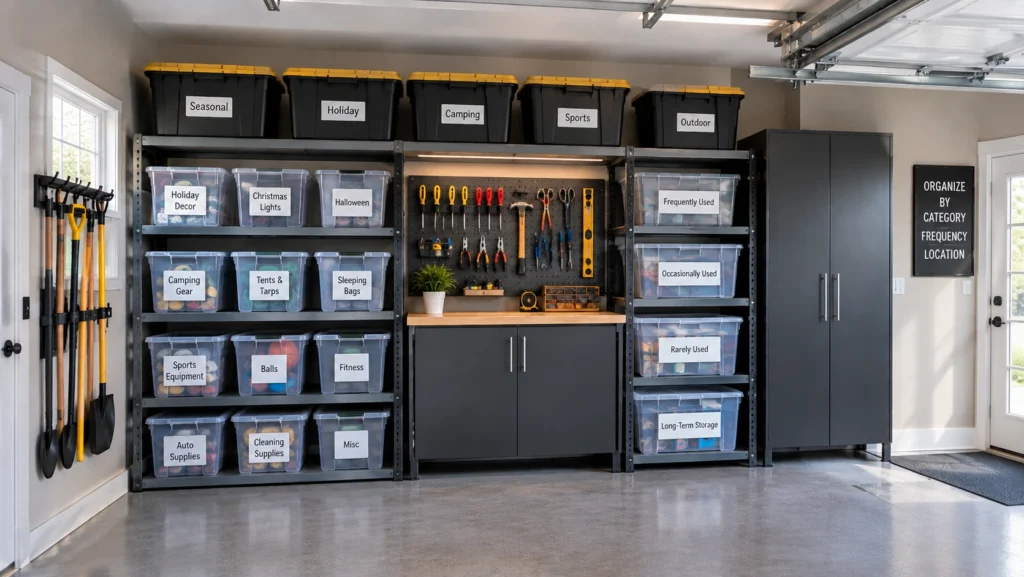
Category alone isn’t enough. Two items may belong to the same category but have completely different storage requirements.
For example, you may own ten types of tools, but the screwdriver you use every day shouldn’t be stored the same way as a specialty tool you use twice a year. Use three questions:
Category
What type of item is it?
Frequency
How often do you use it?
Location
Where is the most convenient place to store it?
This creates a much more practical system.
Daily + small → easy-access wall or drawer
Weekly + medium → cabinet or shelf
Seasonal + bulky → upper shelf or appropriate overhead storage
20. Leave Enough Empty Space for Parking and Future Storage
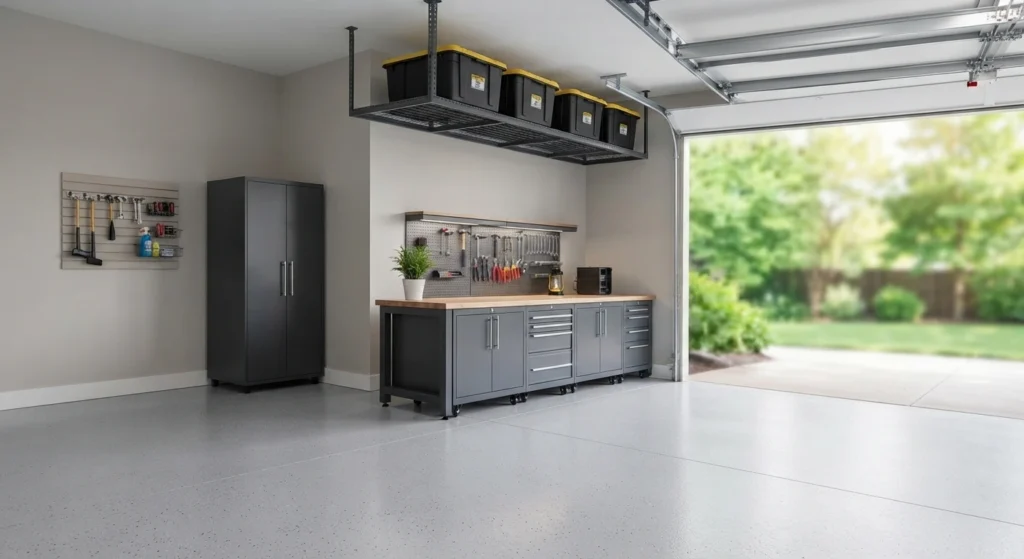
A garage does not need to be filled to capacity to be well organized. In fact, leaving some empty capacity makes the garage easier to use. Open space gives you room to:
- Park comfortably
- Open vehicle doors
- Move large objects
- Add future storage
- Reorganize seasonal items
- Replace equipment
A garage operating below maximum storage capacity may be much easier to maintain than one packed completely full. The goal is usable storage, not maximum storage.
How to Maximize Garage Storage Without Reducing Parking Clearance
Once you’ve identified your parking zone, focus on three things:
Height
Depth
Accessibility
Don’t automatically choose the storage system with the largest capacity. Instead, ask:
- Does it project too far into the garage?
- Can I open my vehicle doors?
- Can I walk around the car?
- Can I access it without moving the car?
- Does it interfere with the garage door?
- Is it appropriate for the weight of the items?
The best storage solution is the one that increases organization without creating a new parking problem.
Don’t Forget the Garage Door and Opener
Ceiling storage can save significant space, but the garage ceiling isn’t simply an empty surface. Before installing overhead racks or hanging storage, check:
- Garage door travel
- Door tracks
- Garage-door opener
- Lighting fixtures
- Vehicle roof height
- Storage-system height
- Other ceiling-mounted equipment
Leave adequate clearance for everything to operate normally. This becomes especially important when the vehicle sits relatively close to the ceiling-mounted hardware.
The 5-Minute Parking Test
After reorganizing the garage, don’t assume the layout works simply because everything looks neat. Test it.
Step 1
Park the vehicle.
Step 2
Open the driver and passenger doors.
Step 3
Walk around the vehicle.
Step 4
Open the trunk or hatch.
Step 5
Walk from the garage entry door to the vehicle.
Step 6
Access the storage you use most often.
If any of these actions feels awkward, the layout needs another adjustment. A storage system is successful only when it works in real life—not just when the garage is photographed from the doorway.
Garage Organization Ideas for a Small Garage
Small garages require even more attention to clearance. Start with the objects consuming the most floor space. Common examples include:
- Bikes
- Lawn equipment
- Large bins
- Sports equipment
- Toolboxes
- Seasonal decorations
Then look for opportunities to move suitable items vertically.
A small garage may benefit from:
- Wall-mounted bike storage
- Tall cabinets
- Narrow shelving
- Pegboards
- Slatwall
- Ceiling storage
- Corner racks
- Folding workbenches
- Wall-mounted tool holders
Avoid oversized storage systems simply because they offer more capacity. A smaller system that lets you park comfortably is usually more useful than a massive system that forces you to leave the vehicle outside.
Parking-Friendly Garage Layouts
One-Car Garage
For a one-car garage, think of the vehicle as the central fixed zone. A simple concept is:
Wall storage → Vehicle → Wall/corner storage
Use the perimeter for cabinets, shelving, tools, bikes, and other equipment. Keep the area around the vehicle doors and walking path open.
Two-Car Garage
Two-car garages need even more planning because the vehicles create two large fixed footprints. A practical concept is:
Wall storage → Car → Car → Wall storage
Use corners and perimeter walls for storage. If a workbench is included, position it where it doesn’t interfere with either vehicle’s doors or walking paths.
How to Organize a Garage With Two Cars
Don’t measure only whether both vehicles physically fit. Test whether you can comfortably:
- Open both vehicles’ doors
- Walk between them
- Reach storage areas
- Open trunks or rear hatches
- Enter the house
- Access your workbench
- Move bikes and equipment
If storage makes either vehicle difficult to access, the system needs to be redesigned. Parking space isn’t just the rectangle occupied by the car. It’s also the usable space around the car.
What Should You Store in the Hardest-to-Reach Areas?
Use high shelves and overhead storage for belongings that don’t need frequent access. Good candidates include:
- Holiday decorations
- Seasonal clothing
- Camping equipment
- Extra luggage
- Backup supplies
- Rarely used sports equipment
Avoid putting daily-use tools or frequently accessed household items in difficult-to-reach locations. The few square feet you save may not be worth the daily inconvenience.
What Should Never Spill Into Your Parking Zone?
Some clutter categories are particularly likely to become permanent floor storage. Watch for:
- Donation boxes
- Empty cardboard
- Unsorted packages
- Seasonal bins waiting to be put away
- Random tools
- Sports equipment
- Broken items
- “Temporary” projects
- Items waiting to be moved elsewhere
One of the biggest reasons a garage slowly loses its parking space is that temporary storage becomes permanent. If something doesn’t have a home, don’t simply place it beside the car. Give it a destination.
Garage Storage Safety Rules
A parking-friendly garage should also be a safe garage. Keep these principles in mind:
- Store heavy items low when practical.
- Secure wall-mounted storage properly.
- Follow manufacturer weight limits.
- Don’t overload shelves or ceiling systems.
- Store chemicals and other hazardous materials appropriately.
- Keep hazardous products away from children and pets.
- Keep electrical panels accessible.
- Keep garage-door mechanisms unobstructed.
- Avoid creating trip hazards.
- Don’t place unstable heavy objects where they could fall onto the vehicle.
Saving space should never come at the expense of safe access.
How to Get Your Parking Space Back in One Weekend?
If your garage has already lost its parking area, you don’t necessarily need a complete renovation. Start with a reset.
Step 1: Remove obvious trash
Get rid of empty boxes, broken items, packaging, and things that clearly don’t belong.
Step 2: Clear the vehicle footprint
Move everything away from the area where the vehicle needs to park.
Step 3: Create four groups
Keep in garage
Move elsewhere
Donate
Discard
Step 4: Return only essential floor items
Anything that can safely move to the wall, shelf, cabinet, or appropriate overhead storage should be evaluated for relocation.
Step 5: Create permanent homes
Give every remaining item a designated location.
Step 6: Park the vehicle
Test the new layout.
Step 7: Adjust
If the vehicle still feels cramped, remove or relocate another floor item.
This process can reveal that you don’t necessarily need more storage—you may simply need a better system.
A Simple Garage Organization Layout
If you’re starting from scratch, use this basic five-zone approach.
Zone 1: Parking
Protect this area first.
Zone 2: Everyday Storage
Keep frequently used household and garage items accessible.
Zone 3: Workshop
Group your workbench, tools, chargers, and project supplies together.
Zone 4: Hobby Storage
Give bikes, sports equipment, fishing gear, gardening supplies, or other hobbies dedicated zones.
Zone 5: Seasonal Storage
Use higher shelves and suitable overhead storage for things you rarely access.
This approach makes the garage easier to navigate because every category has a logical destination.
Garage Cabinets vs. Open Shelving: Which Is Better?
Both have a place in a parking-friendly garage.
Cabinets
Best for:
- Hiding visual clutter
- Protecting supplies
- Small parts
- Appropriate household products
- Tools
- Creating a cleaner appearance
Open Shelving
Best for:
- Frequently accessed bins
- Large containers
- Quick visibility
- Bulky items
- Items you use often
A hybrid system
For many garages, the most practical solution is a combination:
Cabinets → contained storage
Shelves → larger bins
Pegboard → frequently used tools
Wall racks → bikes and equipment
Ceiling → seasonal items
You don’t have to choose one storage method for the entire garage.
Useful Products for a Parking-Friendly Garage
The best products are those that solve a specific storage problem.
| Problem | Useful Product Type | Best Location |
| Tools taking over the floor | Pegboard organizer | Wall |
| Bikes blocking parking | Wall-mounted bike rack | Wall |
| Seasonal bins consuming floor space | Overhead storage rack | Ceiling |
| Small hardware getting lost | Clear storage bins | Cabinet/shelf |
| Bulky equipment | Tall cabinet | Corner |
| Everyday tools | Tool organizer | Workbench wall |
| Mobile workshop tools | Rolling cabinet | Workshop zone |
| Cleaning equipment leaning everywhere | Utility tool holder | Wall |
| Cabinet shelves becoming messy | Shelf organizer | Cabinet |
| Changing storage needs | Slatwall accessories | Wall |
The strongest affiliate recommendations should be connected directly to these problems rather than inserted randomly.
Garage Organization Mistakes That Can Cost You Parking Space
Buying Storage Before Measuring
A product that looks compact online may occupy more usable space than expected.
Using Too Much Floor Shelving
Wide shelves can quickly reduce vehicle-door clearance.
Installing Cabinets That Are Too Deep
More cabinet capacity isn’t useful if it makes parking uncomfortable.
Ignoring Storage Depth
Wall width isn’t the only consideration. A deep cabinet or shelf can project far enough into the garage to reduce usable vehicle clearance.
Ignoring Door Swing
Vehicle doors, cabinet doors, and garage entry doors all require usable clearance.
Using Every Available Inch
A completely full garage has no flexibility.
Putting Everything Overhead
Overhead storage isn’t automatically the best location for heavy or frequently used items.
Letting Temporary Items Become Permanent
Boxes waiting to be sorted often become permanent floor clutter.
Organizing Only by Category
Frequency of use and location matter just as much as category.
Forgetting Future Needs
Leave enough capacity for future purchases, seasonal changes, and household needs.
How to Keep Your Garage Organized Without Losing Parking Space Again?
A good garage organization system should make it easy to put things away. Every large item should have a place. Think of storage as creating parking spots for your belongings.
A lawn mower has a parking spot.
A bicycle has a parking spot.
A toolbox has a parking spot.
A storage bin has a shelf.
A drill has a drawer or cabinet.
When you finish using something, return it to its assigned location.
Every few months, test the parking area again.
If your vehicle clearance is becoming tighter, something has probably expanded beyond its designated zone.
Fix the problem early rather than waiting until the garage becomes unusable again.
FAQ
How can I organize my garage and still park a car?
Start by treating your vehicle’s parking area as a fixed zone. Then move appropriate storage onto walls, into corners, onto vertical shelving, and into carefully planned overhead areas.
What is the best storage for a small garage?
Wall-mounted cabinets, pegboards, slatwall systems, tall narrow shelving, bike racks, and carefully planned overhead storage can work well because they use vertical space.
How much space should I leave around my car in the garage?
There isn’t one universal number that works for every garage and vehicle. The important thing is to test your actual vehicle’s door, walking, and trunk/hatch clearance rather than relying only on the car’s listed dimensions.
Should garage cabinets be deep?
Not necessarily. Deeper cabinets hold more, but they also reduce clearance. In a parking-focused garage, choose cabinet depth based on your actual layout.
Is ceiling storage good for a garage?
It can be useful for seasonal and rarely used items when properly installed and when adequate clearance is maintained around the garage door, opener, lighting, and vehicle.
How do I keep my garage floor clear?
Give large floor items designated parking positions and move everything suitable onto walls, shelves, cabinets, or appropriate overhead storage.
Where should frequently used tools go?
Keep them in easily accessible locations such as pegboards, tool racks, drawers, or cabinets near your workbench.
How can I organize a two-car garage?
Mark both vehicle parking zones first, then build storage around the perimeter and in corners. Test door clearance, walking paths, and access to storage before finalizing the layout.
Final Thoughts
Learning how to organize a garage without losing parking space starts with a simple change in priorities. Protect the parking area first. Build storage around it second.
Use walls for tools and equipment, cabinets for contained storage, vertical shelving for bins, corners for bulky belongings, and carefully planned overhead storage for seasonal items. Then organize those storage areas according to category, frequency, and location.
Pay attention not only to storage width, but also to storage depth. A system that looks efficient on paper can still make parking uncomfortable if it projects too far into the vehicle zone. Most importantly, don’t try to fill every available space.
A garage with some open capacity is easier to park in, easier to clean, and easier to adapt when your storage needs change. The best garage organization system isn’t the one that stores the most stuff. It’s the one that lets you store what you need while still allowing your garage to function as a garage.