15 Smart Garage Fishing Rod Storage Ideas for Easy Organization
Fishing rods are long, awkward to store, and easier to damage than they look. Leaving them leaning in a garage corner can create clutter, make them easier to knock over, and turn one simple storage problem into a tangled mess.
The good news is that you don’t need a dedicated fishing room to keep your rods organized. A small section of wall, an unused ceiling area, a cabinet, or even a narrow corner can become a practical fishing-storage zone.
The best garage fishing rod storage ideas do more than get rods off the floor. They keep equipment protected, make individual rods easier to grab, and give reels, tackle, nets, and other fishing gear a predictable place to live.
Below, you’ll find 15 practical storage ideas ranging from simple wall racks and DIY PVC holders to ceiling storage and complete fishing stations.
Before Choosing Garage Fishing Rod Storage, Check These 5 Things
Before buying a rack or starting a DIY project, look at how your garage and fishing equipment actually work together.
Measure the available space. Fishing rods are long, so measure the rods themselves rather than guessing. Check clearance around garage doors, vehicles, shelves, workbenches, and walking paths.
Think about rod protection. Rod blanks, guides, and tips can be damaged by impacts or pressure. Look for smooth or padded contact points and avoid storage locations where bikes, tools, or other equipment can hit the rods.
Consider accessibility. If you fish regularly, you should be able to remove one rod without pulling several others out first.
Decide whether reels stay attached. Keeping reels on the rods makes grab-and-go preparation easier, while separate reel storage can reduce crowding and protect valuable reels.
Leave room to grow. A rack that is completely full on day one may become frustrating later. If you expect to add equipment, choose a system with spare capacity or room for expansion.
15 Garage Fishing Rod Storage Ideas
1. Install a Wall-Mounted Fishing Rod Rack
Best for: Most anglers who want accessible, space-saving rod storage.
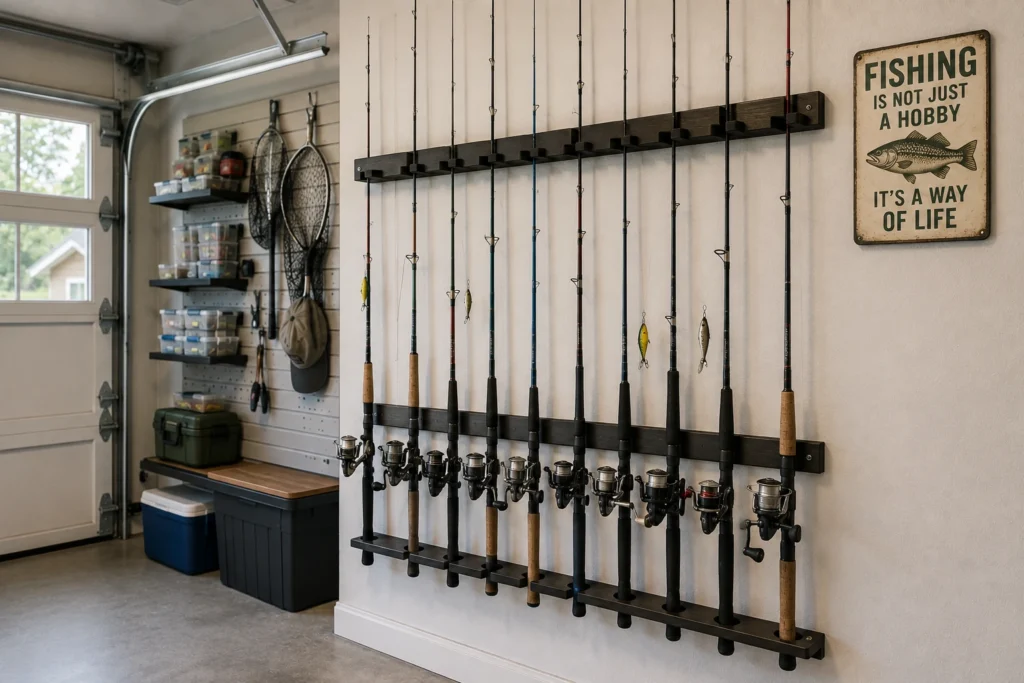
A dedicated wall-mounted fishing rod rack is one of the simplest ways to get rods out of a garage corner and into an organized storage zone.
Individual holders keep rods separated instead of allowing them to lean against one another. This makes it easier to see your collection and grab the rod you actually want.
For smaller collections, a compact rack may be enough. Larger collections can benefit from a rack with extra capacity so you don’t immediately outgrow it.
Look for individual rod slots, smooth or padded contact points, secure mounting hardware, and enough spacing for your rod and reel combinations.
If you’re mounting the rack to drywall, masonry, or another wall material, use hardware appropriate for that surface and follow the rack manufacturer’s load requirements.
What to look for: Individual slots, protected contact points, secure mounting, appropriate capacity, and enough spacing between rods.
2. Use Vertical Wall Storage for Long Rods
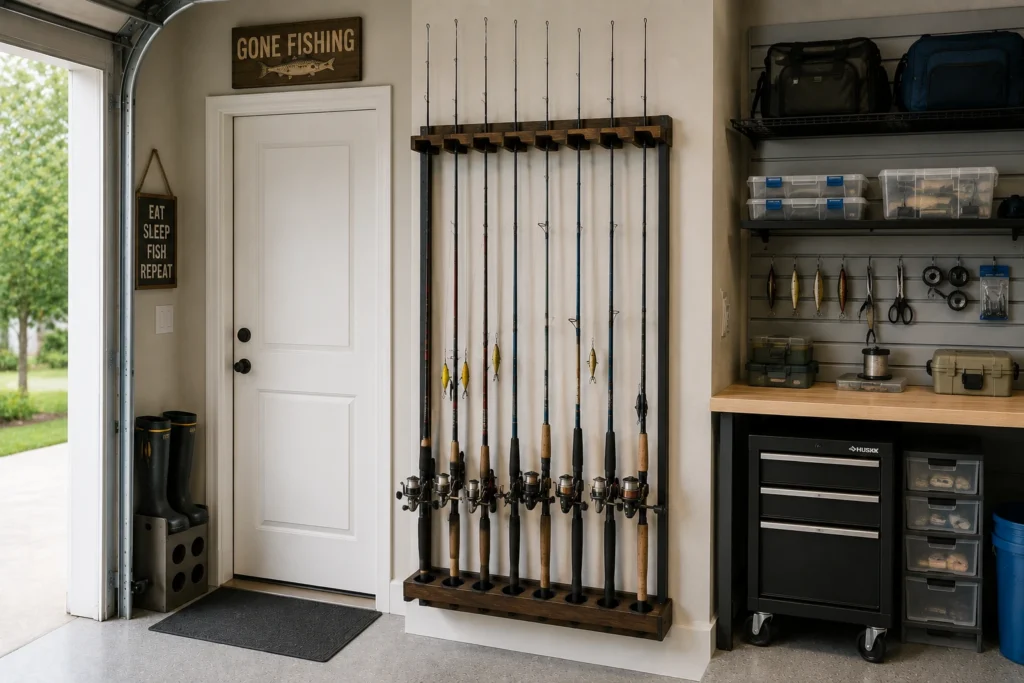
Best for: Narrow garages and anglers with limited horizontal wall space.
Vertical storage can turn a narrow section of garage wall into a useful fishing-rod zone.
Instead of spreading rods across a large wall, an upright rack keeps them grouped into a relatively small footprint. This can work particularly well beside an entry door, near a workbench, or between larger storage systems.
Make sure the rods are properly supported so they cannot tip or slide. Also check the full height of the rods against the garage ceiling, lighting, door tracks, and nearby equipment.
Vertical storage is especially convenient when you use your rods frequently because individual rods can be easy to access.
3. Build a DIY PVC Fishing Rod Holder
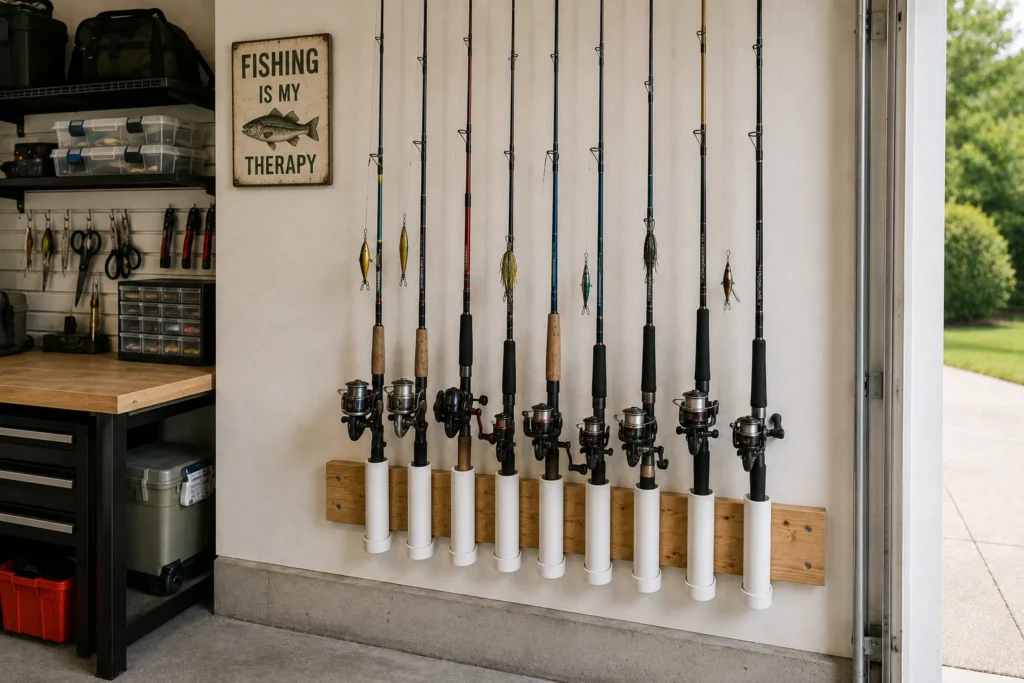
Best for: Budget-conscious DIYers who want customizable storage.
PVC pipe can be transformed into a simple fishing rod organizer with basic tools.
One approach is to cut PVC into individual sections and mount the pieces to a wood backing board. The number and spacing of the holders can be customized to fit your collection.
For a cleaner result, smooth every cut edge before placing rods inside. Rough edges can catch fishing line or create unnecessary contact with the rod.
A PVC system also gives you flexibility if your collection changes. You can build a small holder now and expand it later instead of committing to a large commercial rack immediately.
DIY PVC systems remain a common solution because they can be adapted to both wall and overhead layouts.
DIY tip: Measure the rod handles and reel combinations before deciding on PVC diameter and holder spacing.
4. Store Fishing Rods Horizontally Above a Workbench
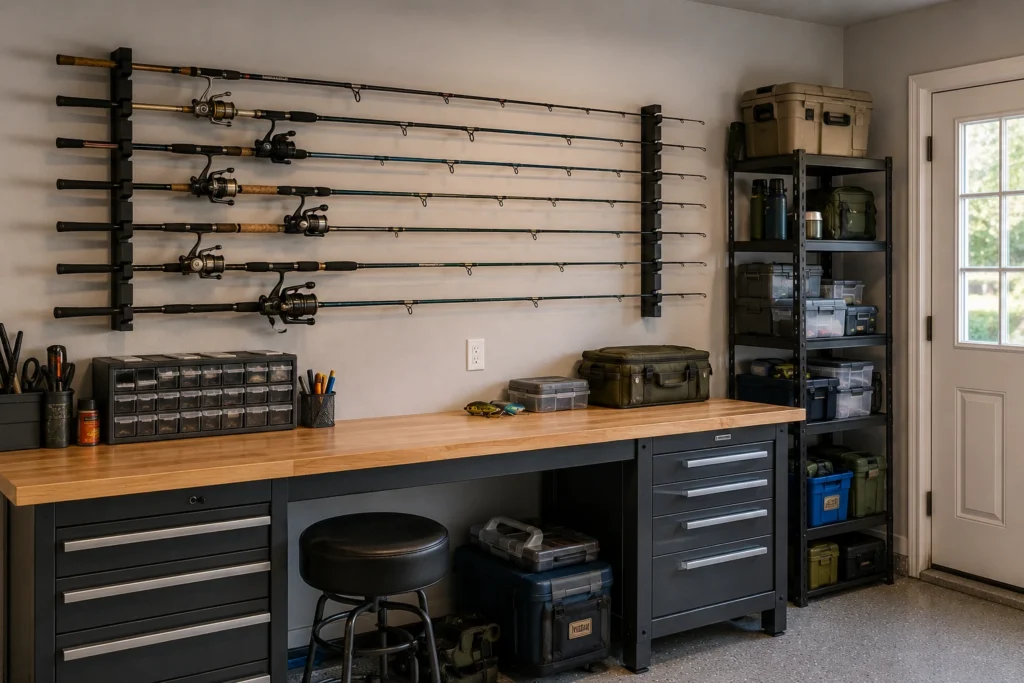
Best for: Garages with unused wall space above an existing workbench.
The wall above a workbench is often wasted space, but it can become a convenient location for horizontal rod storage.
Horizontal storage keeps rods elevated and away from normal foot traffic while allowing you to see the collection easily.
The important part is support. Long rods should not be left resting on only a couple of poorly positioned contact points. Use a storage system designed to support the rods appropriately along their length.
Keep the rack high enough that rods don’t interfere with projects at the workbench, but not so high that removing them becomes awkward.
For long rods, horizontal storage can be particularly useful when vertical clearance is limited.
5. Add a Ceiling-Mounted Fishing Rod Rack
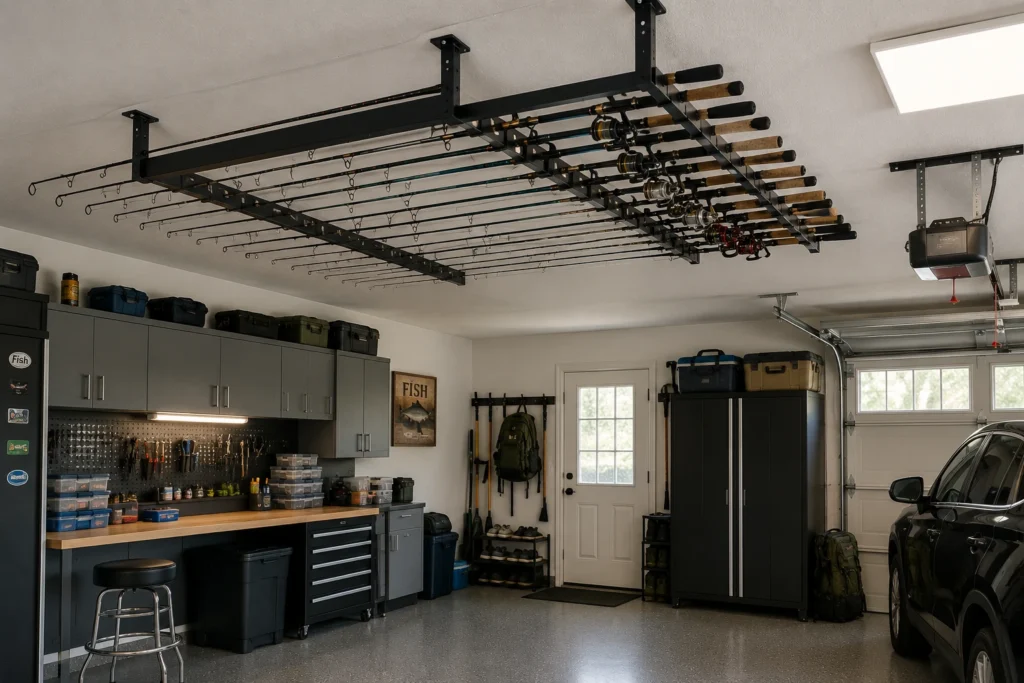
Best for: Large rod collections or garages where wall space is already occupied.
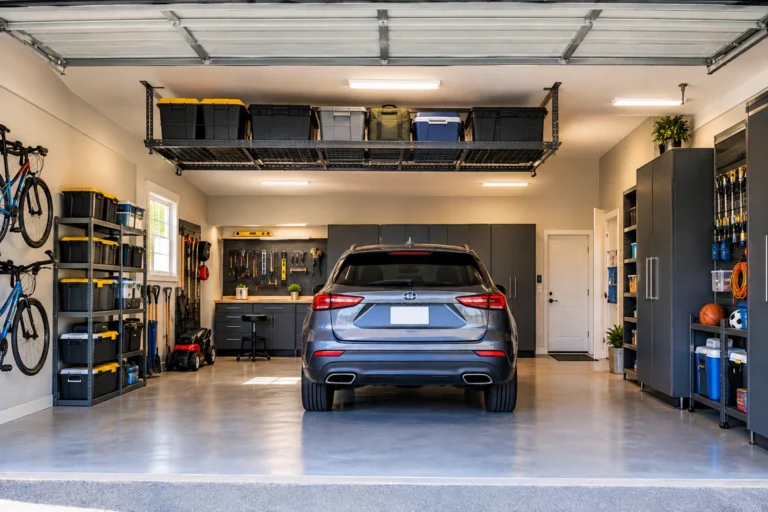
When garage walls are full of cabinets, shelving, bikes, and tools, the ceiling can provide another storage opportunity.
A ceiling-mounted rack can keep long rods completely out of the way and preserve valuable wall and floor space.
However, overhead storage requires more planning than simply installing a wall rack.
Before mounting anything, check:
- Ceiling height
- Garage-door movement
- Door tracks and opener components
- Lighting
- Vehicle clearance
- Access for loading and unloading rods
- The structural support available for mounting
For frequent-use rods, a ceiling rack that requires a ladder every time may be less convenient than a wall-mounted system.
Current fishing-storage coverage also commonly highlights ceiling racks as a way to reclaim otherwise unused garage space.
6. Dedicate One Wall to Fishing Gear
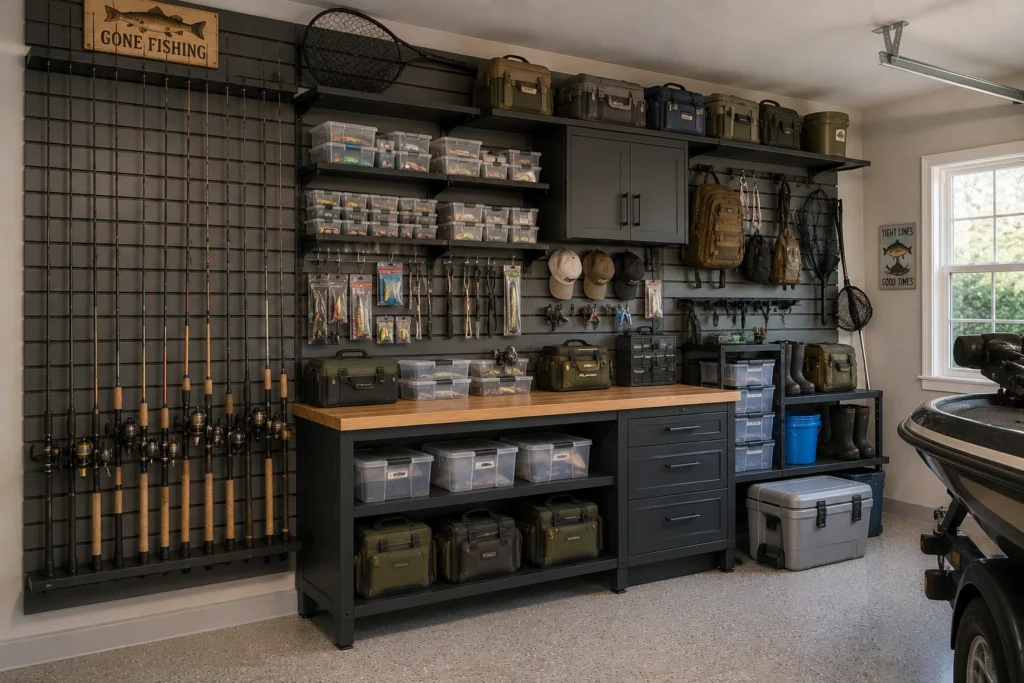
Best for: Frequent anglers who own rods, tackle, reels, and accessories.
Instead of storing fishing equipment throughout the garage, dedicate one wall to the hobby..
Use one section for rods, another for tackle, and hooks or shelves for nets, bags, tools, and other accessories.
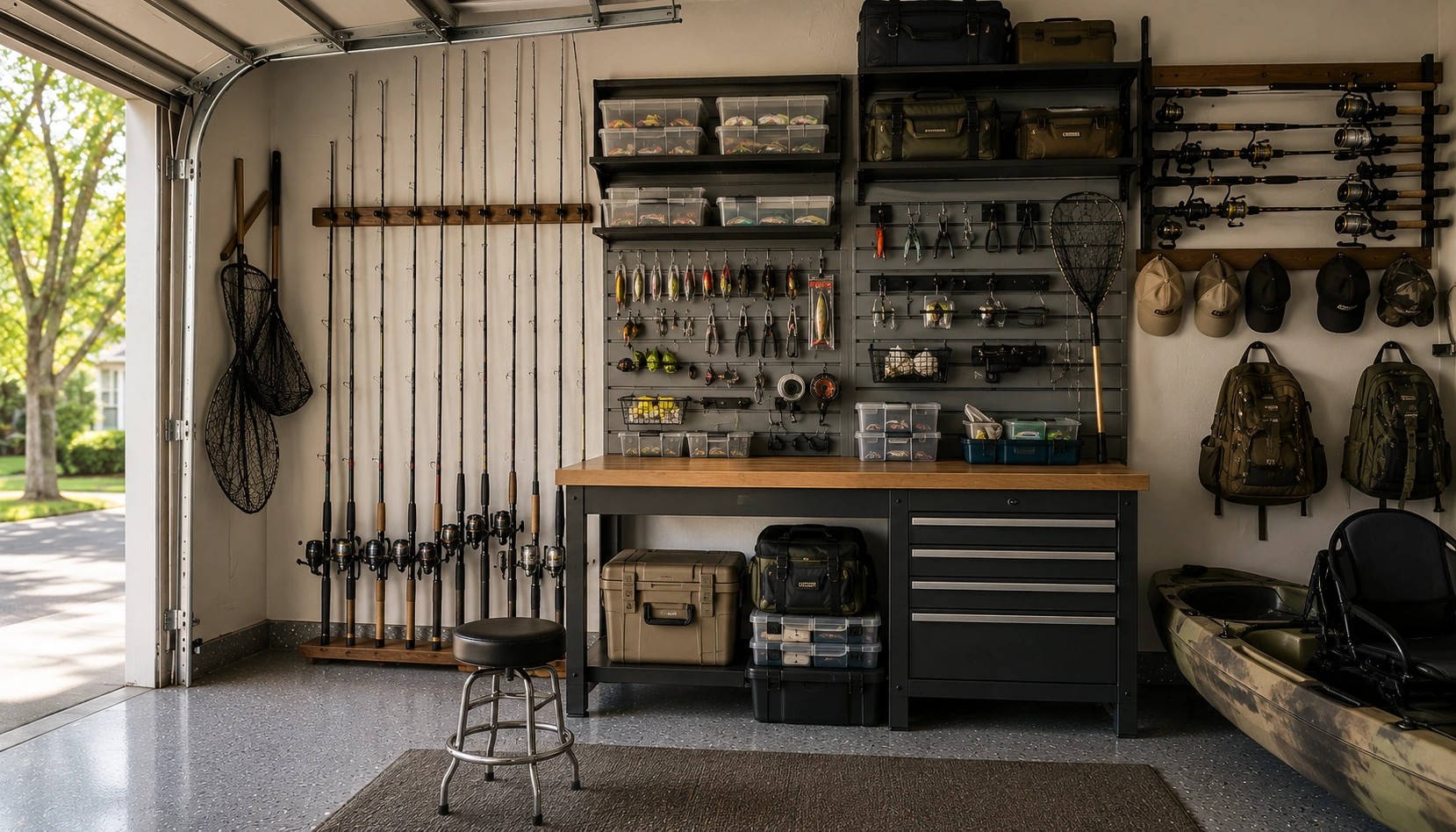
This creates a simple fishing station where everything needed for a trip is stored together.
You don’t necessarily need an entire garage wall. A narrow section can work if you use vertical space efficiently.
Keep the equipment you reach for most often at comfortable heights and reserve higher storage for seasonal or rarely used items.
If your garage also stores other recreational equipment, you can combine the fishing area with a broader sports equipment storage setup.
7. Combine Rod Storage With a Pegboard
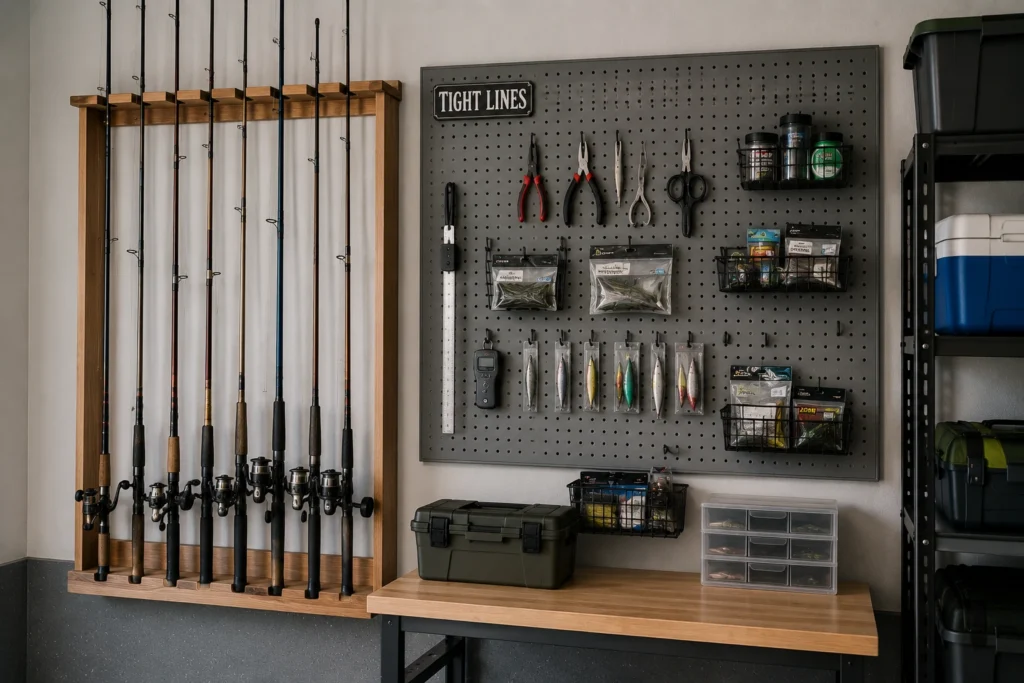
Best for: Anglers who want flexible storage for fishing accessories.
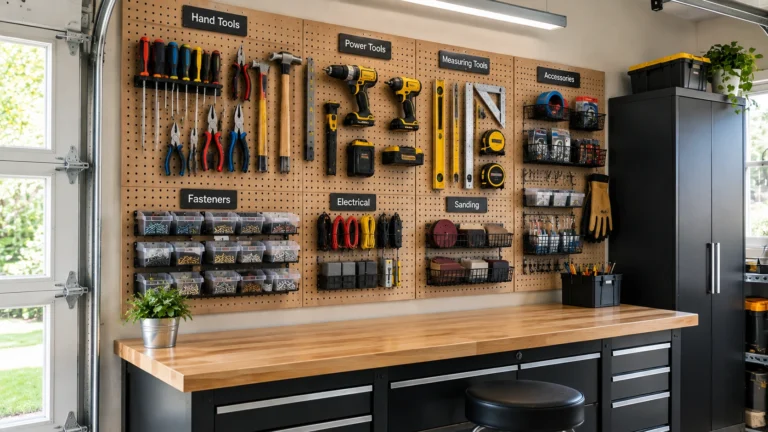
A pegboard can complement a dedicated rod rack by giving smaller fishing tools their own locations.
Use hooks or small baskets for:
- Fishing pliers
- Line cutters
- Scissors
- Measuring tools
- Small bags
- Lightweight accessories
Keep the rods themselves on appropriately designed rod holders rather than trying to make generic pegboard hooks do everything.
One advantage of a pegboard is that accessories can be repositioned as your equipment changes.
Leave some empty space instead of filling every hole. That makes the system easier to expand later and prevents the wall from becoming visually cluttered.
8. Use a Slatwall for Flexible Fishing Storage
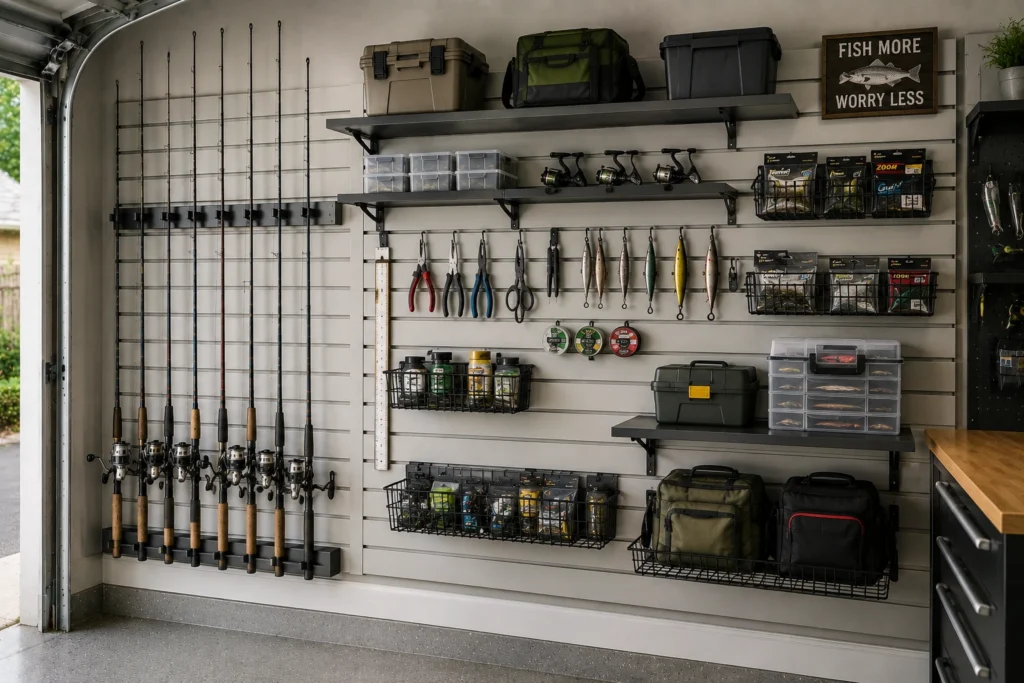
Best for: Polished garage setups that may need to change over time.
A slatwall system can combine rod holders, hooks, shelves, baskets, and other compatible accessories on one organized wall.
This is useful when your fishing equipment changes from season to season or when you want one storage system to handle several categories of gear.
For example, rods can occupy one section while tackle boxes, reels, bags, and tools use shelves or baskets nearby.
The major advantage is flexibility. Instead of permanently fixing every accessory in one position, compatible components can be rearranged when your storage needs change.
What to look for: Compatible rod holders, appropriate load ratings, adjustable accessories, and enough capacity for future additions.
9. Build a Dedicated Fishing Tackle Station
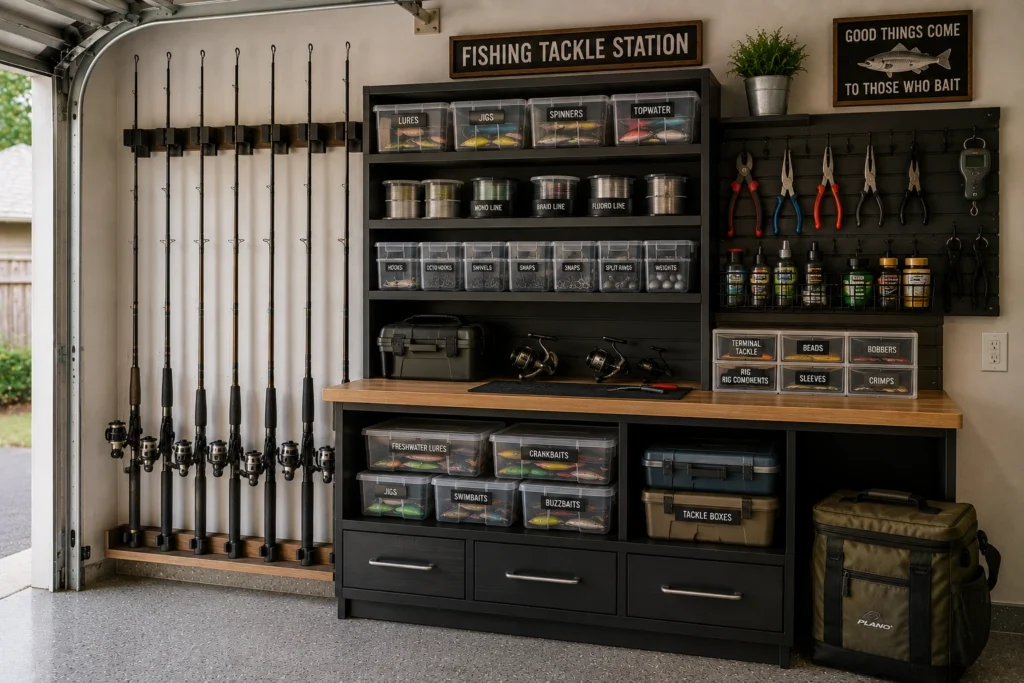
Best for: Anglers who want rods and smaller fishing equipment organized together.
Fishing rods are only part of the storage problem.
Lures, hooks, line, weights, tools, tackle boxes, and other small equipment can create just as much clutter as the rods themselves.
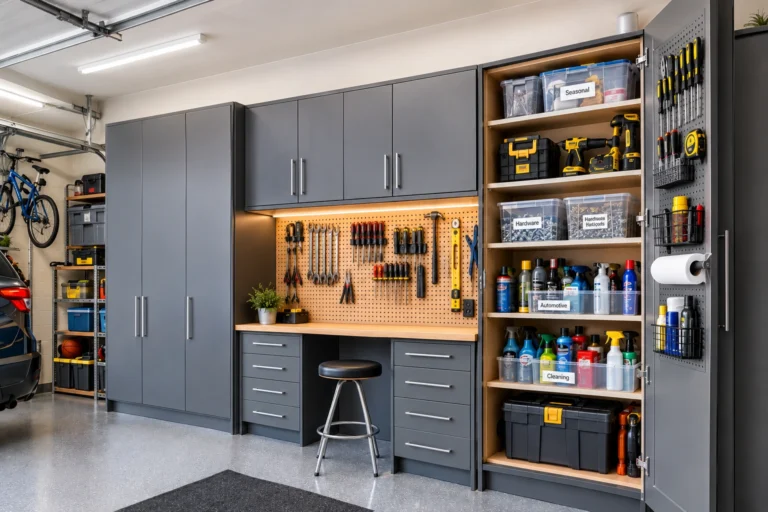
Place a compact shelf, cabinet, or drawer system near your rod rack and organize smaller equipment by category.
For example:
- Lures
- Fishing line
- Hooks
- Terminal tackle
- Small tools
- Spare reels
- Tackle boxes
Clear containers work well when you need to identify contents quickly. Opaque containers can create a cleaner appearance when the storage area is visible.
Keep sharp hooks and other potentially hazardous tackle secured, particularly in garages accessible to children.
10. Store Reels on a Separate Shelf or Cabinet
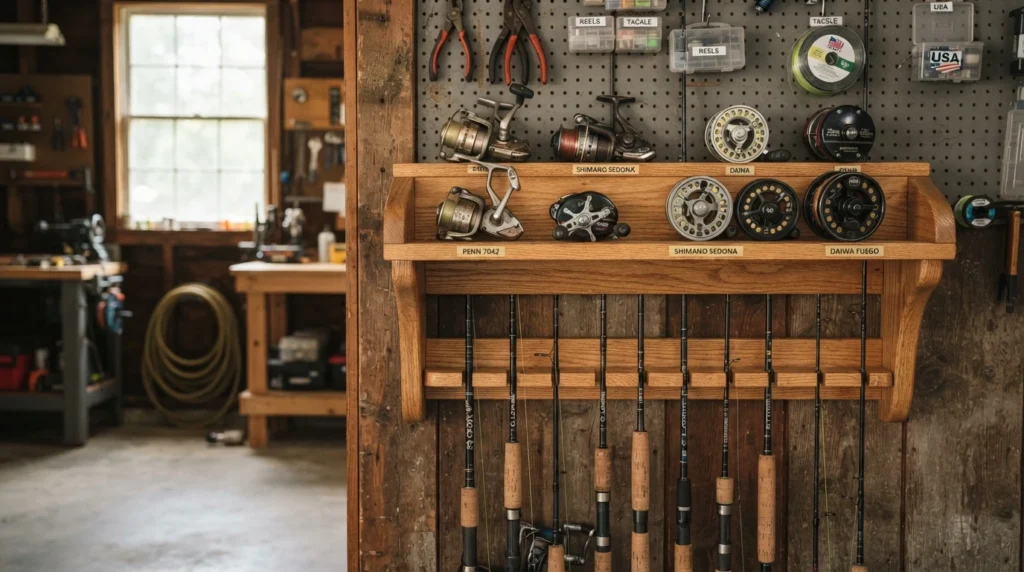
Best for: Anglers with multiple reels or crowded rod racks.
Keeping every reel attached to every rod isn’t always the best use of space.
A separate reel shelf or cabinet can reduce crowding around the rod rack while giving reels their own protected area.
If you leave reels attached, make sure the rack has enough clearance for them. If you store reels separately, choose a shelf with enough depth to keep them stable.
Open shelving provides quick access, while an enclosed cabinet can help protect equipment from dust and accidental impacts.
For valuable gear, protection and accessibility should both factor into the decision rather than simply maximizing capacity.
11. Use a Narrow Storage Cabinet for Fishing Gear
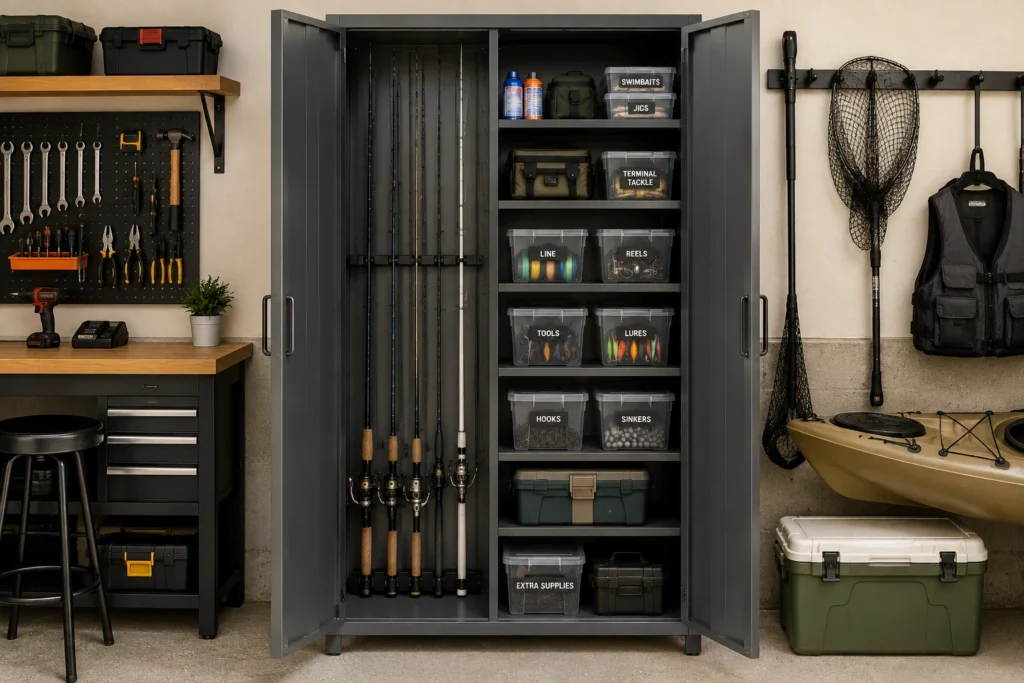
Best for: Anglers who want fishing equipment hidden when not in use.
A narrow cabinet can keep fishing gear organized without allowing the garage to become visually dominated by rods and tackle.
Tall compartments can accommodate rods, while adjustable shelves can handle tackle boxes, reels, line, and smaller accessories.
This can also be useful when fishing equipment shares the garage with automotive supplies, gardening tools, and household storage.
Choose the cabinet location carefully. Make sure doors can open fully without interfering with vehicles, walkways, or other storage.
12. Create a Fishing Gear Drop Zone for Wet Equipment
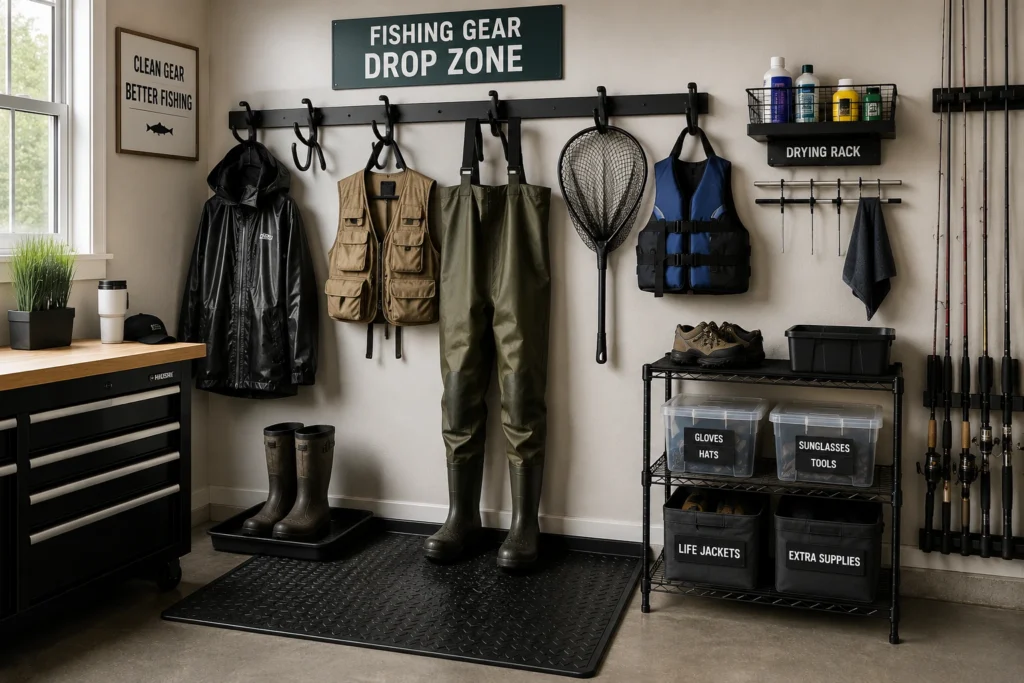
Best for: Anglers who regularly bring wet or dirty gear home after fishing trips.
Fishing equipment doesn’t always return to the garage clean and dry.
Waders, boots, nets, life jackets, and other equipment may need time to dry before being placed into enclosed storage.
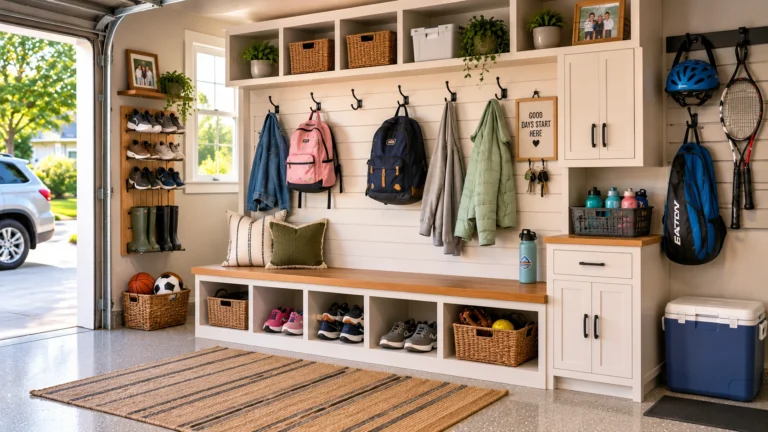
Create a dedicated drop zone with:
- A durable floor mat
- Open hooks
- A small drying rack or shelf
- Space for boots or waders
- Elevated storage for moisture-sensitive items
The goal is to give wet equipment a predictable place to land after a trip instead of allowing it to spread across the garage.
Avoid immediately sealing damp equipment inside an enclosed cabinet or storage bin. Let appropriate gear dry first.
This type of drying/drop zone is also consistent with current fishing-storage guidance emphasizing clean, dry equipment and airflow.
13. Use a Rolling Fishing Gear Cart
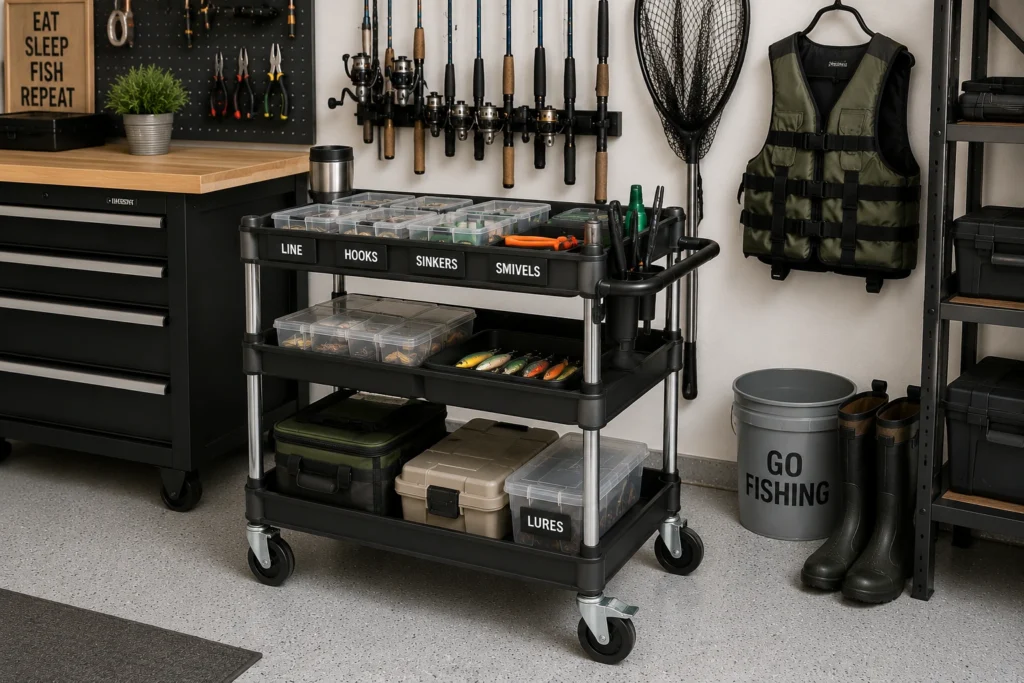
Best for: Anglers who want portable tackle storage.
A rolling utility cart can be useful when you regularly move tackle and accessories between storage, the garage door, and your vehicle.
Use upper shelves for smaller frequently accessed items and lower shelves for heavier tackle boxes.
When you’re finished, park the cart beside or underneath your fishing storage area.
Look for locking casters and a stable frame if you plan to carry heavier equipment.
A rolling cart won’t replace a rod rack, but it can complement one by giving loose tackle and accessories a dedicated mobile home.
14. Add Hooks for Nets, Waders, Bags, and Accessories
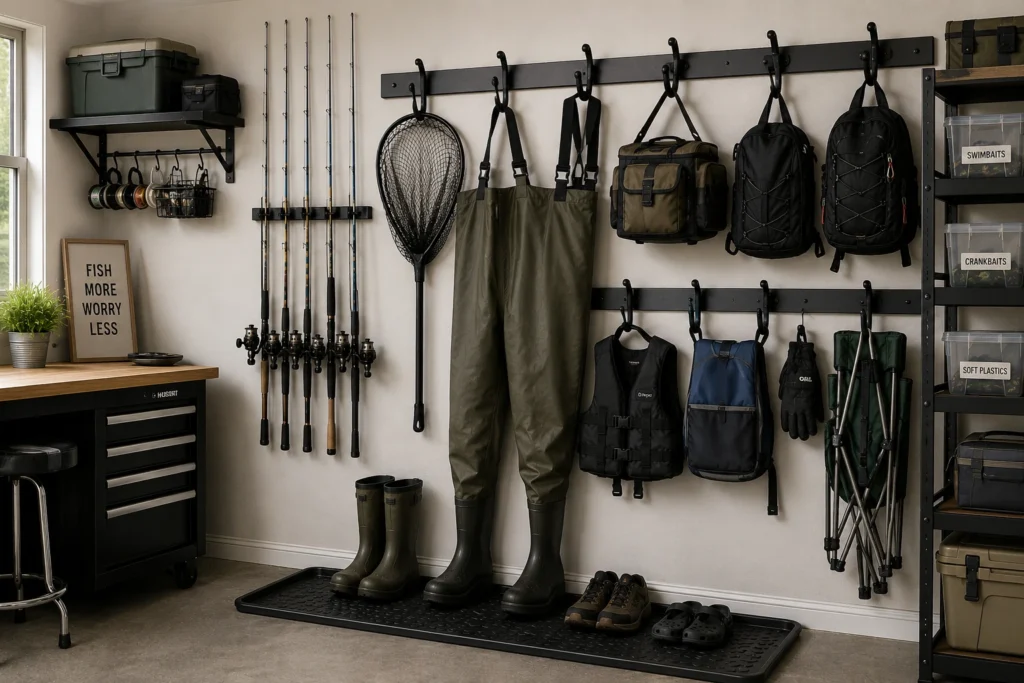
Best for: Anglers whose rods are organized but whose accessories still create clutter.
A fishing setup usually includes much more than rods.
Landing nets, fishing bags, waders, folding chairs, life jackets, gloves, and other accessories can quickly take over available floor space.
Install appropriately rated hooks near your rod rack and assign specific locations to different categories.
For heavier items, use hardware designed for the expected load and appropriate for the wall surface.
Leave enough space between hooks so one item can be removed without pulling neighboring equipment down.
This simple addition can turn a basic rod rack into a more complete fishing station.
15. Build a Modular Fishing Storage Wall That Can Grow
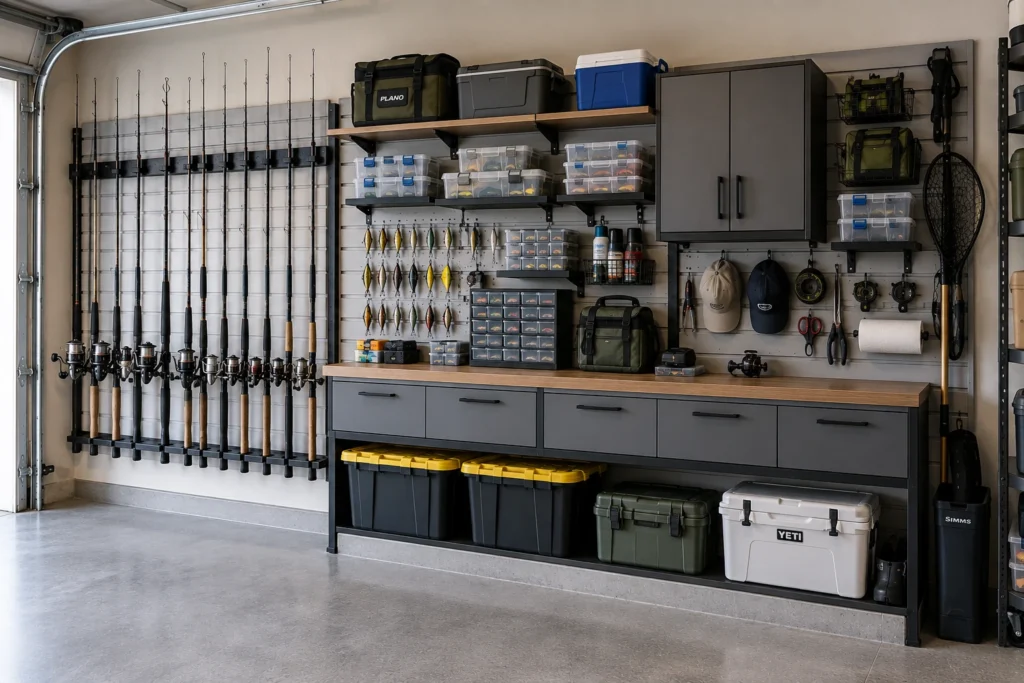
Best for: Large collections or anglers who expect their equipment to expand.
If fishing is a long-term hobby, build your storage around the equipment you own now while leaving room for what comes next.
A modular wall can combine:
- Rod holders
- Shelves
- Cabinets
- Baskets
- Hooks
- Tackle storage
- Reel storage
Start with the rod storage and the equipment you use most often. Add additional components as your needs change.
The goal isn’t to fill every inch of wall space on day one.
Leaving some space unused gives you room to add another rod rack, tackle shelf, or accessory holder later without rebuilding the entire setup.
How to Choose the Best Garage Fishing Rod Storage Idea
The best storage method depends on your rod collection, available space, accessibility needs, and how much of your fishing gear you want to store together.
| Your situation | Best starting option |
| Only a few rods | Wall-mounted rack |
| Narrow wall space | Vertical storage |
| DIY project on a budget | PVC holder |
| Unused space above workbench | Horizontal rack |
| Walls are already full | Ceiling storage |
| Rods + tackle + accessories | Dedicated fishing wall |
| Flexible organization | Pegboard or slatwall |
| Want equipment hidden | Storage cabinet |
| Need portable tackle storage | Rolling cart |
| Large or growing collection | Modular fishing wall |
If you fish only occasionally, you probably don’t need a complicated storage wall. A simple rack may solve the problem.
If fishing is a major hobby, combining rod storage with tackle and accessory organization can save time every time you prepare for a trip.
One useful rule: organize around frequency of use, not just equipment type.
Your everyday rods and tackle should be easy to grab. Seasonal or rarely used equipment can occupy higher shelves, cabinets, or less accessible areas.
What to Look for in a Fishing Rod Storage Rack
A rack shouldn’t be judged only by how many rods it holds.
Rod Compatibility
Make sure the holders accommodate the diameter, shape, and configuration of your rods.
Capacity
Leave some room for future additions rather than buying a rack that is already full.
Protection
Smooth or padded contact points can reduce unnecessary contact with rod blanks and guides.
Mounting System
The mounting hardware should be appropriate for your wall material and the expected load. Follow the manufacturer’s installation instructions rather than assuming a generic anchor will be sufficient.
Orientation
Vertical and horizontal racks solve different space problems. Choose the orientation that works with your garage’s dimensions and your access needs.
Accessibility
You should be able to remove one rod without disturbing the rest of the collection.
Expandability
If your fishing equipment collection is likely to grow, modular storage can save you from replacing the entire setup later.
Fishing Rod Storage Mistakes to Avoid
Even a good rack can become problematic when it’s installed or used incorrectly.
Don’t lean valuable rods in a corner. They can fall, get stepped on, or be damaged by other equipment.
Don’t place heavy boxes on top of rods. Pressure from stored items can damage sensitive rod sections.
Don’t install storage in the garage door’s path. Check the complete movement of the door and its hardware before mounting anything nearby.
Don’t overcrowd rod holders. If rods are jammed together, removing one can disturb the entire collection.
Don’t store wet gear in a sealed cabinet. Give appropriate equipment time to dry before enclosing it.
Don’t leave hooks and lures loose. Small tackle should be kept in secure containers.
Don’t ignore rod-tip clearance. A storage system that looks fine at the handle end may still put delicate tips near doors, shelves, or other equipment.
Don’t overload overhead storage. Ceiling-mounted systems need appropriate structural support and should be installed according to their load requirements.
How to Organize Fishing Tackle in the Garage
Once your rods have a home, organize tackle around how you actually use it.
Avoid putting every small fishing item into one large container.
Instead, create simple categories such as:
- Lures
- Hooks
- Fishing line
- Weights
- Swivels and terminal tackle
- Small tools
- Spare accessories
Clear containers work particularly well for frequently accessed items because you can identify the contents without opening each box.
Place everyday tackle close to the rod rack. Seasonal or rarely used items can move to higher shelves or farther back in a cabinet.
The goal is simple:
You should be able to find what you need without opening every box in the garage.
How to Protect Fishing Rods During Garage Storage
Good storage isn’t only about organization. It should also reduce unnecessary wear and accidental damage.
Avoid placing rods where bicycles, lawn equipment, vehicles, or frequently moved tools can strike them.
If you store rods horizontally, use a system designed to support them appropriately along their length rather than relying on a couple of widely separated contact points.
For vertical storage, make sure rods are properly supported and cannot easily tip.
If you keep reels attached, check that the rack provides enough clearance around the reel and handle.
For expensive or particularly delicate equipment, a protective rod sleeve or case may provide additional protection when combined with suitable storage.
Before storing rods after a fishing trip, remove lures and terminal tackle, wipe away moisture and debris, and make sure equipment is dry before placing it into enclosed storage.
A Simple Garage Fishing Storage Setup
You don’t necessarily need a complete storage wall to get started.
A practical setup for many garages can be built around four zones:
Rod zone: A wall-mounted or vertical rack keeps rods separated and accessible.
Tackle zone: Clear or labeled containers keep smaller fishing equipment organized.
Accessory zone: Hooks handle nets, bags, waders, and other bulky gear.
Drying zone: An open area gives wet equipment somewhere to dry before it goes into enclosed storage.
This approach keeps the system focused on actual fishing routines instead of simply creating more storage.
Frequently Asked Questions
What is the best way to store fishing rods in a garage?
For many anglers, a dedicated wall-mounted rod rack is a practical starting point. It keeps rods off the floor, makes individual rods easier to access, and uses relatively little space.
Larger collections may benefit from vertical, horizontal, ceiling-mounted, or modular storage depending on the garage layout.
Is it okay to store fishing rods vertically?
Yes. Vertical storage can work well when the rods are properly supported and secured.
Make sure they cannot easily fall and that their location doesn’t interfere with vehicles, garage doors, lighting, or walking paths.
Can fishing rods be stored on the ceiling?
Yes, provided the storage system is securely mounted and positioned away from moving garage-door components and other overhead equipment.
Ceiling storage can be useful when wall space is already occupied, but accessibility and structural support should be considered before installation.
Should fishing rods be stored with reels attached?
Either approach can work.
Keeping reels attached makes a setup quick to grab, while separate reel storage can reduce crowding around the rod rack and provide additional protection.
Choose the approach that fits your equipment and fishing routine.
How do I organize fishing tackle in my garage?
Separate tackle by category and use clear or labeled containers for smaller equipment.
Keeping tackle near your rod storage area creates a convenient fishing station and makes it easier to prepare for a trip.
How do you store fishing rods without taking up much space?
Vertical wall storage and ceiling-mounted racks are two space-efficient options.
A narrow wall rack can also hold several rods while leaving garage floor space available for vehicles and other equipment.
Should fishing rods be stored horizontally or vertically?
Both methods can work.
Vertical storage is useful when wall width is limited, while horizontal storage can work well above a workbench or along a longer wall.
The important factors are adequate support, protection, accessibility, and clearance.
How should wet fishing gear be stored in a garage?
Give wet equipment such as waders, boots, and nets an open drying area before placing it into enclosed storage.
Hooks, drying racks, and a durable floor mat can create a simple drop zone that keeps wet gear from spreading through the garage.
How much wall space should I dedicate to fishing equipment?
There isn’t a universal amount.
Start by measuring the equipment you actually own and grouping it by category. Leave some room for future additions rather than filling every available section of wall immediately.
Conclusion
Organizing fishing equipment doesn’t require a dedicated room.
The right garage storage system can keep rods protected, tackle contained, wet gear separated for drying, and frequently used equipment easy to reach.
For a small collection, a simple wall-mounted rack may be enough. DIY PVC storage can provide a customizable alternative, while pegboards and slatwalls offer more flexibility for accessories. Anglers with larger collections may benefit from a dedicated fishing wall that combines rod holders, cabinets, shelves, tackle bins, and hooks.
The best setup depends on your garage, your equipment, and how often you fish.
Start with the storage problem causing the most clutter. Get the rods off the floor, give tackle and accessories defined zones, and leave enough room for the system to grow.
The best garage fishing rod storage ideas aren’t necessarily the most complicated ones. They’re the ones that protect your equipment while making it easier to find, use, and put away after every fishing trip.