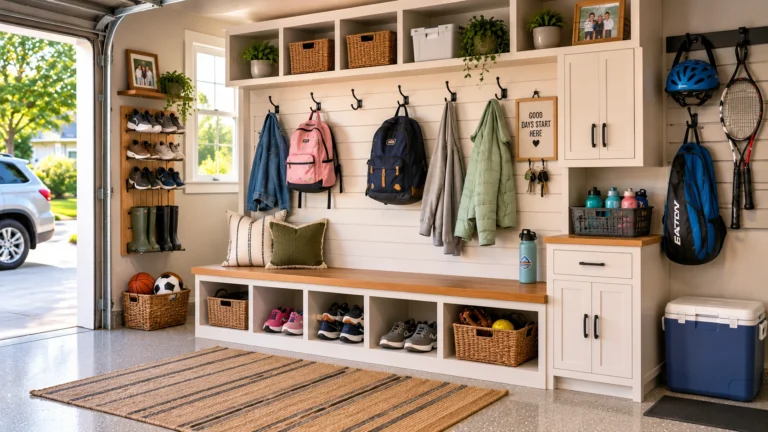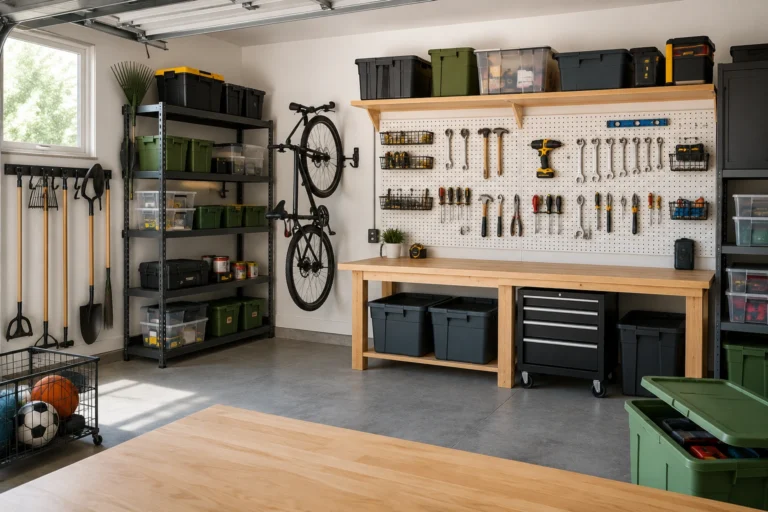
20 Garage Sports Equipment Storage Ideas for an Organized Home
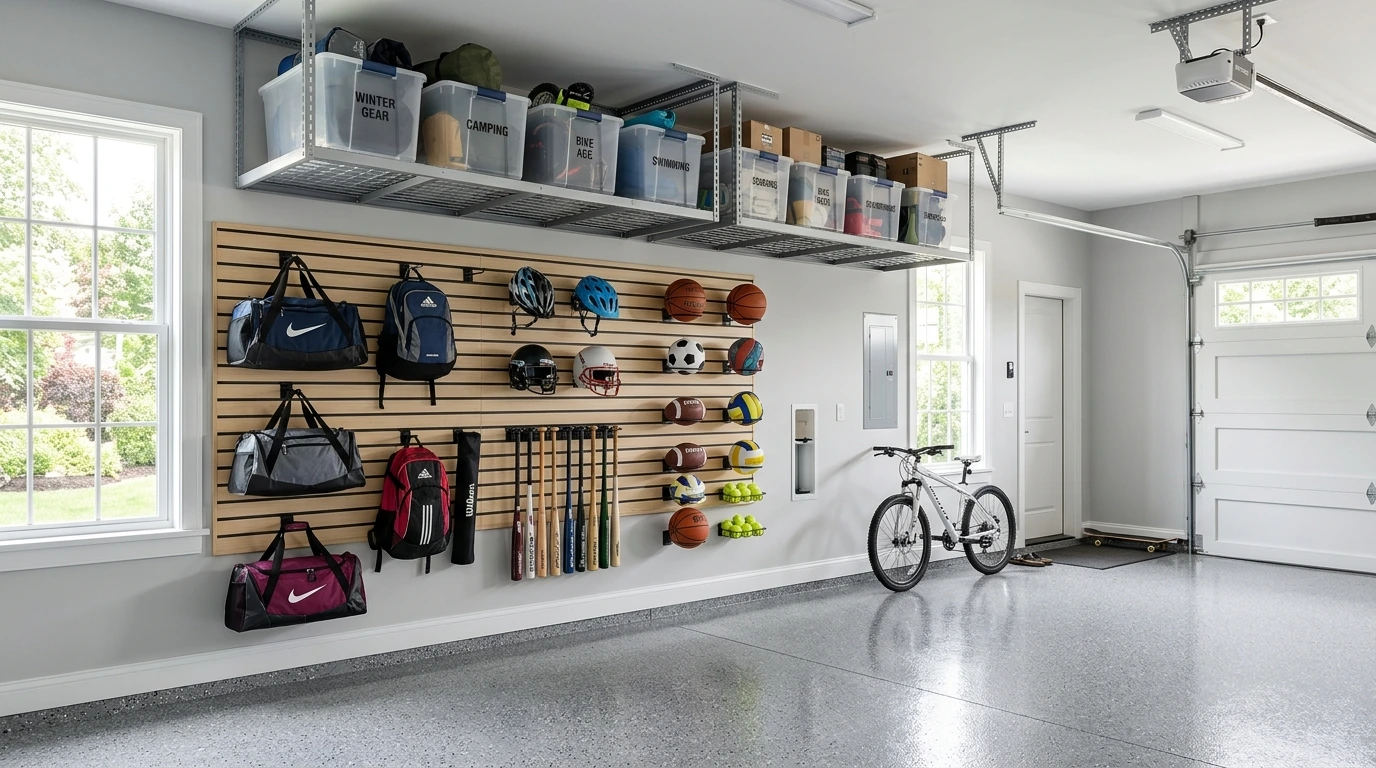
A basketball under the car, two bats leaning against the wall, helmets sitting on a shelf, and a bike blocking the walkway — sports equipment can turn an otherwise organized garage into clutter surprisingly fast.
The problem isn’t always a lack of storage. Sports gear comes in so many different shapes and sizes that one storage solution rarely works for everything.
The good news is that your garage walls, corners, shelves, ceiling, and unused vertical space can provide plenty of opportunities to get equipment off the floor.
The best garage sports equipment storage ideas aren’t simply about fitting more stuff into the garage. They’re about giving different types of equipment a logical home so you can grab what you need quickly and put it away just as easily.
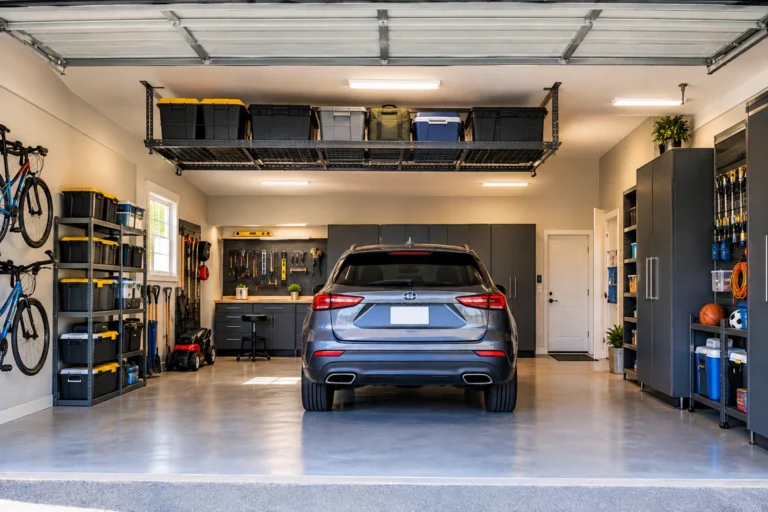
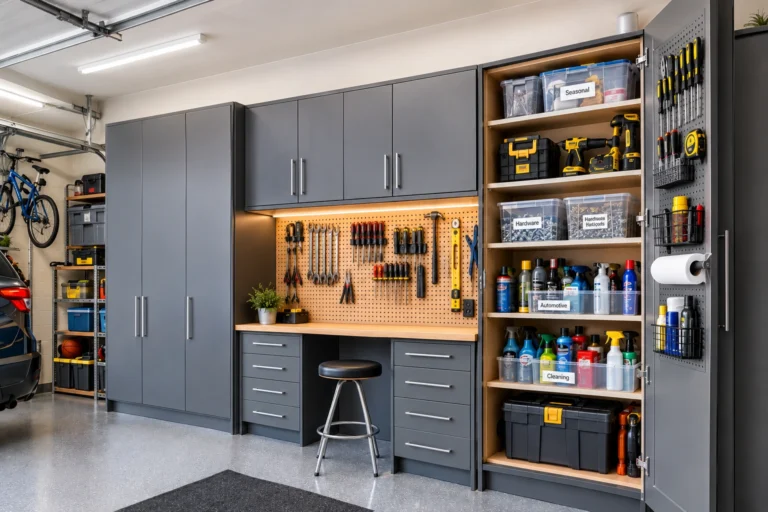
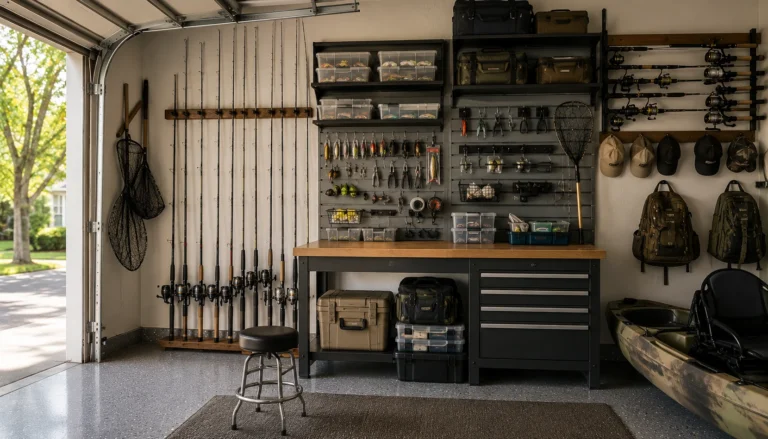
From ball racks and wall hooks to bike storage, drying zones, labeled bins, and flexible wall systems, here are 20 practical garage sports equipment storage ideas to organize sports equipment in your garage.
1. Create a Dedicated Sports Equipment Wall
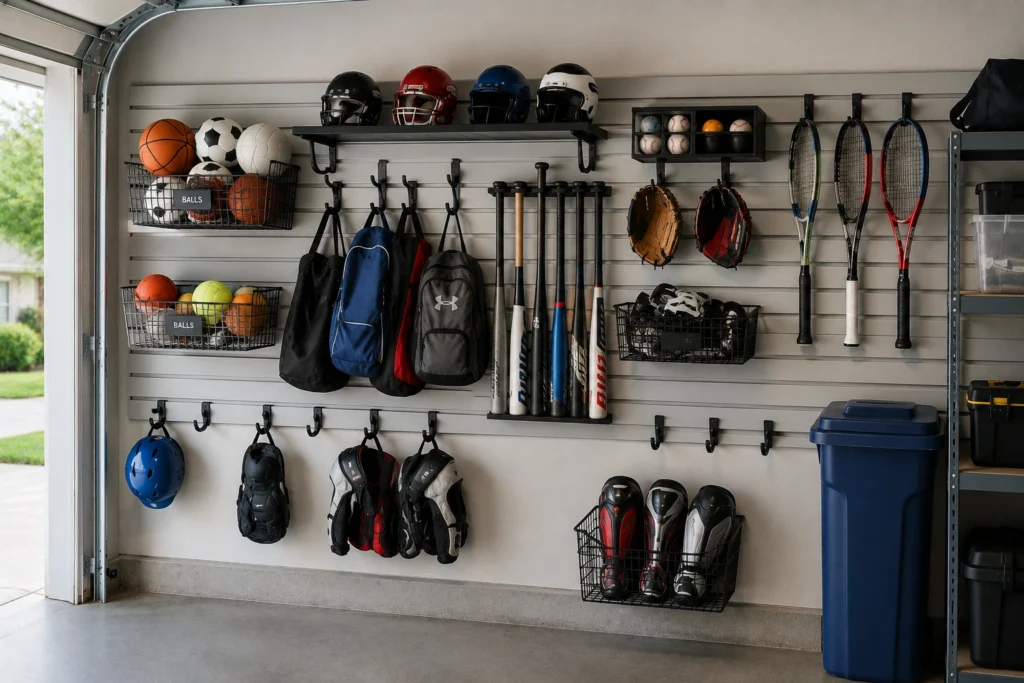
If sports gear is scattered throughout the garage, start by giving it one dedicated zone.
A section of wall can become the home for balls, helmets, bats, rackets, gloves, sports bags, and other frequently used equipment.
Instead of storing each item wherever space happens to be available, organize the wall around how your household actually uses its gear.
Wall-mounted hooks, baskets, shelves, racks, and rails can work together to create different storage areas without taking up much floor space.
Keep frequently used equipment between comfortable waist and shoulder heights. Seasonal or rarely used equipment can go higher.
Before mounting anything, measure the wall and consider nearby vehicles, doors, walking paths, electrical equipment, and garage-door clearance.
If you already use wall-mounted storage elsewhere in the garage, you can also combine ideas from our 15 Garage Wall Storage Ideas for a Clean and Organized Garage article to create a more complete storage zone.
2. Use a Ball Storage Rack
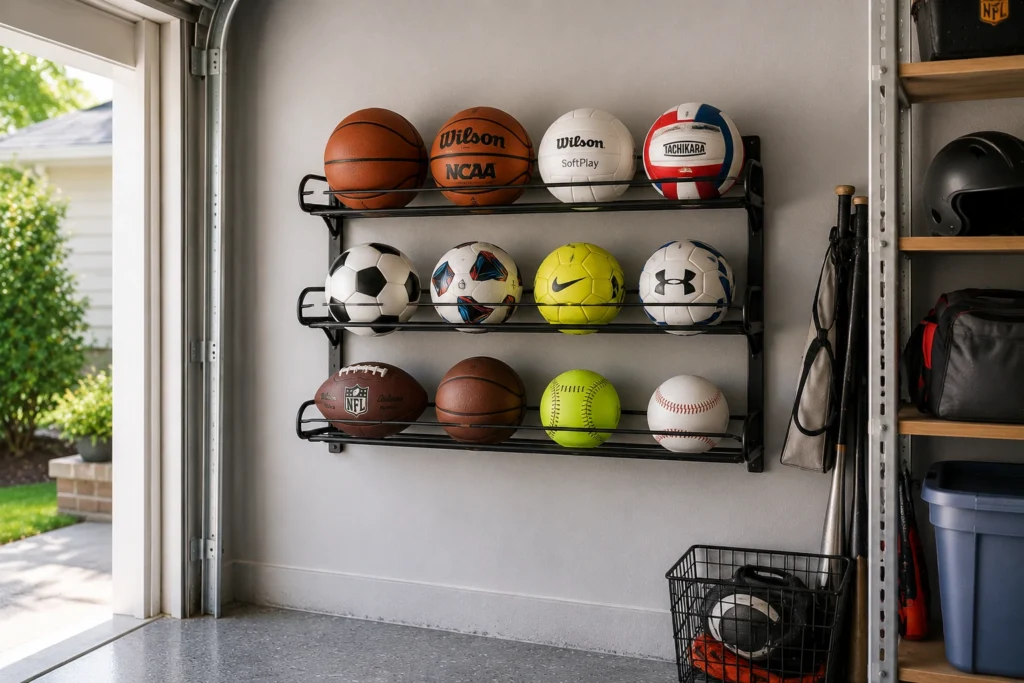
Balls are among the easiest pieces of sports equipment to lose control of.
Basketballs, soccer balls, footballs, volleyballs, and other inflated balls can roll into corners and underneath vehicles unless they have a defined storage spot.
A wall-mounted ball rack keeps them together while allowing you to see what you have.
Choose a rack with openings that fit the types of balls you actually own, and position it where children and adults can reach it safely.
If your household plays several sports, group the balls by activity instead of throwing everything into one large container.
For example:
- Basketballs together
- Soccer balls together
- Baseballs and softballs together
- Smaller training balls in a separate basket
A simple rule can make the system work:
Every ball goes back to its storage spot instead of onto the garage floor.
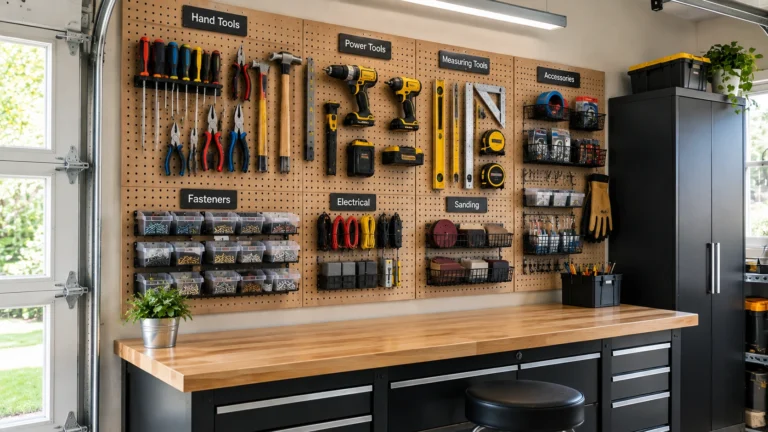
3. Install a Pegboard for Smaller Sports Gear
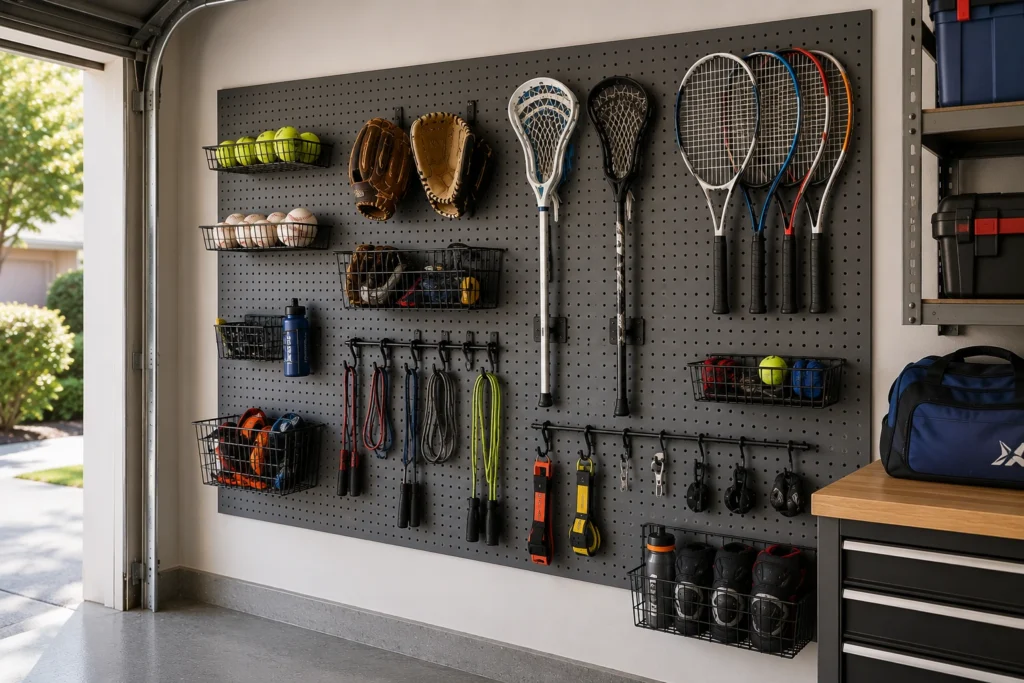
A pegboard is useful for sports equipment that doesn’t need an entire shelf.
Hooks and small baskets can hold baseball gloves, tennis rackets, pickleball paddles, jump ropes, whistles, training accessories, and lightweight protective gear.
The biggest advantage is flexibility.
As your equipment changes, hooks and accessories can be moved without rebuilding the entire storage area.
Keep heavier equipment on hardware designed and rated for the load, and avoid treating a basic pegboard as a solution for heavy items unless the entire system is properly supported.
A pegboard can also work particularly well if the same garage wall already stores tools, because sports accessories can occupy a separate section.
4. Store Bats and Rackets Vertically
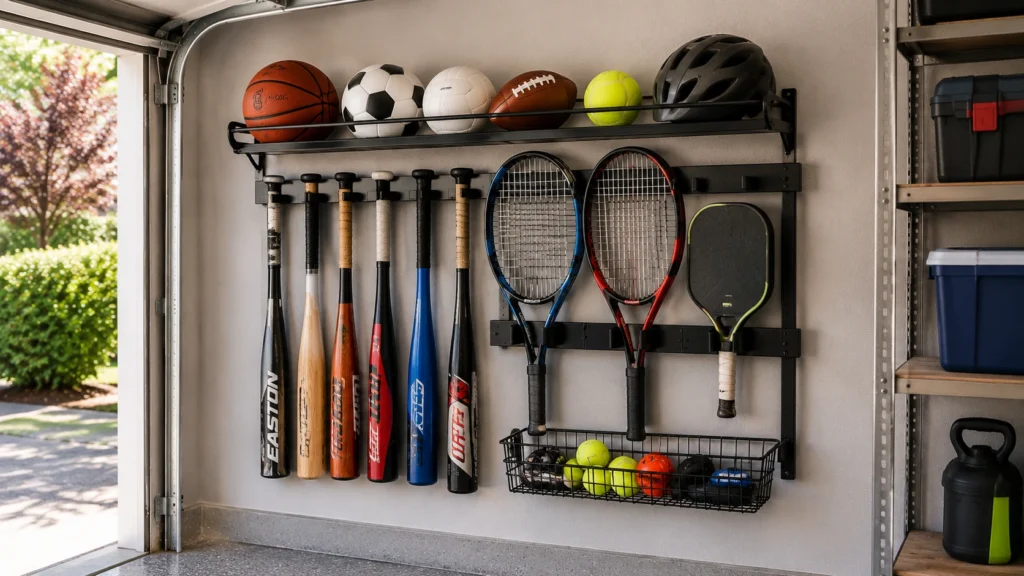
Long, narrow sports equipment doesn’t need much storage width, but it can become difficult to manage when left leaning against a wall.
Install dedicated holders or appropriately spaced hooks to keep baseball bats, softball bats, tennis rackets, pickleball paddles, and similar equipment upright.
Group similar equipment together so you don’t have to dig through a pile to find one racket or bat.
Vertical storage is especially useful in smaller garages because it uses wall height rather than valuable floor space.
Make sure the equipment doesn’t protrude into a walking route or create an obstacle beside a parked vehicle.
5. Hang Bicycles on the Wall
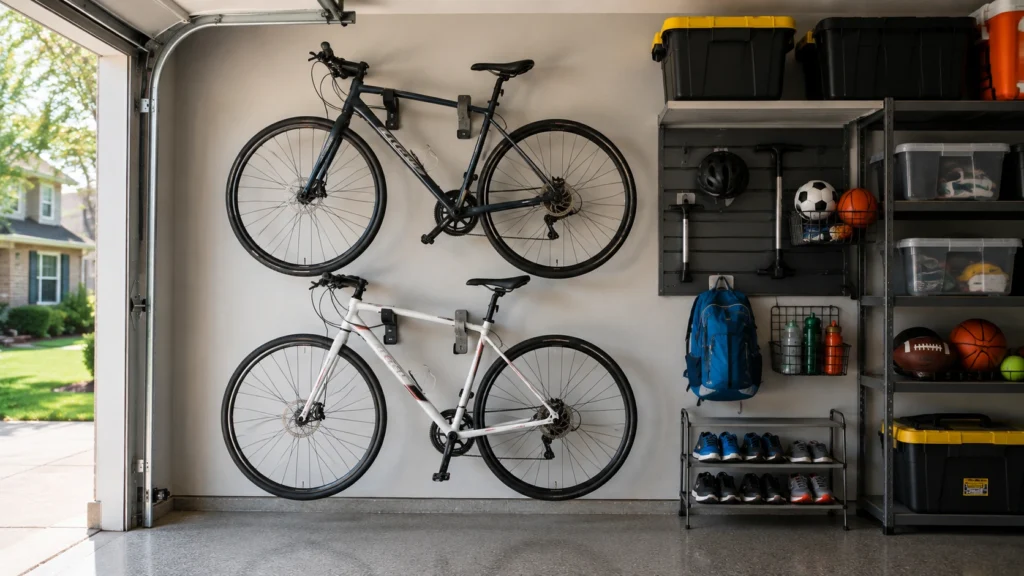
Bikes can consume a surprising amount of valuable garage floor space.
A properly rated wall-mounted bike rack or bike hook can move bicycles off the floor while keeping them accessible.
For everyday bikes, position the storage at a comfortable height and leave enough clearance to remove the bike without hitting a vehicle, garage door, or nearby equipment.
If you’re storing several bikes, plan their positions before installing the hardware.
Handlebar width, frame shape, pedals, and the direction in which each bike is mounted can affect how closely they can safely sit together.Also consider how often each bike is used. Frequently ridden bikes should be easier to access than bikes used only a few times a year.
6. Add a Sports Equipment Basket
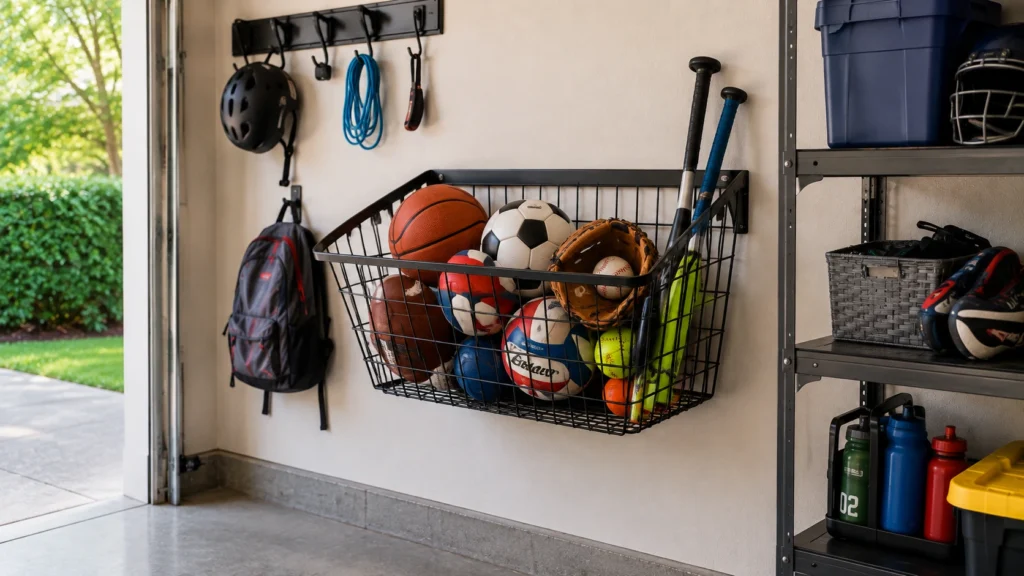
A large wire or heavy-duty basket can be useful for equipment that doesn’t have an obvious individual storage location.
Use it for frequently handled gear such as:
- Soccer balls
- Basketballs
- Helmets
- Gloves
- Training equipment
- Small protective gear
A wall-mounted basket is particularly convenient because equipment can be dropped back into it without requiring perfect organization.
But avoid turning one basket into a giant “everything sports” container.
Balls, helmets, shoes, wet gear, and small accessories mixed together can quickly create another clutter problem.
Instead, use separate baskets for different categories when necessary.
7. Use Wall Hooks for Helmets and Protective Gear
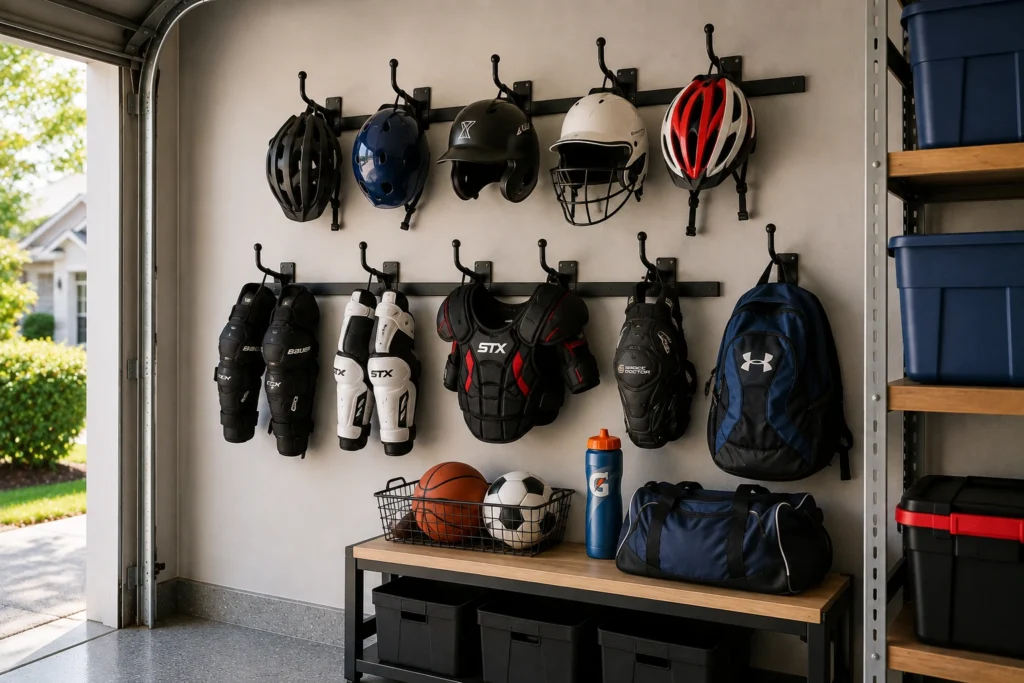
Helmets are bulky but relatively light, which makes them excellent candidates for wall hooks.
Install several hooks together and assign them by person, sport, or equipment type.
Cycling helmets, batting helmets, football helmets, and other protective equipment can each have a predictable location.
Hooks also allow airflow around equipment, which can be useful after use.
Choose hooks that won’t damage the equipment and mount them securely into a suitable wall surface.
If helmets are frequently used by children, position them at a height they can safely reach.
8. Build a Shelf for Seasonal Sports Bins
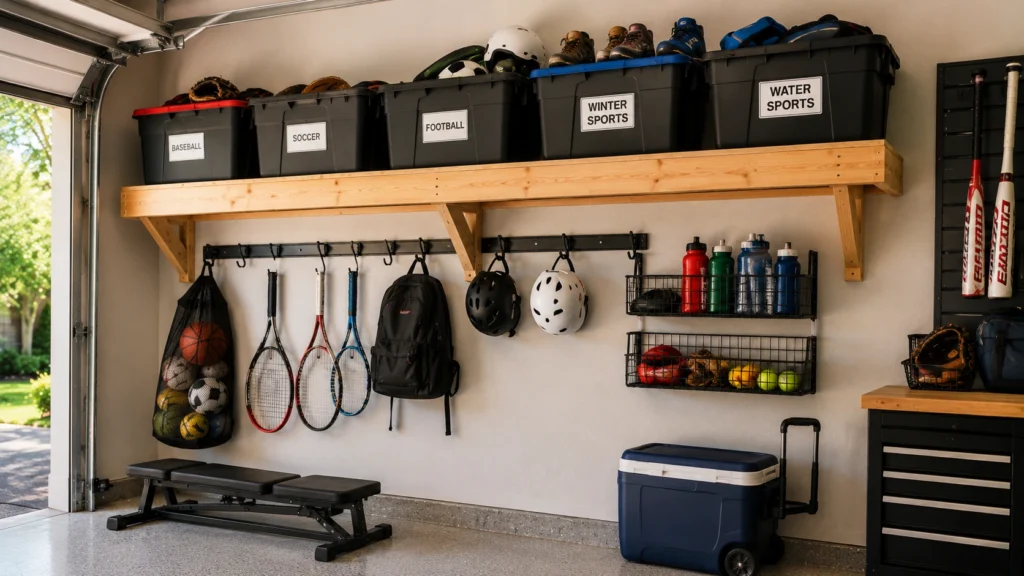
Not every piece of sports equipment needs to remain visible year-round.
For seasonal equipment, sturdy garage shelving combined with labeled storage bins can be a practical solution.
You could dedicate individual bins to:
- Baseball
- Winter sports
- Swimming
- Camping and outdoor games
- Holiday sports equipment
- Training accessories
Clear bins make contents easy to see, while matching opaque bins can create a cleaner appearance.
Whichever style you choose, use simple labels.
“Winter Sports” is much more useful than a vague label such as “Sports.”
Keep heavier bins on lower shelves whenever possible, and always respect the shelving system’s weight rating.
9. Create a Grab-and-Go Sports Zone Near the Garage Door
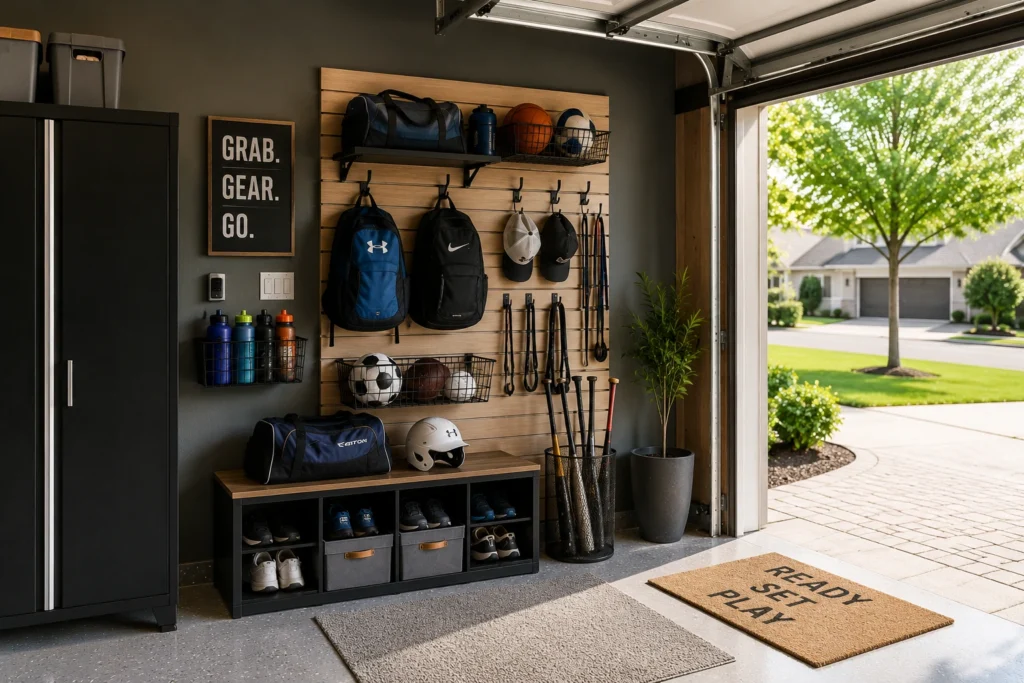
One of the easiest ways to make garage organization more practical is to store frequently used equipment near the point where it leaves the garage.
Create a grab-and-go zone close to the garage entrance for equipment such as:
- Sports bags
- Helmets
- Soccer balls
- Basketballs
- Shoes
- Bike accessories
- Frequently used outdoor gear
Use hooks, baskets, a narrow shelf, or a small rack to keep this equipment accessible.
This approach reduces the amount of walking and searching required before heading outside.
Less frequently used equipment can stay farther inside the garage or higher on shelves.
The goal is simple:
Store frequently used gear where you’re most likely to reach for it.
10. Use a Slatwall System for Changing Sports Gear
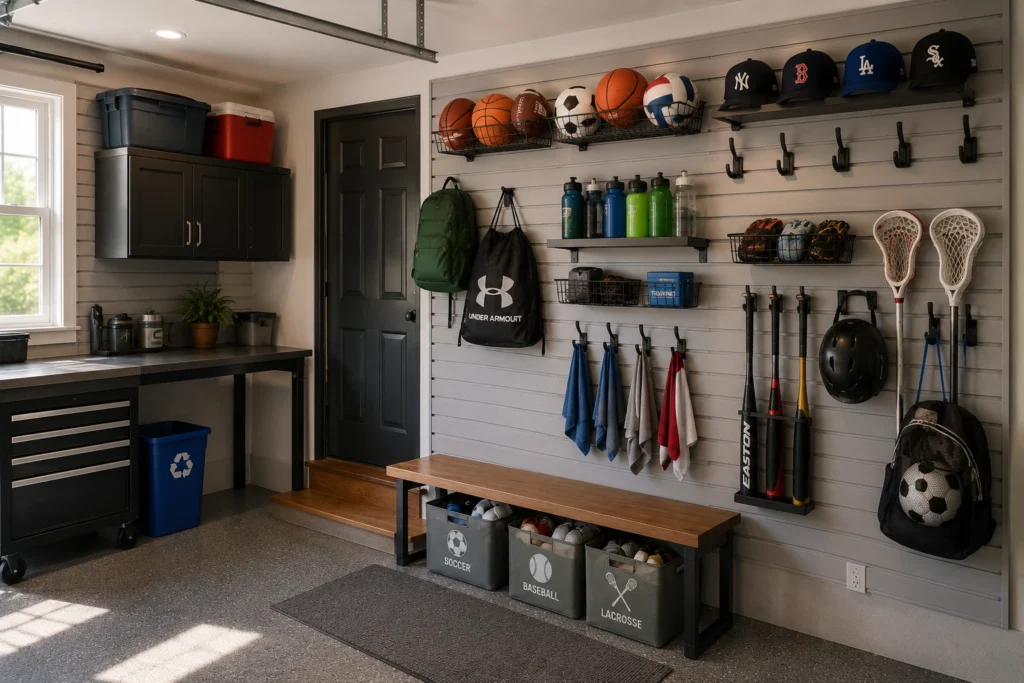
A slatwall system can be useful when your sports equipment collection changes throughout the year.
Hooks, baskets, shelves, and specialized accessories can be moved along the wall as your needs change.
This is particularly helpful for households that cycle between baseball, soccer, basketball, hockey, cycling, and other activities.
Instead of permanently dedicating one location to one type of equipment, you can reconfigure the wall when the season changes.
For example, baseball equipment can occupy the most accessible section during baseball season, while winter equipment can move into that space later in the year.
The flexibility is one of the biggest advantages of slatwall for long-term garage organization.
11. Create a Drying Zone for Wet Sports Gear
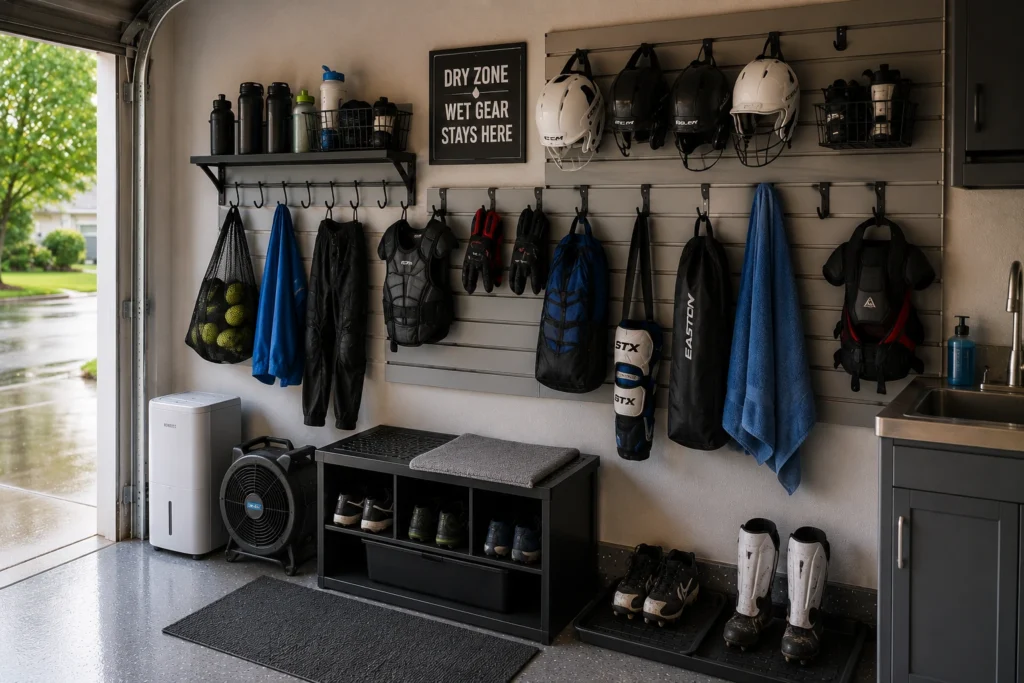
Sports equipment isn’t always clean and dry when it comes back into the garage.
Cleats, gloves, pads, helmets, swimsuits, outdoor gear, and other equipment can become unpleasant to store when they’re immediately sealed inside a closed bin.
Create an open drying zone using wall hooks, a ventilated rack, mesh baskets, or other storage that allows airflow.
Keep wet gear separated from dry equipment until it has had time to dry properly.
This area can be especially useful near the garage entrance so wet equipment has a designated place to go immediately after use.
Avoid turning the drying zone into permanent storage. Once equipment is dry, return it to its normal storage location.
12. Organize Golf Clubs and Accessories Together
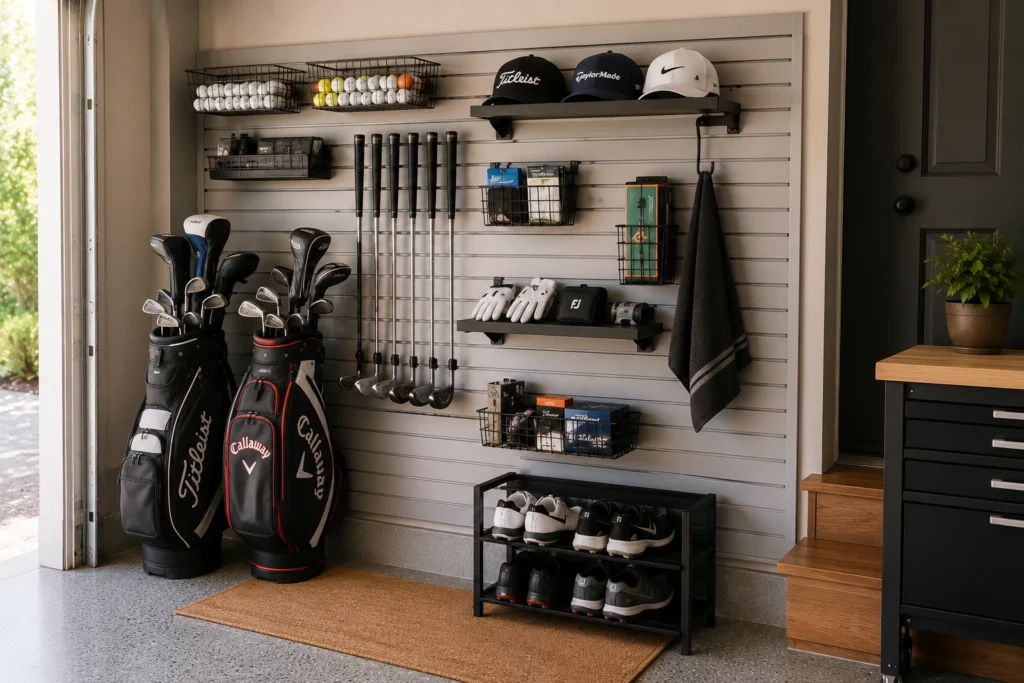
Golf equipment benefits from having a dedicated storage area.
A golf bag can stand vertically in a suitable corner or rack, while golf balls, gloves, tees, shoes, and other accessories can go into a nearby drawer, shelf, or labeled container.
Keeping everything together prevents small accessories from spreading across shelves and work surfaces.
If the garage becomes damp, avoid storing moisture-sensitive equipment directly against a cold or damp wall.
Good ventilation and an appropriate storage location can help protect equipment while keeping the area easier to manage.
13. Install a Narrow Rack for Hockey Sticks and Similar Gear
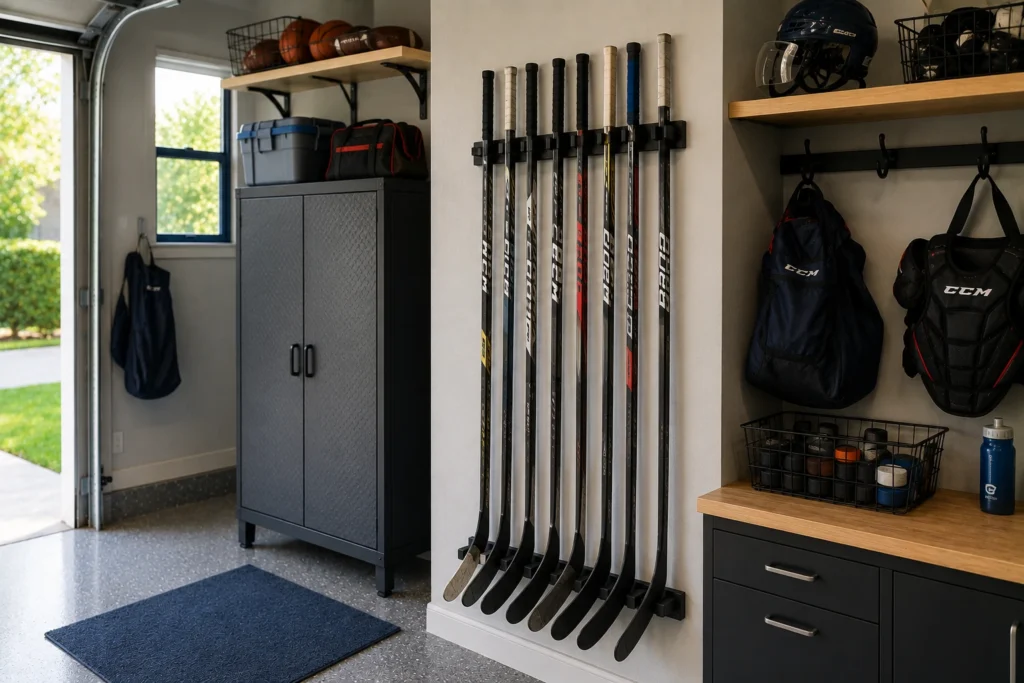
Long equipment such as hockey sticks, lacrosse sticks, field-hockey equipment, and similar gear can be difficult to store inside conventional bins.
A narrow vertical rack or series of wall-mounted holders can keep these items together without consuming much wall width.
Store similar equipment together and position the rack away from vehicle doors and major walking paths.
A dedicated holder also prevents long equipment from leaning across the garage and becoming a tripping hazard.
This is a good example of why sports equipment should be stored according to its shape rather than simply placing everything into generic containers.
14. Use Clear Bins for Small Sports Accessories
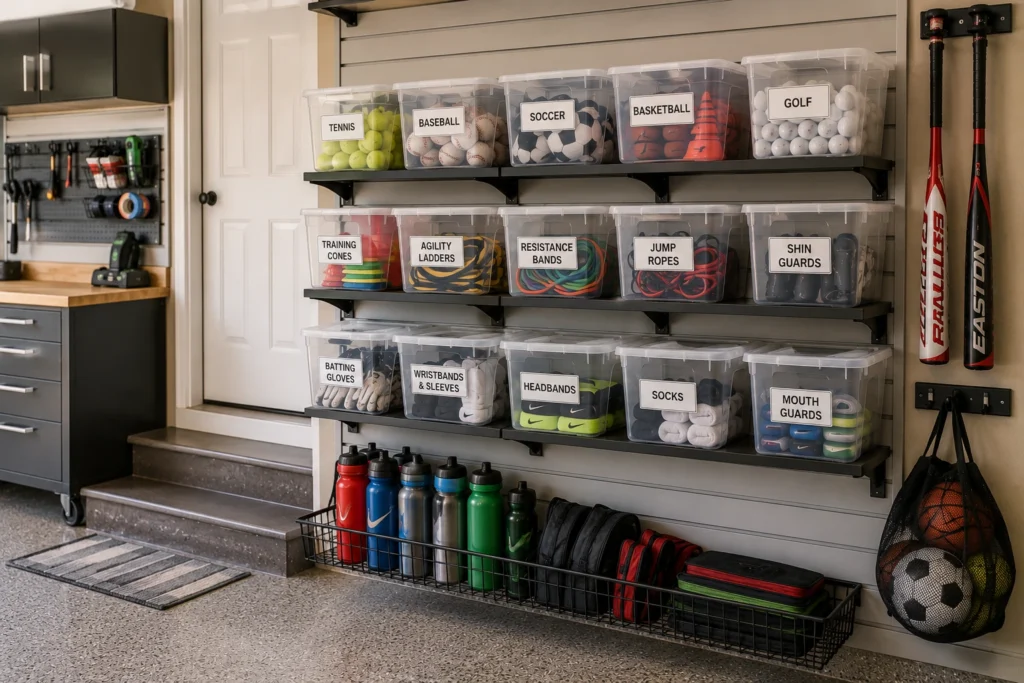
Small sports accessories are easy to lose when they’re scattered across shelves.
- Clear bins can hold:
- Tennis balls
- Baseballs
- Golf balls
- Resistance bands
- Jump ropes
- Training accessories
- Small protective equipment
- Game-specific accessories
Label each bin by sport or equipment type rather than using vague labels.
For example:
“Tennis & Pickleball”
is more useful than:
“Miscellaneous.”
If the bins are stored on a shelf, choose a size that can be pulled out comfortably without disturbing the containers around it.
15. Add an Equipment Rail With Hooks
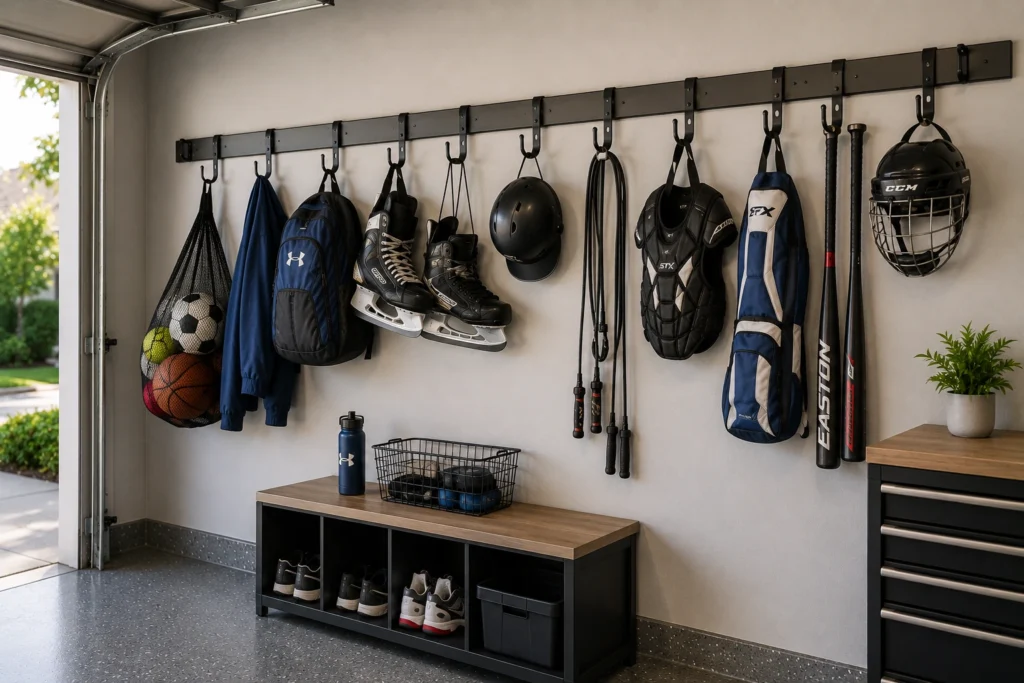
A wall-mounted rail with movable hooks can provide flexible storage without requiring a large modular system.
- Use individual hooks for:
- Helmets
- Gloves
- Sports bags
- Jump ropes
- Training equipment
- Lightweight protective gear
Because the hooks can often be repositioned, the arrangement can change as your equipment collection grows.
This makes a rail particularly useful for families whose storage needs change frequently.
Before loading the rail, check its mounting requirements and weight capacity and use hardware appropriate for your wall.
16. Create a Dedicated Sports Bag Station
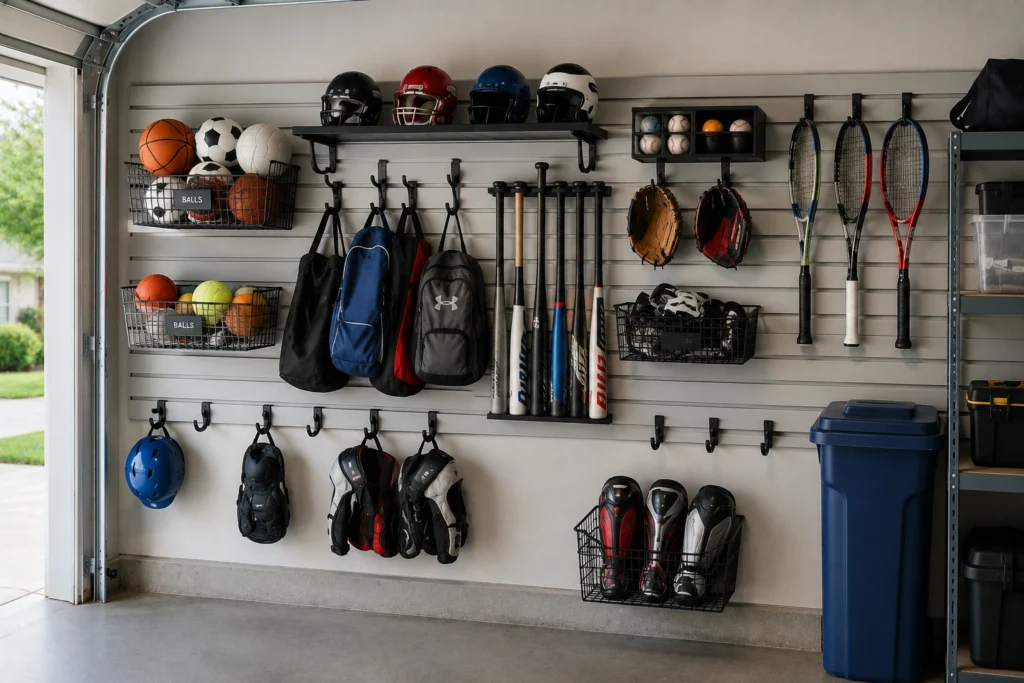
Sports bags have a habit of ending up on the floor, especially when everyone in the household participates in a different activity.
A row of sturdy wall hooks can create a simple sports-bag station.
Assign one hook to each person or sport and keep the bags off the floor.
Frequently used bags should stay at an accessible height, while less frequently used bags can go higher.
You can also install a narrow shelf above the hooks for water bottles, small accessories, or labeled containers.
This simple station can make a surprisingly noticeable difference in a busy family garage.
17. Combine Open Shelves With Hooks
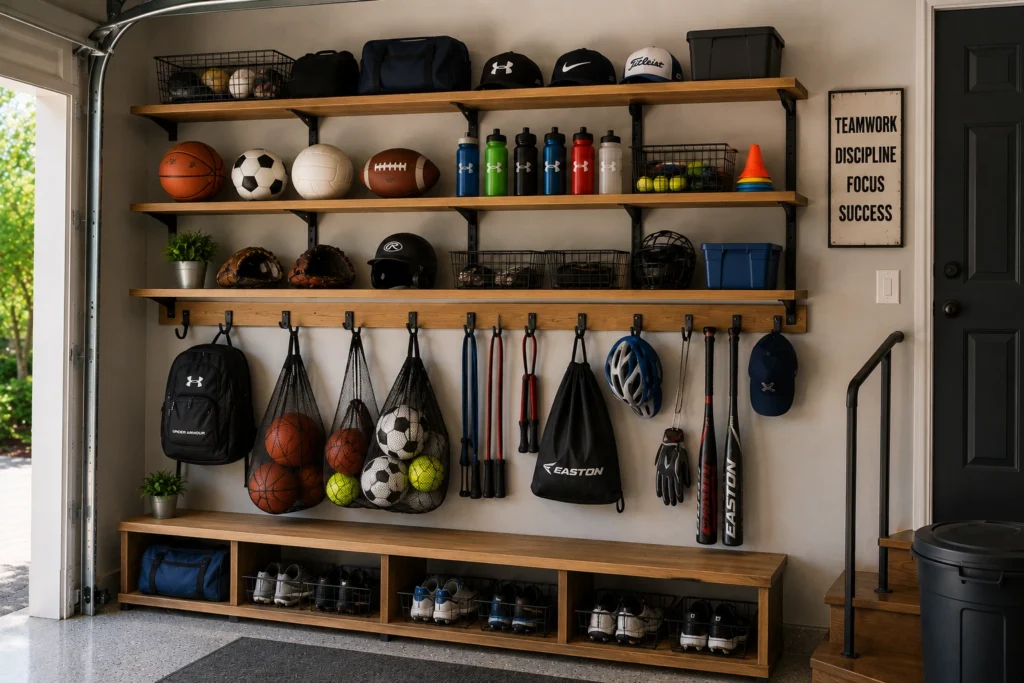
You don’t have to choose between shelving and hanging storage.
A combination system can use shelves for bins and bulky equipment while hooks underneath or beside them hold bags, helmets, gloves, and smaller gear.
This makes better use of vertical space because different parts of the wall perform different jobs.
For example:
Upper shelf: seasonal sports bins
Middle shelf: frequently used equipment
Hooks below: bags and helmets
Keep heavier objects on properly supported shelves and use hooks according to their intended load capacity.
18. Use the Garage Side Wall for Seasonal Gear
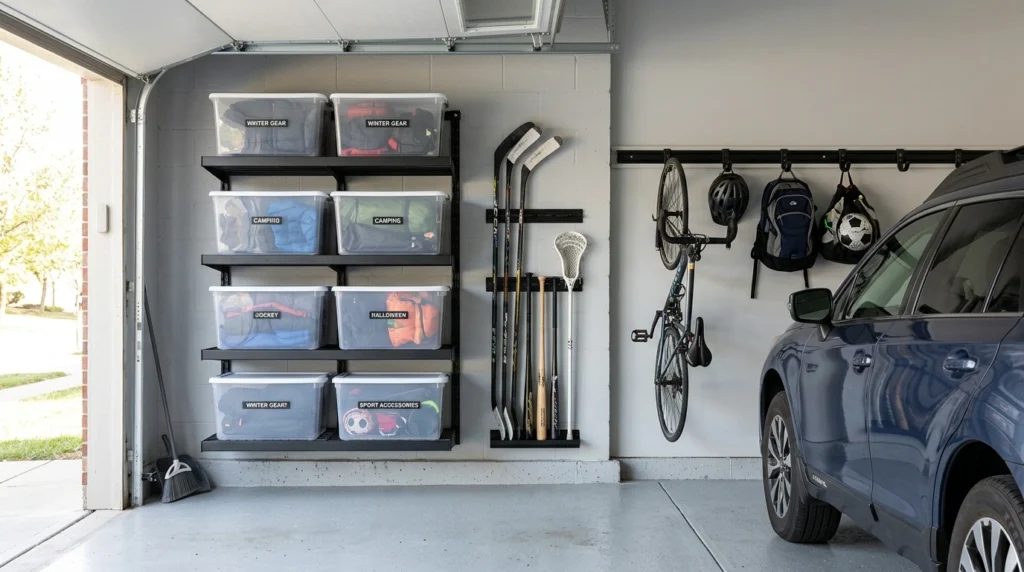
The side wall near the garage entrance can sometimes provide useful storage space that gets overlooked.
Depending on your layout, this area can hold seasonal sports equipment, bins, or a narrow vertical rack without taking over the main parking area.
Before installing anything, check:
- Garage door movement
- Vehicle clearance
- Walking paths
- Electrical equipment
- Safety mechanisms
- Door opening space
Storage should never interfere with the normal operation of the garage door or create an obstacle beside a parked vehicle.
19. Use Overhead Storage for Bulky Seasonal Sports Gear
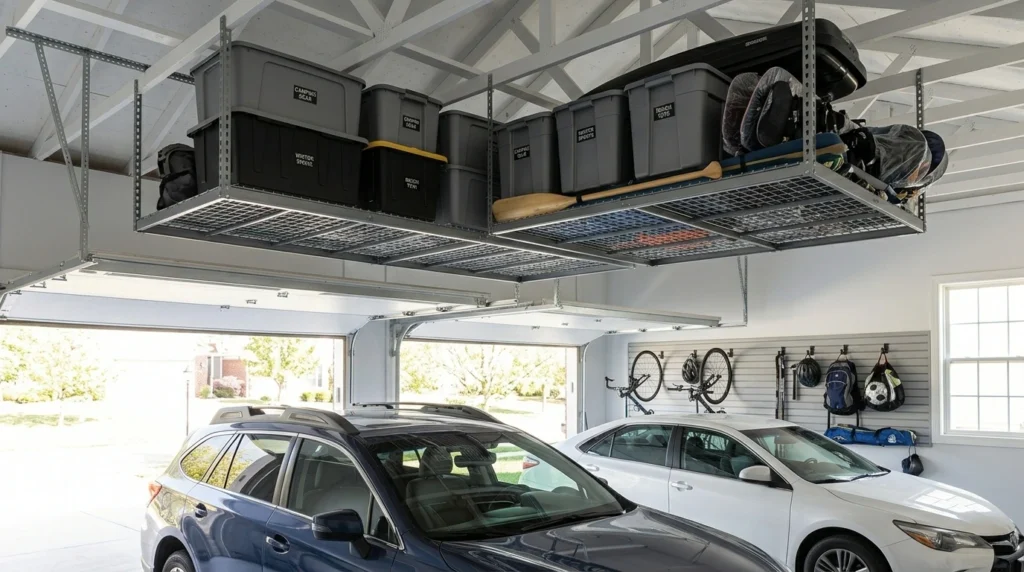
Some sports equipment takes up too much space to justify keeping it at eye level all year.
Overhead storage can be useful for bulky equipment that is used only occasionally, such as certain camping and outdoor recreation equipment, seasonal gear, or large equipment that doesn’t need frequent access.
The important part is safe installation.
Follow the storage system’s load rating and mounting requirements, and make sure the structure is attached to appropriate framing or support.
Don’t place extremely heavy or hazardous objects overhead simply because there is empty ceiling space.
Also consider how the stored equipment will be lowered safely when you eventually need it.
Overhead storage should create usable space, not create a new safety problem.
20. Build a Flexible Sports Storage Wall You Can Expand
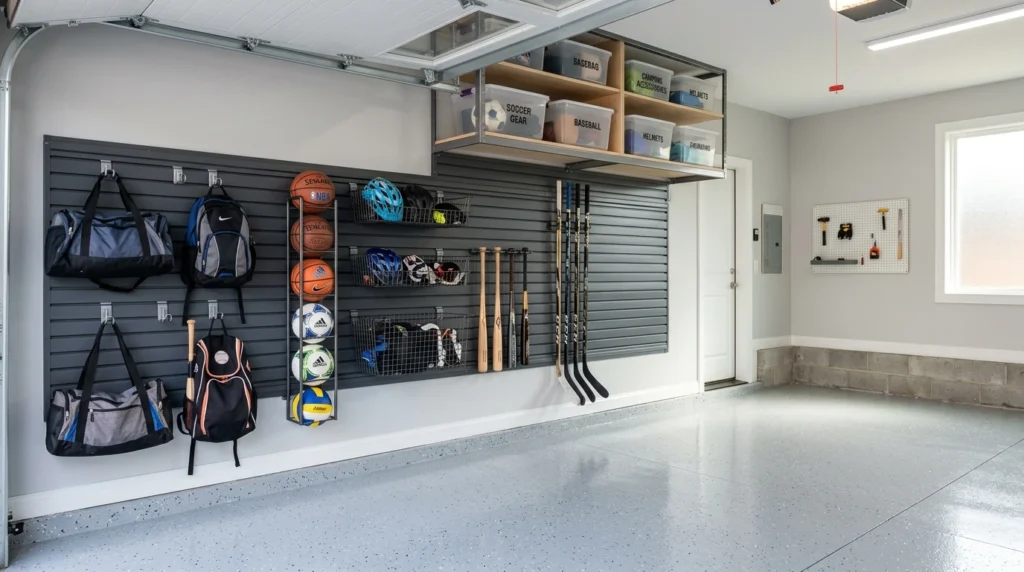
If your sports collection is likely to grow, build your storage system around flexibility rather than a fixed arrangement.
A combination of slatwall, shelving, hooks, baskets, racks, and bins can provide dedicated spaces for different equipment while leaving room for future additions.
Start with the equipment you actually own instead of trying to predict everything you’ll ever need.
Leave some wall space intentionally unused.
That empty space can become valuable when your household adds another sport, another bike, or a new type of equipment.
A flexible system is often more practical in the long run than filling every available inch on day one.
Don’t Put Every Sport in One Giant Bin
A large container may look like an easy solution, but mixing every type of sports equipment together can make organization harder.
Imagine opening one bin and finding:
- Basketballs
- Baseball gloves
- Helmets
- Cleats
- Rackets
- Training accessories
You may technically have everything stored, but finding one item becomes a chore.
Instead, organize equipment by category or action.
For example:
Balls → ball rack or basket
Bats & sticks → vertical rack
Helmets → hooks
Sports bags → hook station
Small accessories → labeled bins
Seasonal gear → shelves or overhead storage
Wet gear → drying zone
The best storage system is the one that makes the correct place obvious.
How to Choose the Right Garage Sports Equipment Storage Ideas
The best garage sports equipment storage ideas depend less on how much equipment you own and more on how you use it.
Start by grouping your equipment by type and frequency of use.
Items used every week should be easy to grab. Seasonal equipment can go into labeled bins, higher shelves, or appropriate overhead storage.
Then look at your available wall space.
If you have a wide open wall, shelving or a modular wall system may make sense. If space is limited, vertical racks, hooks, rails, and narrow organizers can provide useful capacity without sacrificing valuable floor space.
Pay attention to the wall itself, too.
Garage walls may be drywall, wood-framed, concrete, or another material. Storage hardware needs to match the wall construction and the weight of the equipment being stored.
Weight matters just as much as available space.
A lightweight basket and a shelf loaded with sports equipment have very different mounting requirements. Always follow the storage system’s weight rating and use hardware appropriate for the specific wall.
Also think about vehicle clearance.
Open your vehicle doors before finalizing storage positions. A rack that looks perfect when the garage is empty may become inconvenient when a car is parked.
Most importantly, don’t organize around what looks good in an empty garage.
Organize around what your household actually reaches for.
Which Garage Sports Storage Idea Should You Start With?
If you’re not sure which storage solution makes sense for your garage, start with the problem rather than the product.
| Garage problem | Storage solution to consider |
| Balls rolling across the floor | Ball rack or open basket |
| Bikes taking up floor space | Wall-mounted bike storage |
| Bats and rackets falling over | Vertical rack or holders |
| Helmets and bags piling up | Wall hooks |
| Seasonal equipment creating clutter | Labeled bins and shelving |
| Wet equipment after practice | Open drying zone |
| Bulky seasonal gear | Appropriate overhead storage |
| Mixed equipment with changing needs | Modular wall or slatwall |
| Narrow unused wall space | Rail, hooks, or slim rack |
| Kids leaving equipment on the floor | Low, accessible sports zone |
This simple approach can prevent you from buying storage before you understand what problem you’re actually trying to solve.
Safety Tips for Garage Sports Equipment Storage
Good organization should make a garage easier to use without creating new hazards.
Before installing any rack, shelf, hook, or wall system:
- Check the manufacturer’s weight rating.
- Use mounting hardware appropriate for your wall type.
- Secure heavy storage to suitable structural support.
- Keep walkways clear.
- Check vehicle-door clearance.
- Avoid blocking garage-door tracks or safety equipment.
- Keep frequently used equipment at safe, comfortable heights.
- Store heavy items lower whenever practical.
- Make sure overhead storage is securely mounted.
- Don’t place hazardous or excessively heavy items overhead.
- Keep wet equipment separated from dry storage until it has dried.
- Follow the manufacturer’s installation instructions for specialized racks and storage systems.
A storage solution isn’t successful if it saves floor space but makes the garage harder or less safe to use.
FAQ
What is the best way to store sports equipment in a garage?
The best approach is usually a combination of storage methods. Use racks for balls and long equipment, hooks for bags and helmets, shelves for bins, and dedicated areas for frequently used gear.
Different equipment benefits from different storage solutions, so you don’t need to force everything into one system.
How do I keep sports equipment off the garage floor?
Wall-mounted hooks, racks, baskets, shelving, rails, and modular storage systems can move sports equipment vertically.
Start with the bulky items that take up the most floor space, such as bikes, ball collections, sports bags, and long equipment.
How should I organize sports equipment for kids?
Keep frequently used equipment at a height children can safely reach.
Open baskets, low hooks, simple racks, and clearly defined storage zones make it easier for kids to put equipment away without creating another pile.
Heavier equipment and anything requiring adult supervision should be stored appropriately.
Is slatwall good for garage sports equipment?
Slatwall can be useful when your storage needs change frequently.
Hooks, shelves, baskets, and other accessories can be repositioned, making the system adaptable to different sports and seasons.
It’s particularly useful when one garage needs to accommodate several types of equipment over the course of a year.
How do I store sports equipment that I only use seasonally?
Use labeled bins, higher shelving, or suitable overhead storage for seasonal equipment.
Keep the sports currently in use in the easiest-to-reach areas and rotate equipment as seasons change.
A predictable rotation system can reduce clutter without requiring more storage space.
How do I organize sports equipment in a small garage?
Start with vertical space.
Wall-mounted racks, hooks, pegboards, narrow shelving, rails, and other vertical storage solutions can move equipment off the floor without requiring a larger garage footprint.
Keep frequently used items accessible and reserve higher areas for seasonal or less frequently used gear.
Should sports equipment be stored in bins or on open racks?
It depends on the equipment.
Open racks and hooks are generally more convenient for items you use frequently, while labeled bins can work well for small accessories and seasonal equipment.
Wet gear should generally have an opportunity to dry before being sealed inside a closed container.
How much wall space should I dedicate to sports equipment?
There isn’t a fixed amount.
Start by measuring the equipment you actually own and grouping it by category and frequency of use.
Leave some room for future additions rather than filling every available inch immediately.
Conclusion
A garage doesn’t necessarily need more square footage to become more organized.
Often, the biggest opportunity is already there: the walls, corners, vertical space, and unused areas above the floor.
The best garage sports equipment storage ideas don’t rely on one universal solution.
Balls can live on racks or in accessible baskets. Bats and sticks can go into vertical holders. Helmets and bags work well on hooks. Bikes can move onto properly installed wall racks. Seasonal equipment can go into labeled bins or appropriate overhead storage, while wet gear benefits from an open drying zone.
The key is matching the storage method to the equipment.
Start with the gear that creates the most clutter. Give frequently used equipment an easy-to-reach location, move seasonal items into less prominent storage, and leave some space for your system to grow.
A well-organized garage isn’t one where every inch is filled.
It’s one where everything has a logical place — and putting it back there is easy.