18 Small Garage Storage Ideas for Tight Spaces That Actually Work
Affiliate Disclosure: This article contains affiliate links. If you purchase through one of these links, we may earn a commission at no additional cost to you. As an Amazon Associate I earn from qualifying purchases.
Table of Contents
A small garage doesn’t always have a storage problem. It has a space-allocation problem. When you’re trying to park a vehicle, walk comfortably, store tools, keep bikes accessible, and still have room for seasonal items, simply adding more shelves isn’t enough.
The goal is to make better use of the space you already have. That means looking beyond the garage floor and paying attention to overlooked areas such as the wall above a workbench, narrow strips beside doors, inside cabinet doors, corners, upper wall sections, and the space above the garage door.
The best small garage storage ideas don’t just create more places to put things. They make the garage easier to walk through, easier to work in, and easier to use every day.
Below are 18 practical ideas for getting useful storage into a genuinely tight garage without sacrificing the space you need for parking and movement.
Quick Answer: Start With These 5 Small-Garage Storage Moves
If you don’t want to redesign the entire garage, start with these five changes:
- Move frequently used tools and equipment onto the walls instead of keeping them on the floor or workbench.
- Use tall, narrow storage where wall width is limited.
- Move seasonal and rarely used items overhead to preserve the easiest-to-reach storage areas.
- Store bikes, garden tools, and other long items vertically when floor space is limited.
- Keep the center of the garage open whenever possible so parking, walking, and working remain comfortable.
The important idea is simple: use the perimeter and vertical space first, then consider the floor.
Before Adding Storage, Measure These 5 Things
Buying an organizer before measuring the space is one of the easiest ways to make a small garage feel even smaller. Before choosing shelves, cabinets, racks, or hooks, check:
1. Available wall width
Measure the actual section of wall where the storage will go. Don’t assume an entire wall is usable.
2. Storage depth
A shelf that sticks too far into the garage can take away valuable walking or vehicle clearance.
3. Garage-door movement
Check the path of the garage door, tracks, opener, and any moving components before installing overhead or high wall storage.
4. Vehicle and door clearance
Think about more than whether the car technically fits.
Can you open the vehicle doors comfortably? Can you walk around the vehicle? Can you reach the storage without constantly moving the car?
5. Walking and working clearance
If the garage doubles as a workshop, entryway, hobby area, or equipment-storage space, leave enough room for normal movement.
Think in Clearance, Not Just Storage
In a tight garage, every inch of storage depth takes space away from something else.
A larger cabinet may technically hold more, but that doesn’t automatically make it the better choice.
Before installing storage, ask:
- Can you open the vehicle door comfortably?
- Can you walk past the storage without squeezing through?
- Can the garage door operate normally?
- Can you reach frequently used items easily?
- Will the setup still work if you add another bike, tool, or storage bin later?
The best storage solution isn’t necessarily the one that holds the most. It’s the one that adds useful capacity without creating a new clearance problem.
18 Small Garage Storage Ideas
1. Install Wall-Mounted Shelves Instead of Floor Shelving
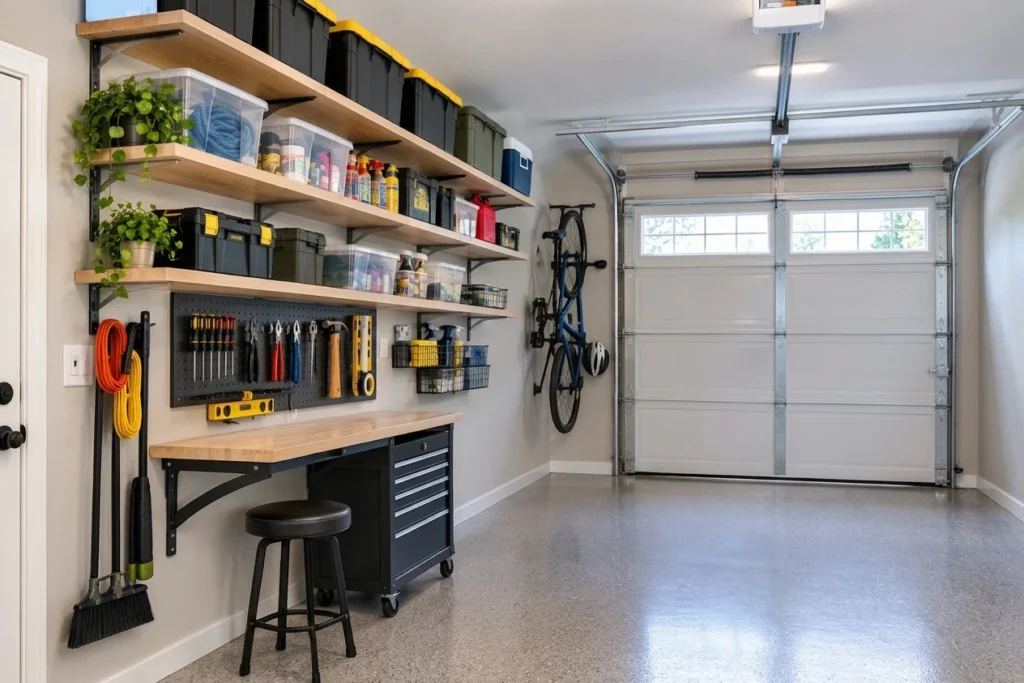
When floor space is limited, move storage upward. Wall-mounted shelves can hold bins, tools, household supplies, automotive products, and other garage items without occupying the footprint of a traditional floor shelving unit.
Use the wall space above areas that already need to remain open, such as a workbench or a section of floor used for parking. For heavier items, use properly rated brackets and mounting hardware suitable for your wall surface.
Best for: Small garages with usable wall space but limited floor area.
Space-saving advantage: Storage moves upward while keeping the floor available for vehicles and movement.
Wall-mounted shelves are a practical way to reclaim floor space, especially when bins and supplies are taking over a small garage. For more ways to use your available wall space, explore these garage wall storage ideas.
A useful option to consider is heavy-duty garage shelf brackets when building or installing wall-mounted shelving. Look for brackets with an appropriate load rating and mounting system for your wall.
Trade-off: Wall shelves save floor space, but they still require sufficient wall width and proper mounting.
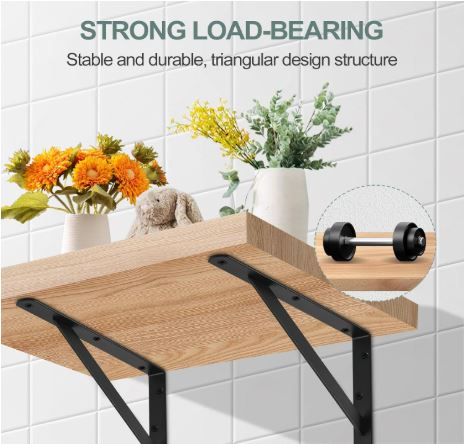
Heavy-duty shelf brackets can help support a wall-mounted shelving setup for garage bins, supplies, and everyday equipment. Choose brackets rated for your intended load, and make sure the shelf, fasteners, and wall structure are suitable for the weight. [#CommissionEarned]
View on Amazon →
2. Choose a Tall, Narrow Shelving Unit
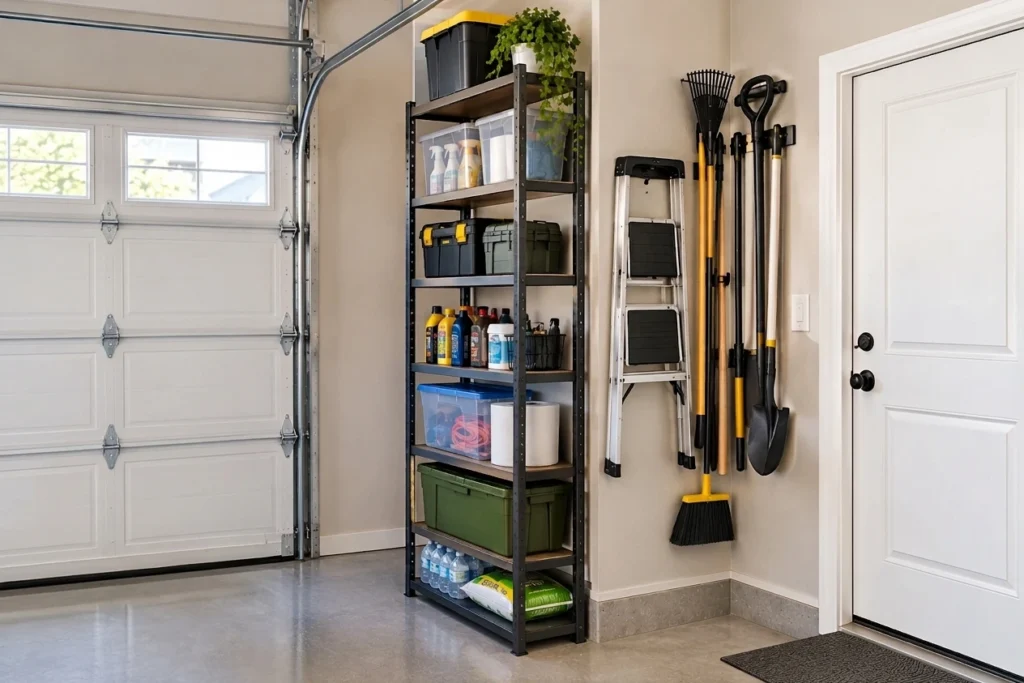
A wide shelving unit may provide more storage, but a tall and narrow unit can be much more practical when wall space is limited.
Use vertical shelving for containers, tools, cleaning supplies, seasonal items, or other belongings that don’t need a large footprint.
Place frequently used items between comfortable reach levels and reserve higher shelves for less frequently accessed belongings.
Best for: Narrow garages or unused vertical wall sections.
Space-saving advantage: You gain multiple storage levels without spreading storage across the floor.
Consider a narrow garage storage shelving unit when the available footprint is limited.
Trade-off: Narrow shelving uses less floor width, but it may require better category organization because each shelf has less horizontal space.
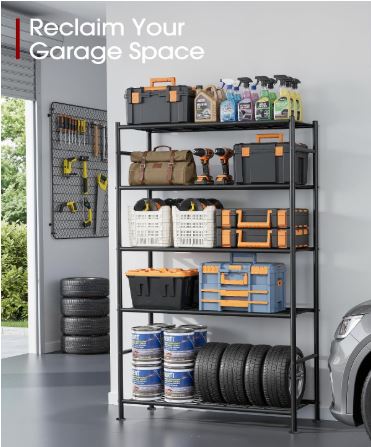
A tall, narrow shelving unit can organize storage bins, cleaning supplies, and garage essentials in a compact footprint. Compare its dimensions, shelf spacing, stability, and weight capacity with the items you plan to store. [#CommissionEarned]
Buy on Amazon →
3. Turn an Unused Corner Into Storage
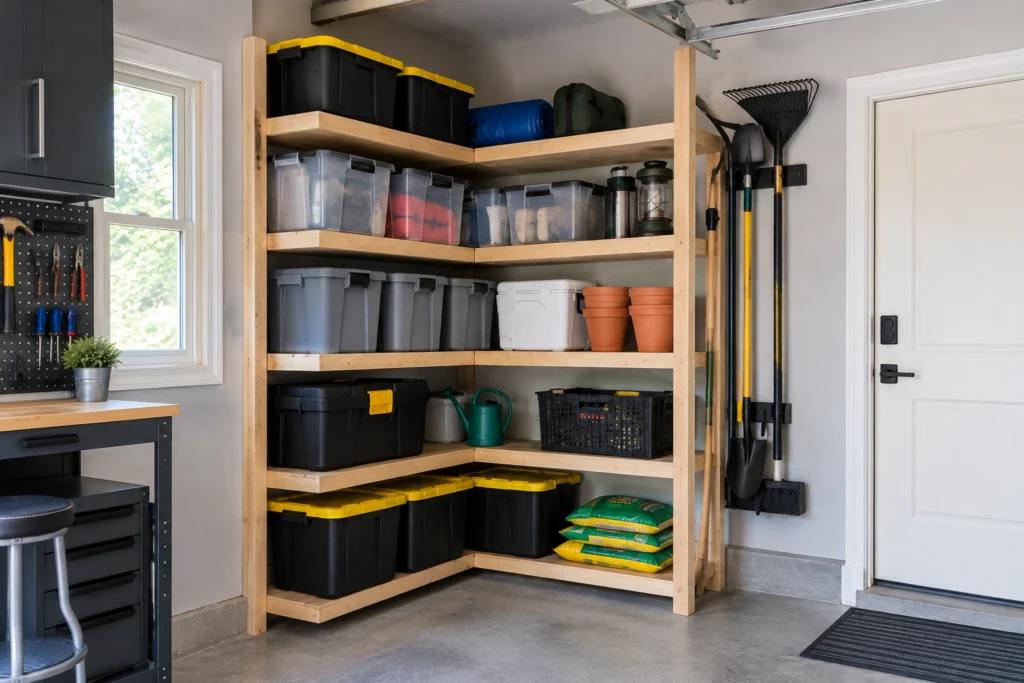
Garage corners are easy to overlook because they’re often awkward to access.
Instead of leaving one empty or allowing boxes to accumulate there, use a compact corner shelving system or purpose-built corner storage.
Corners work particularly well for items that don’t need to be accessed every day.
Best for: Dead corners and awkward unused spaces.
Space-saving advantage: A previously wasted area becomes useful storage without extending far into the main garage.
A compact corner garage shelving unit can be useful when the corner has enough depth and clearance.
Trade-off: Corner storage can reclaim wasted space, but very deep corner shelving may make items difficult to reach.
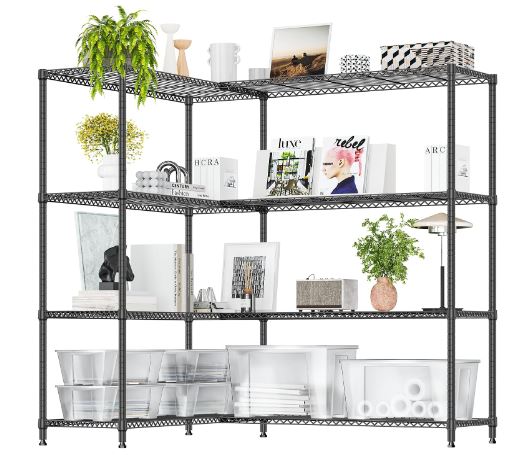
Compact corner shelving can make an awkward garage corner more useful for smaller bins, supplies, and items that don’t need to be accessed constantly. Check the unit’s footprint and depth so it doesn’t interfere with walking paths or vehicle clearance. [#CommissionEarned]
Order on Amazon →
4. Create a Dedicated Pegboard Tool Wall

If tools regularly end up scattered across your workbench, a pegboard can turn a small section of wall into an accessible tool zone.
Use it for hand tools and lightweight accessories that benefit from being visible.
You don’t need to cover an entire wall. Even a compact pegboard above or beside a workbench can make a meaningful difference.
Best for: Hand tools and frequently used workshop accessories.
Space-saving advantage: Tools move from drawers, shelves, and work surfaces onto vertical wall space.
A pegboard hook and accessory kit can make it easier to create different storage positions as your tool collection changes.
For more ways to arrange hand tools, accessories, and small workshop essentials, explore these garage pegboard ideas.
Trade-off: Pegboard is excellent for visible, accessible tools, but it isn’t the right place for every heavy or bulky item.
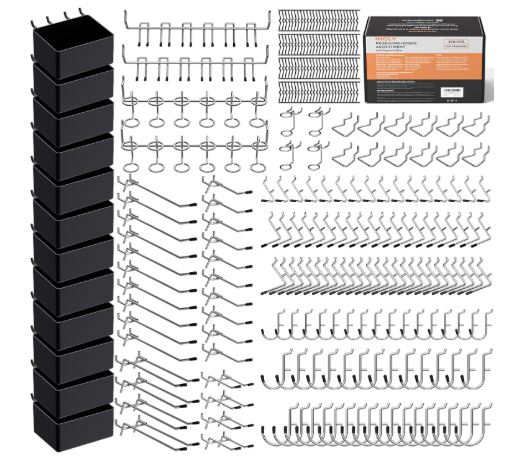
A compatible pegboard hook and accessory kit can give screwdrivers, pliers, measuring tools, and other lightweight hand tools designated storage positions. Check that the hooks fit your pegboard and are suitable for the tools you intend to hang. [#CommissionEarned]
View on Amazon →
5. Install a Shallow Wall-Mounted Garage Cabinet
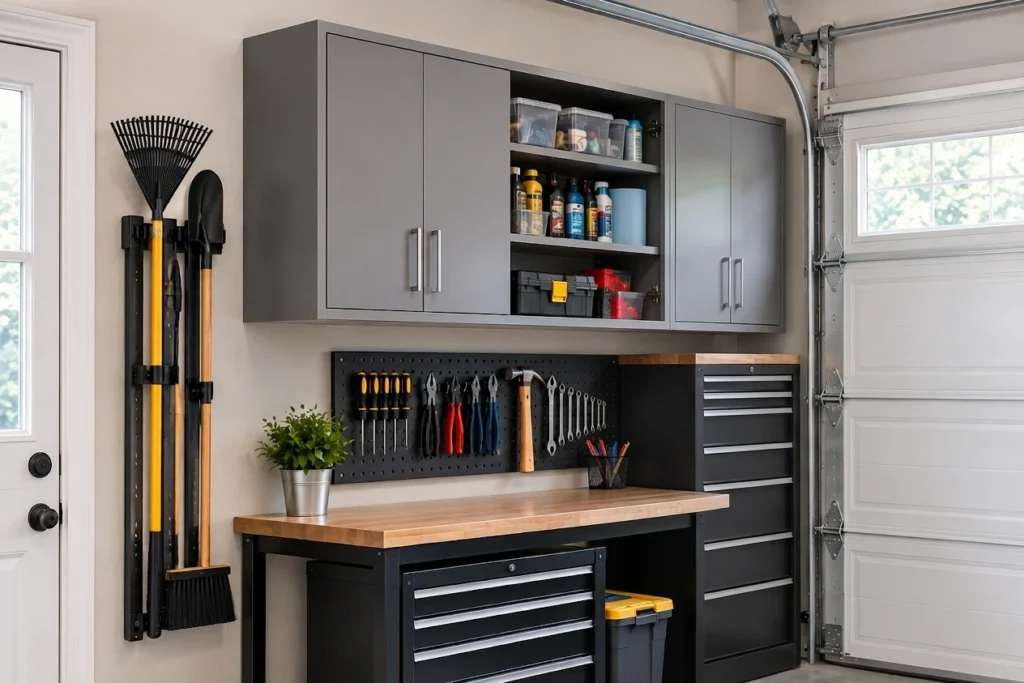
Closed cabinets are useful when you want the garage to look less cluttered. In a tight garage, however, cabinet depth matters.
A shallow wall-mounted cabinet can provide enclosed storage without extending as far into the garage as a deeper cabinet.
Use it for smaller tools, supplies, household items, or belongings that you don’t need to see constantly.
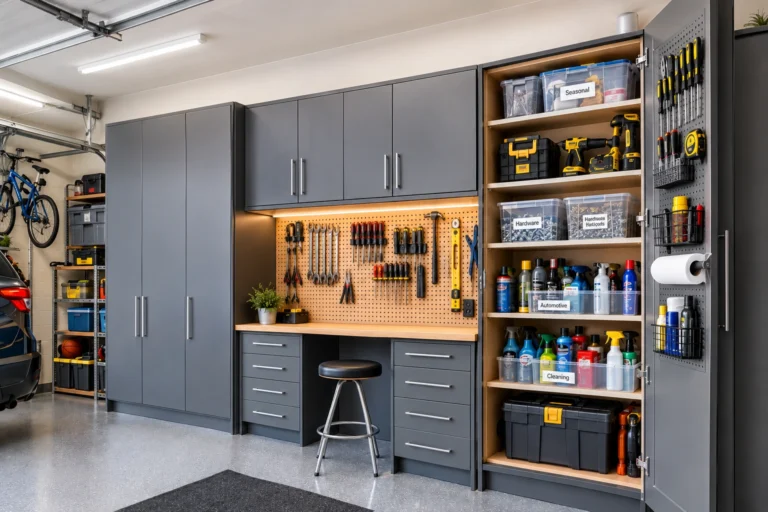
These garage cabinet organization ideas can help you make better use of the storage you already have.
Best for: Hidden storage in garages with limited floor depth.
Space-saving advantage: It uses wall space while keeping smaller items contained.
A shallow wall-mounted garage cabinet can be particularly useful when floor clearance is more important than maximum cabinet capacity.
Trade-off: Closed cabinets create a cleaner appearance, but deep cabinets can become difficult to access if they’re packed too tightly.
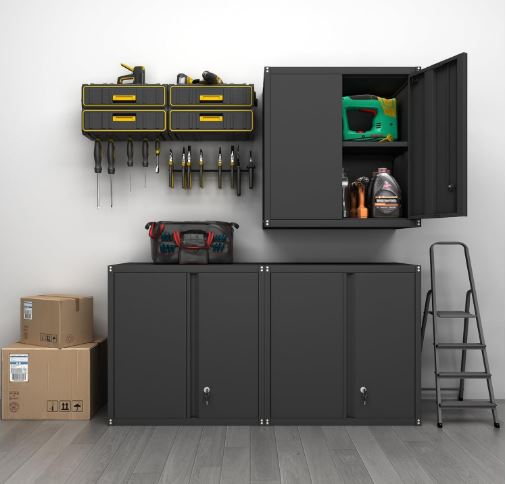
A shallow wall-mounted cabinet can keep small garage supplies, accessories, and everyday essentials contained without projecting as far into the garage as a deeper cabinet. Check its dimensions, mounting requirements, door clearance, and rated load before choosing one. [#CommissionEarned]
Buy on Amazon →
6. Use the Space Above the Garage Door
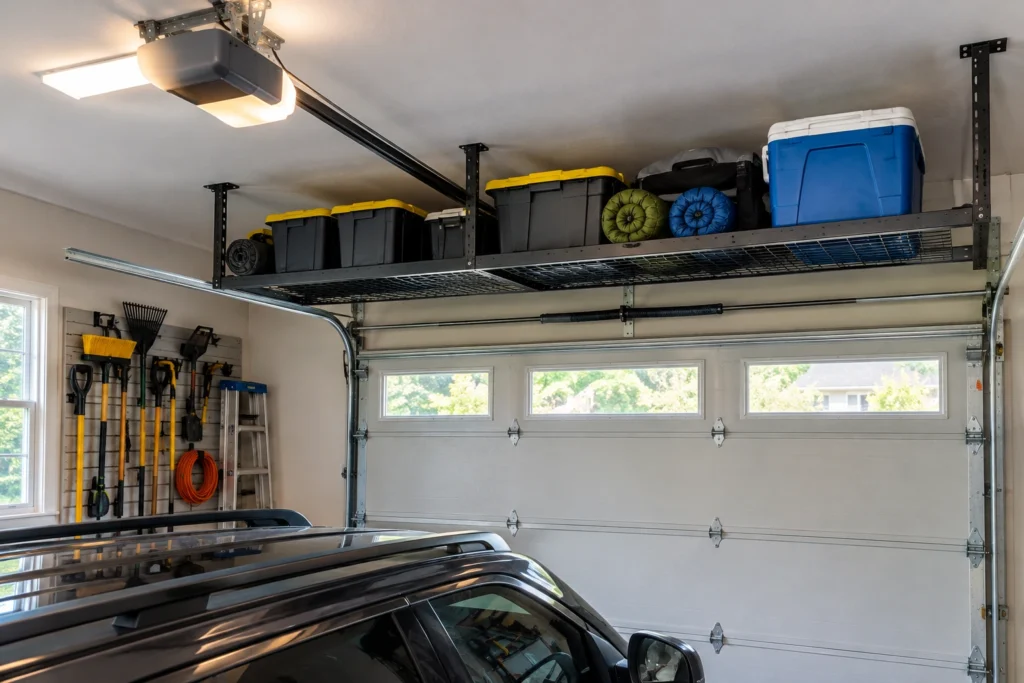
The area above the garage door can be valuable overhead storage space, provided the installation doesn’t interfere with the door, tracks, opener, lighting, or vehicle.
This is usually better suited to seasonal decorations, spare household supplies, luggage, or other items you don’t need every day.
Best for: Seasonal and rarely used belongings.
Space-saving advantage: It uses overhead space that otherwise contributes little to storage.
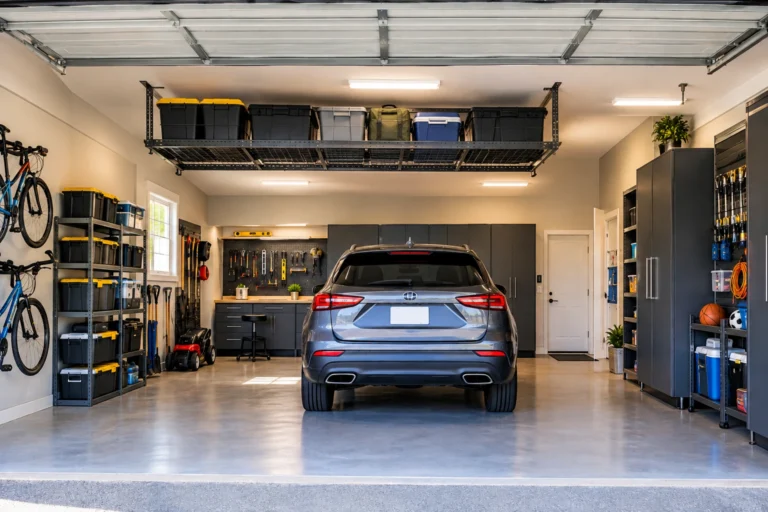
An overhead garage storage rack can help organize larger bins when the ceiling structure and available clearance are suitable.
Trade-off: Overhead storage preserves floor space, but anything stored there is less convenient to access.
Always follow the manufacturer’s installation and load requirements.
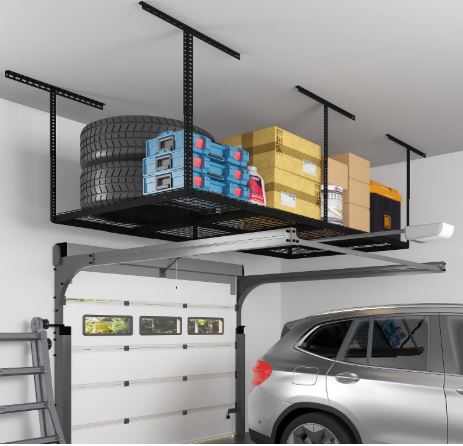
An overhead garage storage rack can provide a dedicated place for seasonal items and bulky belongings that you don’t need every day. Before choosing one, verify ceiling support, the rack’s load rating, garage-door track clearance, and safe access to stored items.[#CommissionEarned]
Order on Amazon →
7. Store Bikes Vertically on the Wall
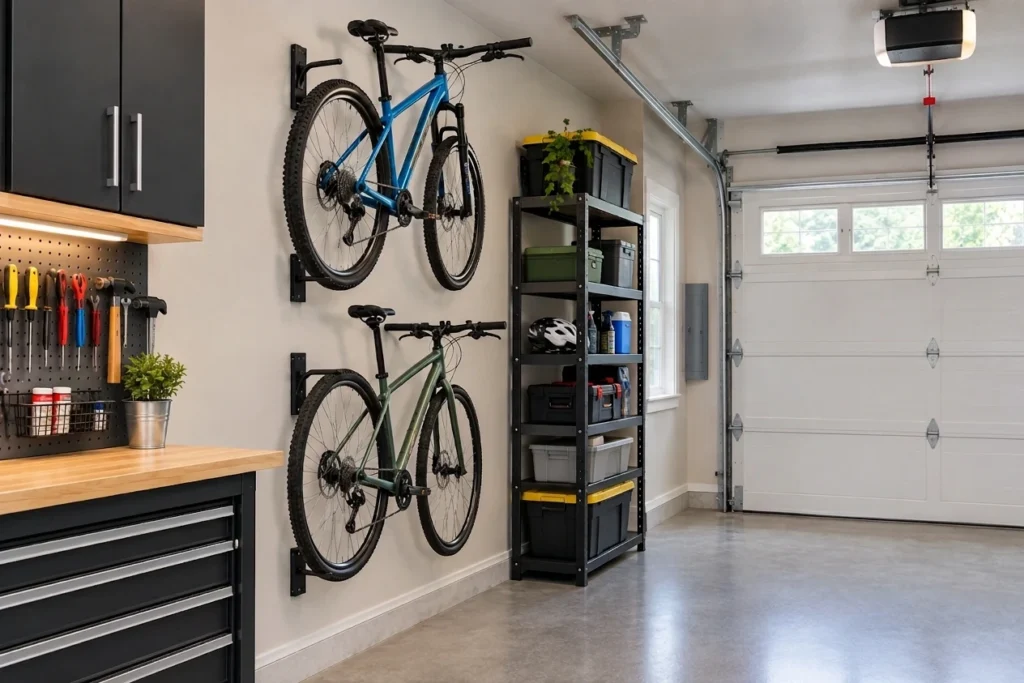
Bikes can consume a surprising amount of floor space.
If you’re trying to maintain a clear parking area, vertical wall-mounted bike storage can move the bicycle footprint upward. Before installing a rack, check the bike’s height, handlebars, pedals, nearby doors, and vehicle clearance.
Best for: Small garages with one or more bikes.
Space-saving advantage: Bikes are moved away from the floor and organized along the garage perimeter.
A wall-mounted bike rack can be a practical option when the wall and mounting location can safely support it.
Trade-off: Vertical bike storage saves floor space, but the rack needs enough surrounding clearance for handlebars and pedals.
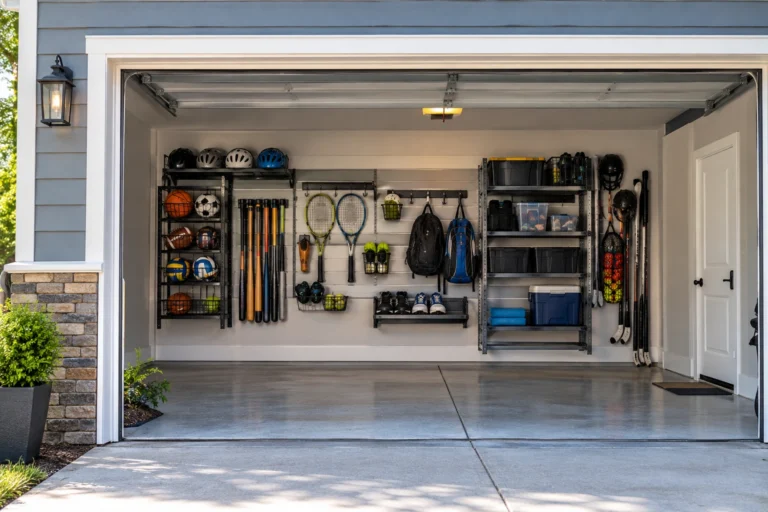
If bikes are only part of the equipment taking over your garage, these garage sports equipment storage ideas can help you organize balls, helmets, bats, rackets, and other gear.
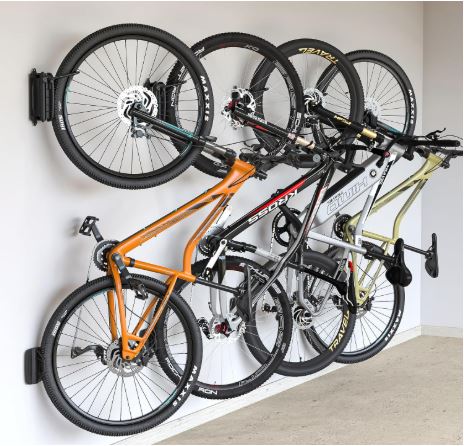
A wall-mounted bike rack can move a bicycle off the garage floor and help keep the surrounding area easier to use. Check bike compatibility, mounting requirements, weight capacity, and the clearance needed for handlebars and pedals. [#CommissionEarned]
View Price on Amazon →
8. Use the Back of an Entry Door
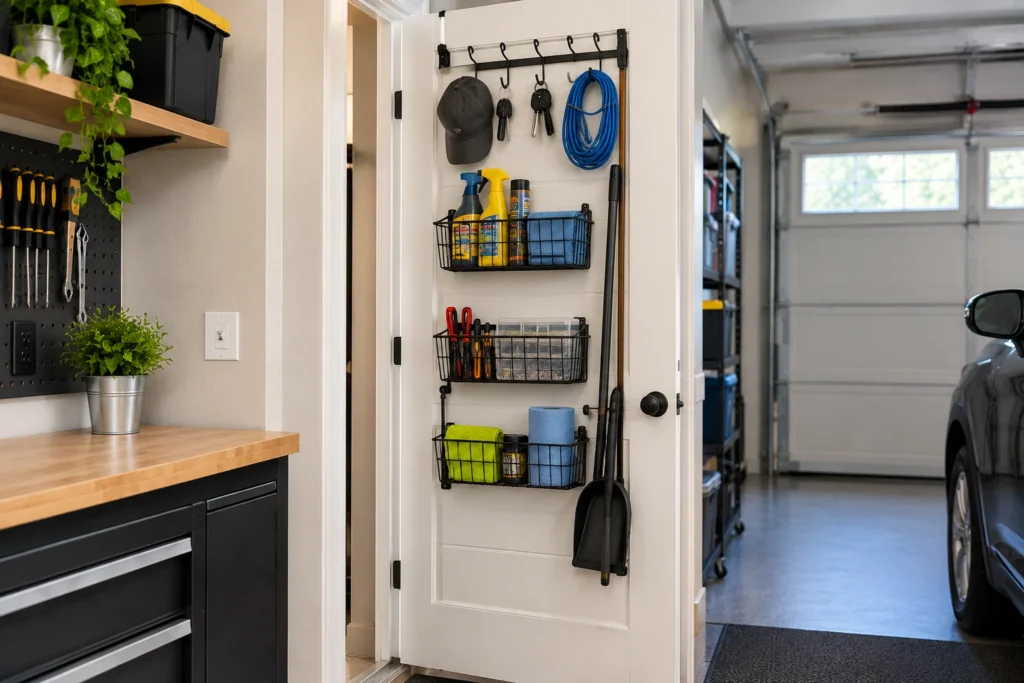
The back of an entry door is easy to ignore because it’s only visible when the door is open.
Depending on the door and available clearance, an organizer can provide space for smaller supplies, cleaning items, lightweight equipment, or accessories.
Make sure the added weight doesn’t interfere with the door’s operation.
Best for: Small items and narrow storage needs.
Space-saving advantage: It creates storage without taking additional wall or floor area.
A garage door storage organizer can help make otherwise unused door space functional.
Trade-off: Door storage is convenient, but it must remain lightweight enough and clear enough for normal door operation.
9. Install Slatwall on Only One Section of Wall
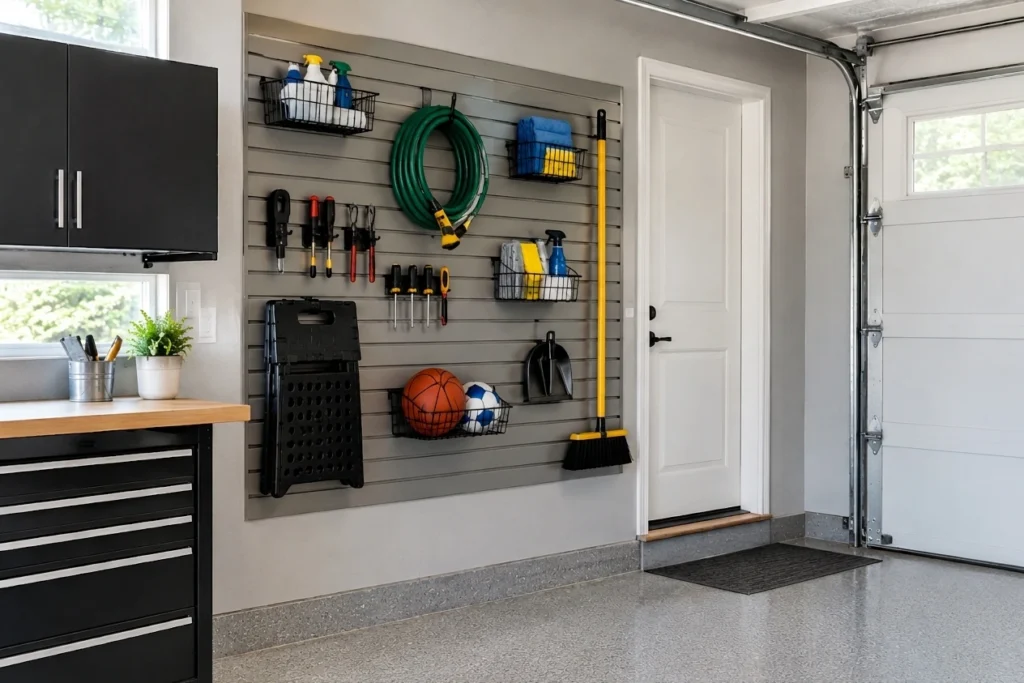
You don’t need a complete slatwall installation to benefit from flexible wall storage.
Installing slatwall on one strategically chosen section can give you a place for hooks, shelves, baskets, tool holders, and other compatible accessories.
This can be particularly useful if your needs change frequently.
Best for: Garages where storage needs are likely to evolve.
Space-saving advantage: One wall section can perform multiple storage jobs without requiring several separate systems.
A garage slatwall panel and accessory system can provide a flexible base for hooks, shelves, baskets, and other components.
Trade-off: Slatwall is flexible, but a system only becomes useful when its accessories are arranged around the actual items you own.
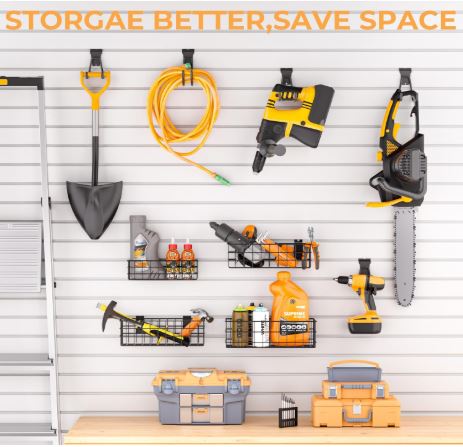
Garage slatwall panels can provide a flexible base for organizing compatible hooks, baskets, shelves, and selected tools on one wall section. Check accessory compatibility, installation requirements, and the system’s load limits before adding equipment. [#CommissionEarned]
Check Price on Amazon →
10. Store Seasonal Items in Clear Stackable Bins
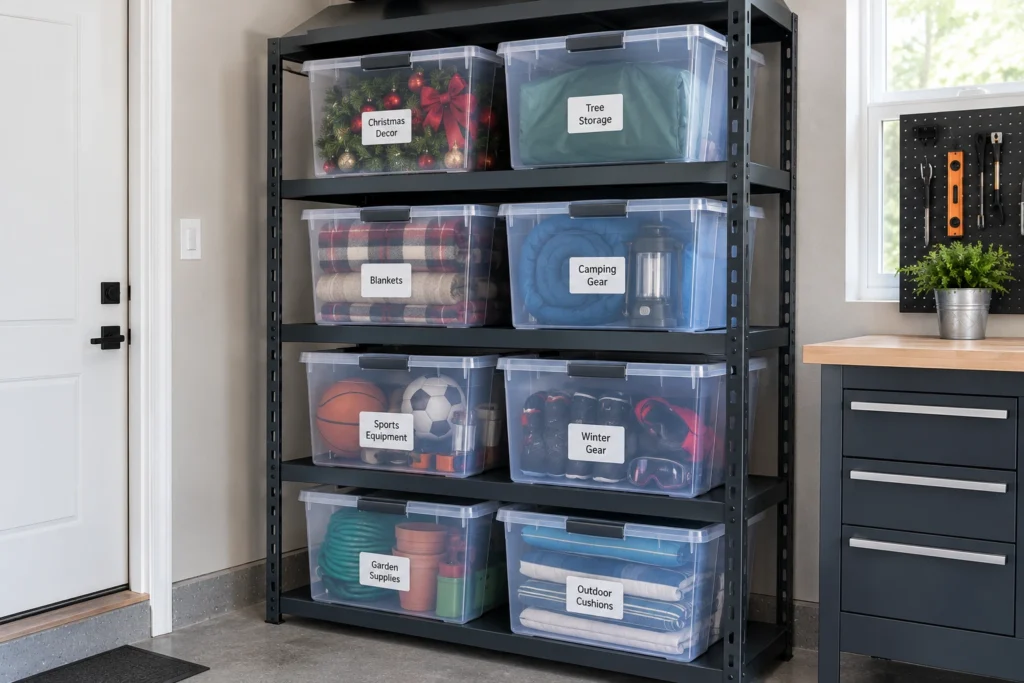
Seasonal items don’t need prime garage real estate.
Use stackable containers to consolidate decorations, occasional-use household supplies, or other belongings that aren’t needed regularly.
Clear containers can make contents easier to identify, while labels can help when the bins aren’t transparent.
Best for: Seasonal and infrequently used items.
Space-saving advantage: Stackable containers make better use of vertical storage space.
Clear stackable garage storage bins can be useful when you want to see contents without opening every container.
Trade-off: Stacking saves space, but frequently used items shouldn’t be buried under several containers.
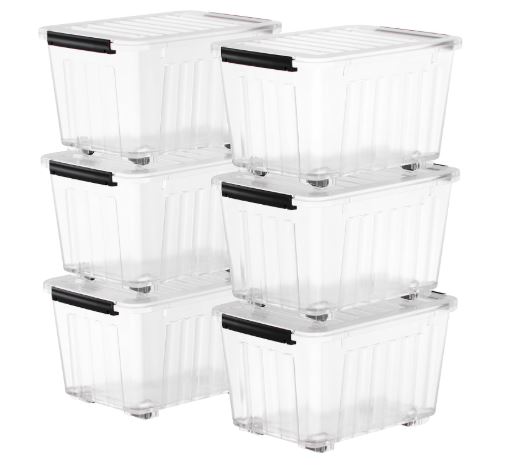
Clear stackable storage bins can help you identify seasonal decorations, accessories, and other stored belongings without opening every container. Compare bin dimensions, lid design, stackability, and the available shelf height before buying a set. [#CommissionEarned]
Buy on Amazon →
11. Create a Vertical Cleaning-Tool Station
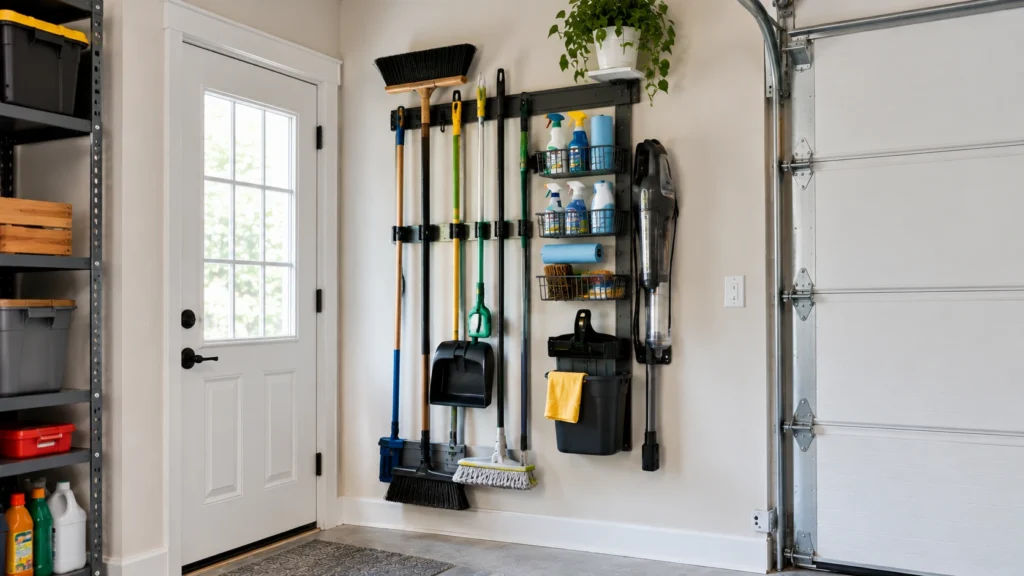
Brooms, mops, brushes, dustpans, and similar tools can take up an awkward amount of floor and wall space when they’re simply leaned into a corner.
A vertical organizer can keep them together in one narrow section. Place the station near the area where you normally use the tools.
Best for: Cleaning tools and long lightweight equipment.
Space-saving advantage: Several long items can share a narrow vertical footprint.
A wall-mounted broom and tool organizer can make this type of storage easier to maintain.
Trade-off: Vertical storage works well for long tools, but the organizer needs enough spacing to remove individual items without disturbing everything else.
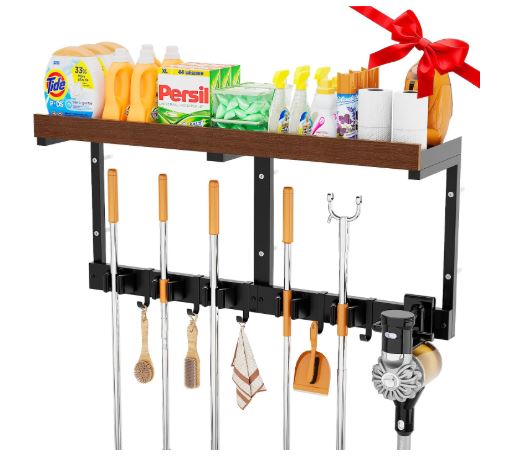
A wall-mounted broom and tool organizer can keep brooms, mops, dusters, and other long-handled cleaning tools grouped together instead of leaning against a wall. Look for secure grips, suitable tool spacing, and mounting hardware compatible with your wall. [#CommissionEarned]
Order on Amazon →
12. Use the Wall Above a Workbench
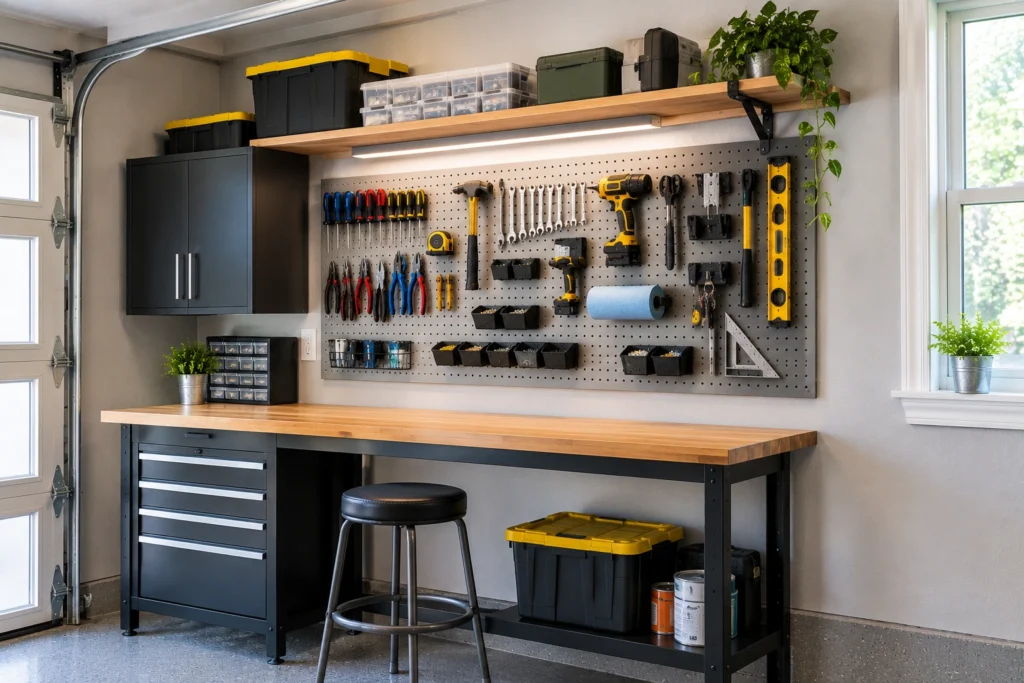
The wall above a workbench is often one of the most valuable areas in a small garage.
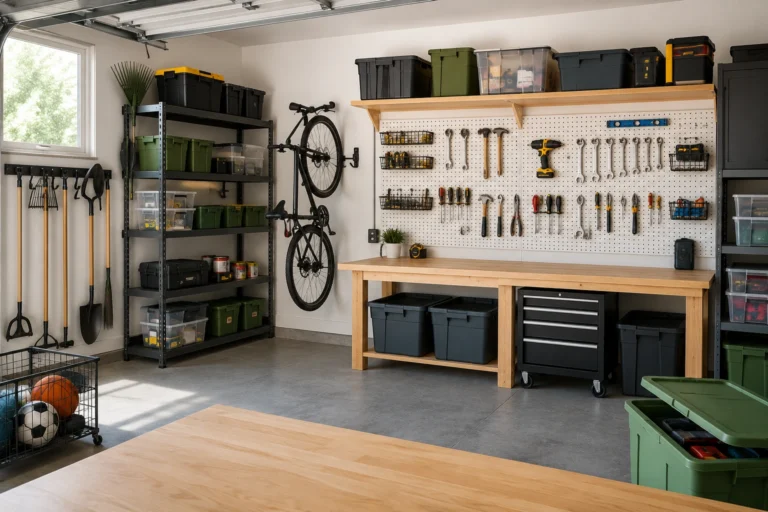
Instead of allowing that space to remain empty, use it for shelves, pegboard, cabinets, or a combination of systems. Keep the tools and supplies you use during projects within easy reach.
Best for: Garages that double as workshops.
Space-saving advantage: It adds storage without consuming additional workspace or floor area. A wall-mounted workbench shelf can provide useful upper-level storage for smaller tools and supplies.
Trade-off: Storage above a workbench is convenient, but don’t install shelves so low that they interfere with the work surface.
If you prefer building a solution that fits your own garage, these DIY garage storage ideas offer more projects for tools, shelves, bins, and other everyday equipment.
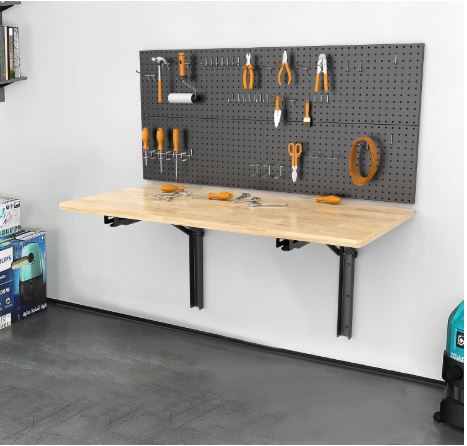
A wall-mounted workbench shelf can keep small tools, containers, and frequently used supplies close to your workspace. Check the shelf depth, mounting strength, and height so stored items remain accessible without getting in the way while you work. [#CommissionEarned]
Read Details on Amazon →
13. Add a Fold-Down Work Surface
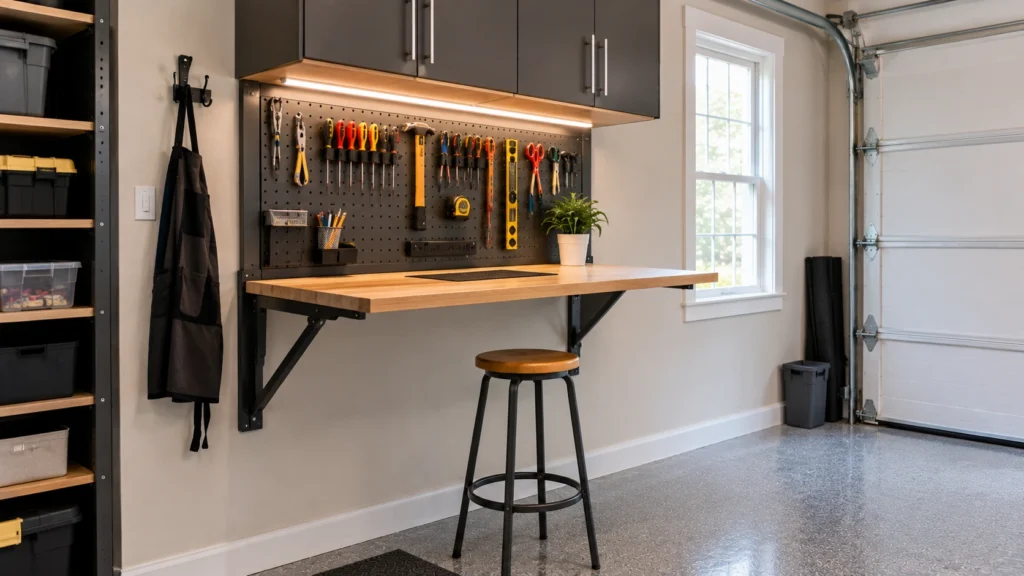
A permanent workbench can be difficult to fit into a small garage.
A fold-down work surface provides a workspace when needed and can be folded away when you’re finished. This can be especially useful when the garage needs to serve multiple purposes.
Best for: Small garages that need occasional workspace.
Space-saving advantage: The work surface doesn’t permanently occupy the floor.
A folding wall-mounted workbench can provide a compact workspace when installed securely and used within its intended load capacity.
Trade-off: A fold-down workbench saves floor space, but it won’t provide the same continuous heavy-duty workspace as a permanent bench.
14. Use a Narrow Rolling Storage Cart
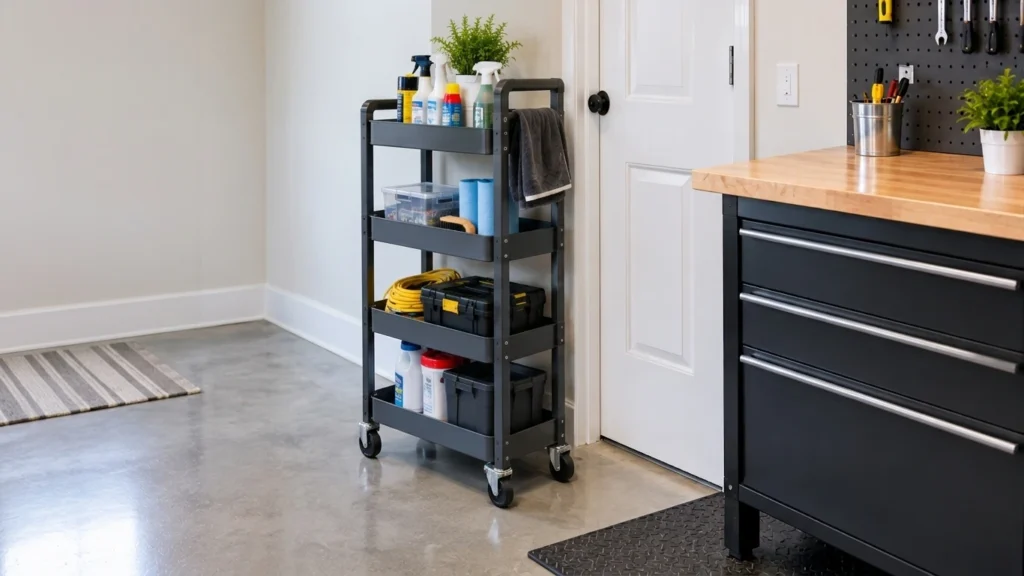
A rolling cart can make use of a narrow gap while remaining movable.
Use the cart for small tools, project supplies, cleaning products, or other categories that need to move between the workbench and another area. Choose a cart that fits comfortably without blocking doors or walking paths.
Best for: Flexible storage and project-based equipment.
Space-saving advantage: A narrow cart can use a small footprint and move when the garage layout changes.
A narrow rolling garage storage cart can be useful when permanent storage isn’t practical.
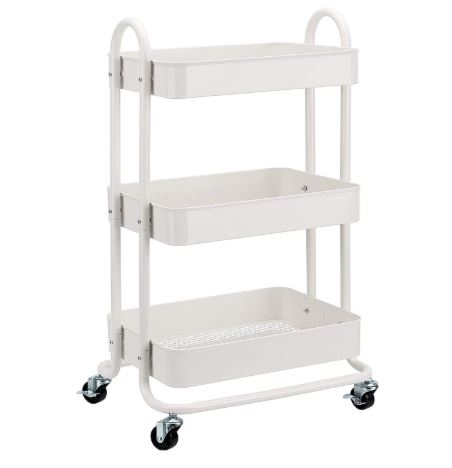
A narrow rolling storage cart can keep frequently used supplies together while allowing you to move them between the workbench and other parts of the garage. Check its width, shelf spacing, wheel locks, and weight capacity before selecting one. [#CommissionEarned]
View Price on Amazon →
15. Turn a Narrow Wall Strip Into Storage
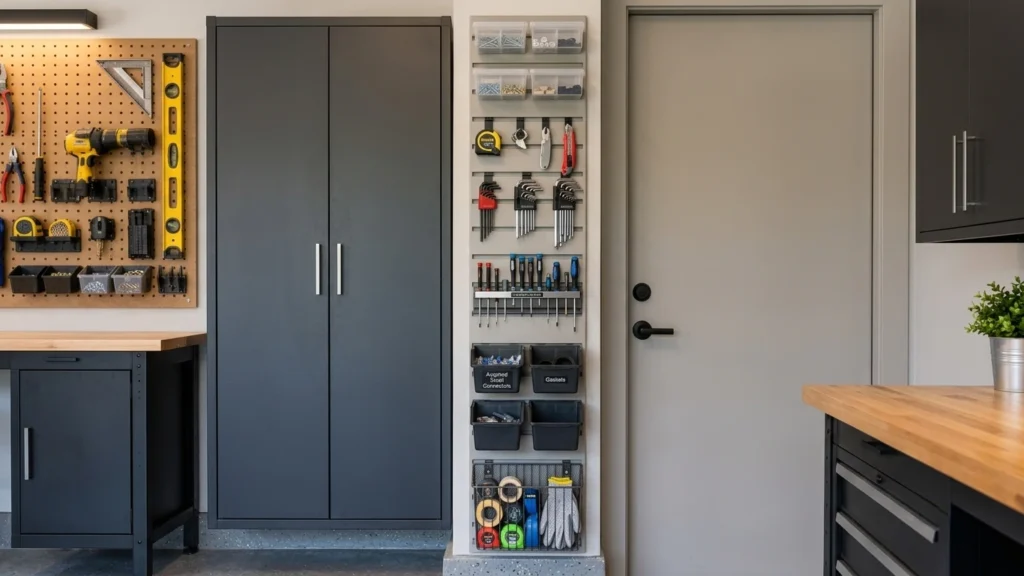
Not every useful wall section is large enough for shelving.
A narrow strip beside a door, cabinet, or workbench can still accommodate appropriately sized hooks.
Use it for lightweight or moderately sized items that are awkward to store elsewhere.
Best for: Narrow leftover wall sections.
Space-saving advantage: It turns small unused sections into dedicated storage.
Heavy-duty garage wall hooks can work well for suitable items when their load rating and mounting hardware match the wall and intended use.
Trade-off: Hooks are excellent for individual items, but they can become visually cluttered if too many unrelated categories are mixed together.
16. Push Storage Toward the Garage Perimeter
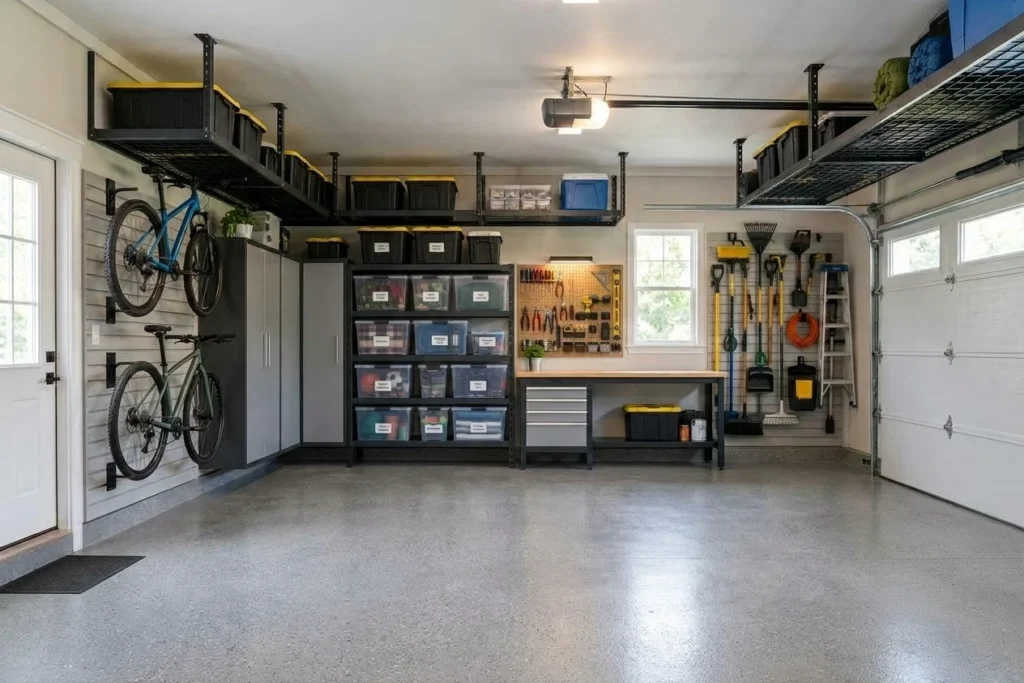
When a garage needs to retain parking space, one of the most effective strategies is to push storage toward the perimeter.
Instead of placing freestanding organizers in the center, use walls, corners, cabinets, and overhead areas wherever practical.
The goal is to create a clear central area that can support parking and normal movement.
If you need to keep a vehicle inside the garage, learn more about how to organize a garage without losing parking space while making room for useful storage.
Best for: Garages that still need to accommodate a vehicle.
Space-saving advantage: The center remains available instead of becoming a storage aisle.
17. Use the Inside of Cabinet Doors
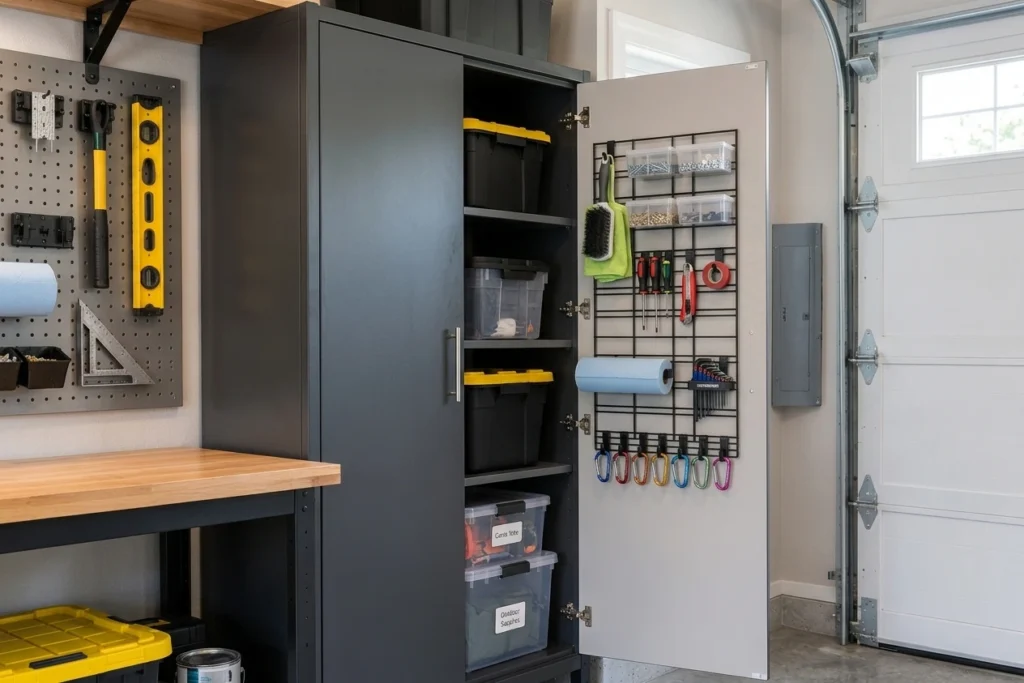
If you already have garage cabinets, don’t overlook the inside of the doors.
Depending on the cabinet design, lightweight organizers can hold small accessories, measuring tools, gloves, or other compact items.
Before installing anything, check the door clearance and make sure the organizer won’t interfere with shelves or cabinet contents.
Best for: Small accessories in existing cabinets.
Space-saving advantage: It creates another storage surface without adding a new cabinet.
A garage cabinet-door organizer can recover otherwise unused interior door space.
18. Create a Narrow Storage Zone Beside the Garage Door
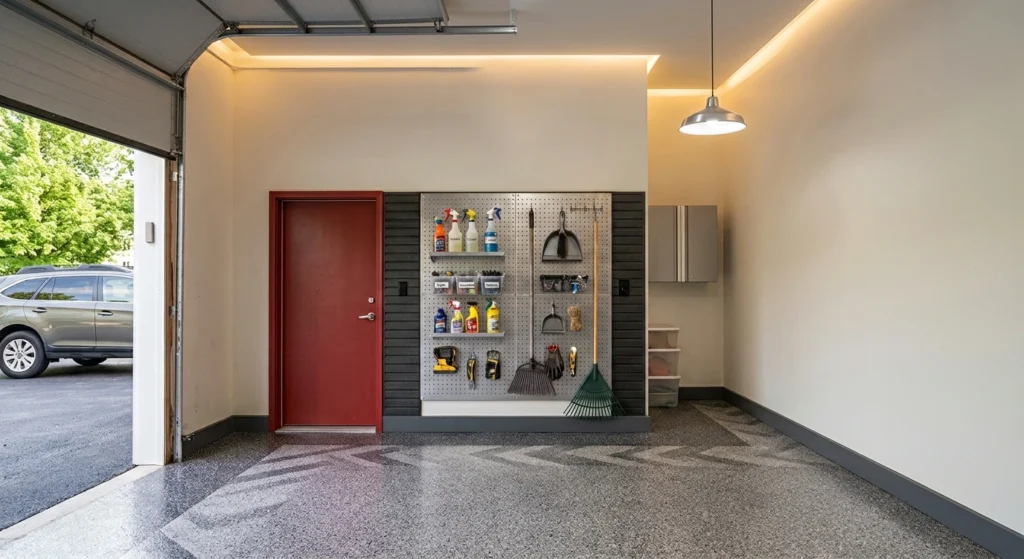
The area beside the garage entry door can sometimes become an awkward strip that isn’t wide enough for conventional shelving.
Instead of ignoring it, give it a specific storage purpose.
Depending on the available width, it could hold cleaning tools, lightweight garden equipment, hooks, small shelves, or frequently used accessories.
Best for: Awkward narrow spaces that don’t suit full-size storage units.
Space-saving advantage: A small strip becomes useful without extending deeply into the garage.
The important thing is to measure first. In a tight garage, a few inches of unnecessary depth can make a noticeable difference.
How to Find the “Dead Space” in Your Garage?
If your garage still feels crowded after adding storage, look for areas that aren’t doing anything useful.
Check:
- the wall above the garage door
- the wall above the workbench
- the inside of cabinet doors
- narrow strips beside doors
- upper wall sections
- unused corners
- vertical space around bikes
- space above existing cabinets or shelves
Walk through the garage slowly and look at the areas between eye level and the ceiling.
You may discover that the garage doesn’t need significantly more floor storage. It needs better use of vertical and perimeter space.
Don’t Give Prime Garage Space to These Items
In a small garage, easy-to-reach storage should be reserved for things you actually use.
Give prime locations to:
- everyday tools
- car-care supplies
- frequently used outdoor equipment
- items used weekly
- commonly used workshop supplies
Move less frequently used items higher or farther away:
- seasonal decorations
- spare supplies
- rarely used camping gear
- empty luggage
- backup containers
- occasional-use equipment
This simple change can make an existing storage system feel much larger without buying another organizer.
A Simple Small-Garage Storage Plan
Instead of organizing everything randomly, divide the garage into practical zones.
Zone 1: Everyday Tools
Keep frequently used tools near the workbench or in easily accessible wall storage.
Zone 2: Bulky or Infrequent Items
Use higher shelves, cabinets, or overhead storage for things you don’t need every day.
Zone 3: Long Items
Store bikes, garden tools, fishing equipment, and similar items vertically or along suitable wall sections.
Zone 4: Small Items
Use drawers, bins, baskets, pegboard accessories, or cabinet organizers.
Zone 5: Workspace
Keep the area around your workbench or fold-down work surface accessible.
Zone 6: Parking and Walking
Protect this space instead of filling every available inch with storage.
A small garage becomes easier to manage when every area has a job.
If Your Garage Has This Layout, Start Here
Narrow single-car garage
Prioritize:
wall → vertical storage → overhead storage → shallow cabinets
Lots of wall space but little floor depth
Prioritize:
wall-mounted shelves → pegboard/slatwall → shallow cabinets
Crowded walls
Prioritize:
overhead storage → door storage → corners → carefully selected vertical storage
Garage that must still park a vehicle
Prioritize:
perimeter storage → shallow systems → vertical bike storage → overhead seasonal storage
Garage that doubles as a workshop
Prioritize:
wall tool storage → fold-down work surface → compact rolling cart
This approach is usually more useful than choosing storage products first.
How to Make a Small Garage Feel Bigger
You don’t necessarily need a larger garage to make the space feel more usable.
A few principles help:
- Keep the center as open as practical.
- Choose shallow storage where possible.
- Use consistent containers for small items.
- Keep everyday equipment easy to reach.
- Move seasonal items higher.
- Avoid filling every shelf completely.
- Group related items together.
- Keep walking paths obvious.
A little empty space is not wasted space. In a small garage, it can be what makes the entire storage system functional.
Declutter Before You Add More Storage
Before buying another organizer, look at what you’re already storing.
Ask:
- Have I used this during the last year?
- Would I replace it if it disappeared?
- Does it actually deserve garage space?
- Do I own duplicates?
- Is this item broken or incomplete?
- Could it be stored somewhere more appropriate?
More containers don’t automatically create better organization.
Sometimes the most effective storage improvement is removing items that no longer deserve the space they occupy.
Good storage should solve a space problem—not preserve unnecessary clutter.
Small Garage Storage Mistakes to Avoid
Even a good storage product can create problems when it’s installed in the wrong location.
Avoid:
- buying storage before measuring
- choosing shelves that are unnecessarily deep
- blocking garage doors or tracks
- ignoring vehicle-door clearance
- placing heavy items where mounting isn’t adequate
- putting everyday items in difficult-to-reach locations
- filling every shelf completely
- allowing storage to spread into the center
- overloading hooks or racks
- creating trip hazards
- using overhead storage without checking structural support
- leaving no room for future changes
A storage system should make the garage easier to use, not simply make it look fuller.
Small Garage Storage Safety Tips
Storage should improve the garage without introducing new hazards.
Before installing anything:
- Follow the manufacturer’s installation instructions.
- Use mounting hardware appropriate for the wall or ceiling structure.
- Check product load ratings.
- Don’t exceed recommended weight limits.
- Keep garage-door tracks and moving components clear.
- Don’t block electrical panels or important access points.
- Keep heavy items lower where practical.
- Prevent stored items from falling into walking or parking areas.
- Use safe access methods for elevated storage.
- Recheck overhead storage periodically if it carries significant weight.
For wall-mounted and overhead systems, proper installation matters just as much as the storage capacity itself.
Which Small Garage Storage Idea Should You Choose?
| Your problem | Good starting point |
| Very little floor space | Wall-mounted storage |
| One narrow wall | Tall, narrow shelving |
| Wasted corner | Corner shelving |
| Too many hand tools | Pegboard |
| Need hidden storage | Shallow cabinet |
| Seasonal items | Overhead storage |
| Bikes taking up the floor | Vertical bike rack |
| Cleaning tools everywhere | Vertical tool organizer |
| Storage needs change often | Slatwall |
| Lots of small items | Clear storage bins |
| No permanent workspace | Fold-down workbench |
| Need movable storage | Rolling cart |
| Awkward narrow wall | Wall hooks |
| Existing cabinets | Cabinet-door organizers |
| Need to preserve parking | Perimeter storage |
| Too much clutter | Decluttering + zoning |
Frequently Asked Questions
What is the best storage for a very small garage?
The best starting point is usually vertical or wall-mounted storage because it moves belongings away from the floor. Tall narrow shelving, pegboards, shallow cabinets, hooks, and vertical bike storage can all work well depending on what you own.
How can I add storage without losing parking space?
Start with the garage perimeter rather than the center. Use walls, corners, shallow storage, vertical racks, and appropriate overhead areas while checking vehicle and door clearance before installation.
How do I organize a garage with very little wall space?
Look for overlooked areas such as corners, the backs of doors, the area above a workbench, vertical spaces around bikes, and suitable overhead areas. A narrow rolling cart can also provide flexible storage without requiring permanent wall space.
Are overhead garage racks worth using?
They can be useful for seasonal and rarely used items because they preserve floor and wall space. However, overhead storage is less convenient for daily-use belongings, and the ceiling structure, mounting method, load rating, garage-door movement, and safe access all need to be considered.
How do I prevent a small garage from becoming cluttered again?
Give each category a defined home, keep frequently used items accessible, return items after use, avoid filling every storage area completely, and periodically remove duplicates or items you no longer need.
Is shallow or deep storage better for a small garage?
Shallow storage is often easier to fit into a tight garage because it preserves walking and vehicle clearance. Deep storage can provide more capacity, but it needs to be planned carefully so the back doesn’t become difficult to access.
Conclusion
A small garage doesn’t need to feel permanently crowded. The biggest improvement usually comes from changing where you store things rather than simply buying more storage.
Use walls before the floor. Use vertical space when horizontal space is limited. Move seasonal belongings overhead when appropriate. Turn corners and narrow strips into purposeful storage zones. Use shallow cabinets when you need enclosed storage, and protect the center of the garage when parking and walking space matter.
Most importantly, don’t measure success by how much storage you can fit into the garage.
Measure it by how easily you can park, walk, work, reach your belongings, and put things away again.
The best small garage storage system is the one that gives you more usable space without making the garage harder to live with.