20 Garage Cabinet Organization Ideas to Maximize Storage
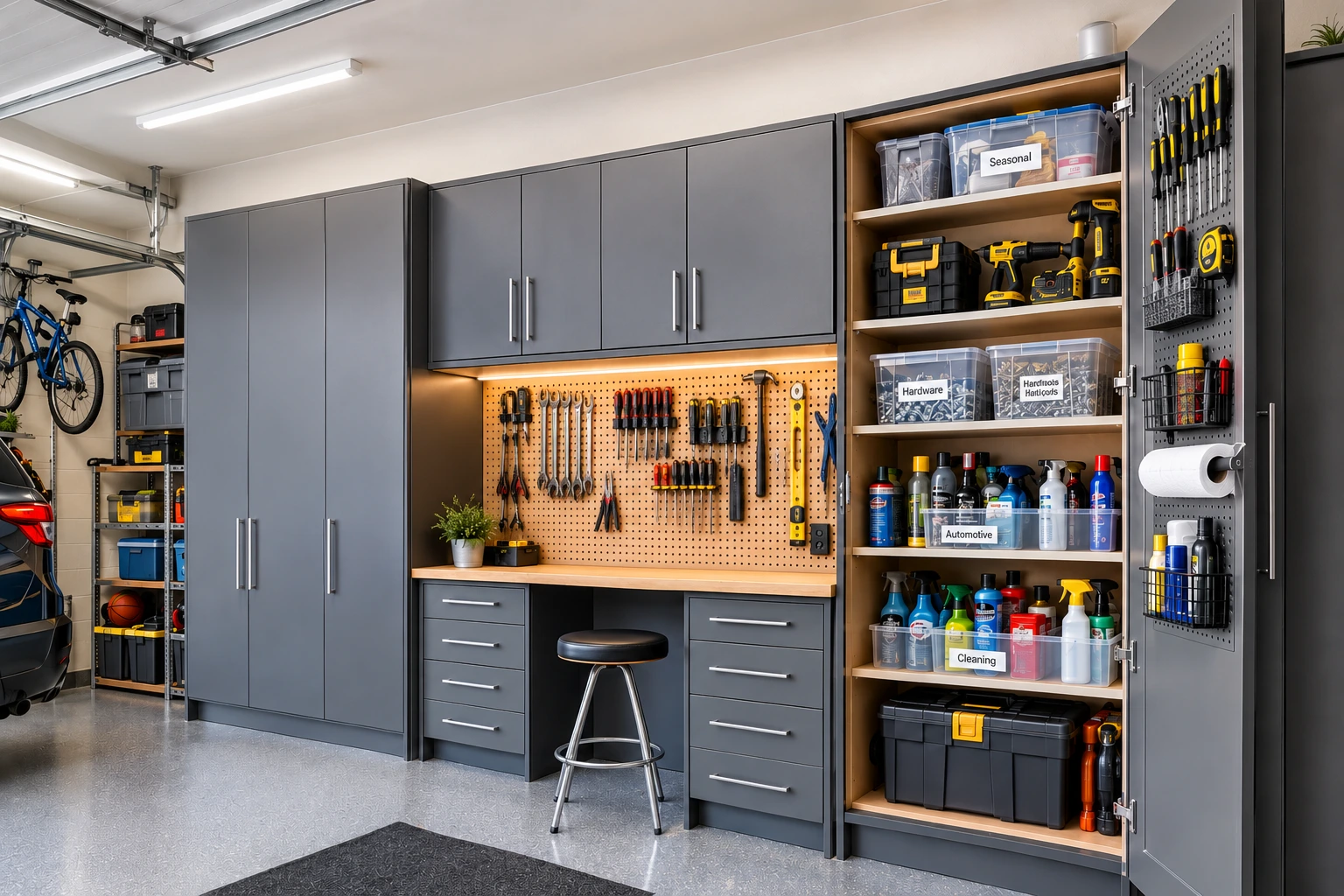
Garage cabinets can make a crowded garage feel dramatically more organized—but only when the inside of the cabinets is designed around the way you actually use the space.
Simply putting more bins behind cabinet doors doesn’t necessarily create better storage. Deep shelves can become difficult to reach, frequently used tools can end up in inconvenient locations, and seasonal items can consume the prime storage space you need every day.
The best garage cabinet organization ideas combine three things: what you own, how often you use it, and where you use it.
In this guide, you’ll find 20 practical ways to organize garage cabinets, maximize every inch of storage, handle deep cabinets and small garages, choose between cabinets and shelving, and create a system that stays organized over time.
Quick Garage Cabinet Organization Checklist
Before buying organizers or rearranging your cabinets, start here:
- Empty the cabinets completely.
- Group similar items together.
- Remove broken, duplicate, or unwanted items.
- Measure the usable cabinet space.
- Decide what each cabinet is responsible for.
- Separate daily, weekly, monthly, and seasonal items.
- Keep frequently used items easy to reach.
- Store heavy items low.
- Use cabinet doors for suitable lightweight items.
- Use vertical space where practical.
- Add pull-outs to difficult deep storage.
- Leave some empty space for future items.
- Check garage parking and walking clearance before adding cabinets.
The goal isn’t to make every cabinet completely full.
The goal is to make every cabinet easy to use.
Before Organizing Your Garage Cabinets, Do These 5 Things
1. Empty the Cabinets Completely
Take everything out before deciding where it should go.
This gives you a chance to find:
- Duplicate tools
- Broken equipment
- Expired products
- Items that belong somewhere else
- Supplies you forgot you owned
- Wasted shelf space
Spread similar items together on the garage floor or workbench so you can see the actual size of each category.
You may discover that you don’t need another storage cabinet at all—you simply need to reorganize the space you already have.
2. Group Similar Items Together
Start with broad categories:
- Hand tools
- Power tools
- Hardware
- Automotive supplies
- Cleaning supplies
- Gardening supplies
- Hobby equipment
- Sports equipment
- Painting supplies
- Seasonal items
Don’t create dozens of tiny categories immediately.
Start broad and divide a category only when it becomes difficult to find things.
3. Organize Around Category + Frequency + Location
This is one of the most useful ways to think about garage cabinet organization.
Don’t organize based on category alone.
Instead ask three questions:
What is it?
That’s the category.
Example: cordless drill.
How often do I use it?
That’s the frequency.
Example: weekly.
Where do I use it?
That’s the location.
Example: workbench.
So the drill shouldn’t simply go into “the power-tool cabinet.”
It should go into an easy-to-access power-tool zone near the workbench.
Now compare that with holiday decorations:
Category: Seasonal
Frequency: Once or twice a year
Location: Storage area
Best position: Upper shelf or less-accessible cabinet
This simple framework prevents one of the biggest garage organization mistakes: giving every category equal priority.
4. Measure Before Buying Organizers
Measure:
- Cabinet width
- Cabinet depth
- Interior height
- Shelf thickness
- Door clearance
- Space between shelves
Then measure your organizers.
A container that technically fits may still waste valuable vertical space.
Also check whether drawers, baskets, or pull-out shelves can open fully without hitting the cabinet door or neighboring storage.
5. Give Every Cabinet a Clear Purpose
Instead of having a cabinet labeled “Garage Stuff,” give each cabinet a job.
For example:
Cabinet 1: Everyday tools
Cabinet 2: Power tools and batteries
Cabinet 3: Hardware
Cabinet 4: Automotive
Cabinet 5: Cleaning
Cabinet 6: Garden and hobbies
Upper storage: Seasonal
This makes putting things away much easier.
When an item has an obvious home, you’re much less likely to leave it on the workbench or garage floor.
20 Garage Cabinet Organization Ideas
1. Create a Dedicated Hand Tool Cabinet
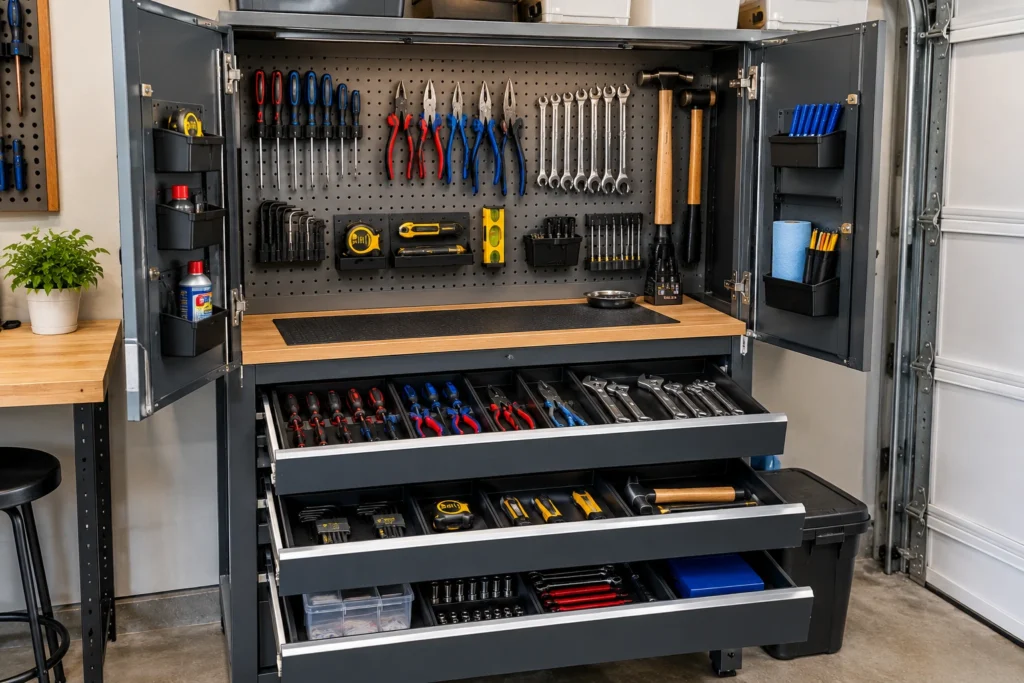
Give frequently used hand tools their own zone.
Store items such as:
- Screwdrivers
- Pliers
- Wrenches
- Hammers
- Tape measures
- Utility knives
- Hex keys
Separate tools by type rather than throwing everything into one deep container.
Shallow drawers, trays, or small organizers can work particularly well because you can see the tools without digging through a pile.
Best for: DIYers and homeowners who regularly perform repairs.
2. Use Adjustable Shelves to Match Your Items
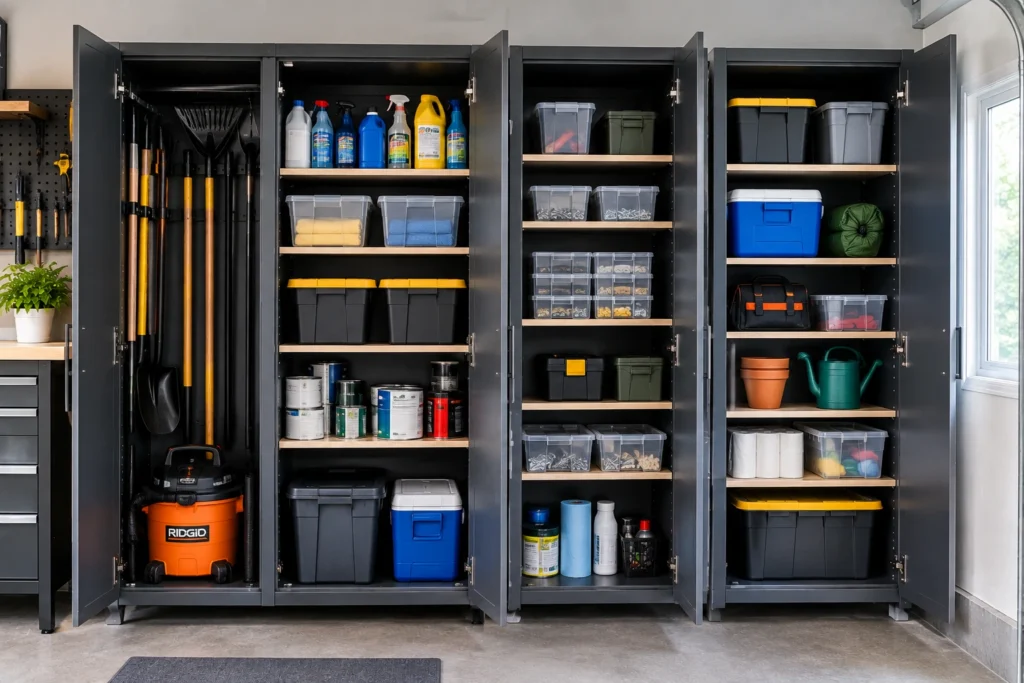
Fixed shelf spacing can leave large amounts of unused vertical space.
Adjustable shelves let you create:
- Tall sections for bottles
- Medium sections for bins
- Short sections for hardware
- Flexible areas for changing storage needs
Current garage-storage guidance specifically recommends planning cabinet type and layout before purchase and using different cabinet configurations based on the garage and stored items.
Instead of making every shelf the same height, make each shelf work for the objects stored there.
3. Add Pull-Out Storage to Deep Cabinets
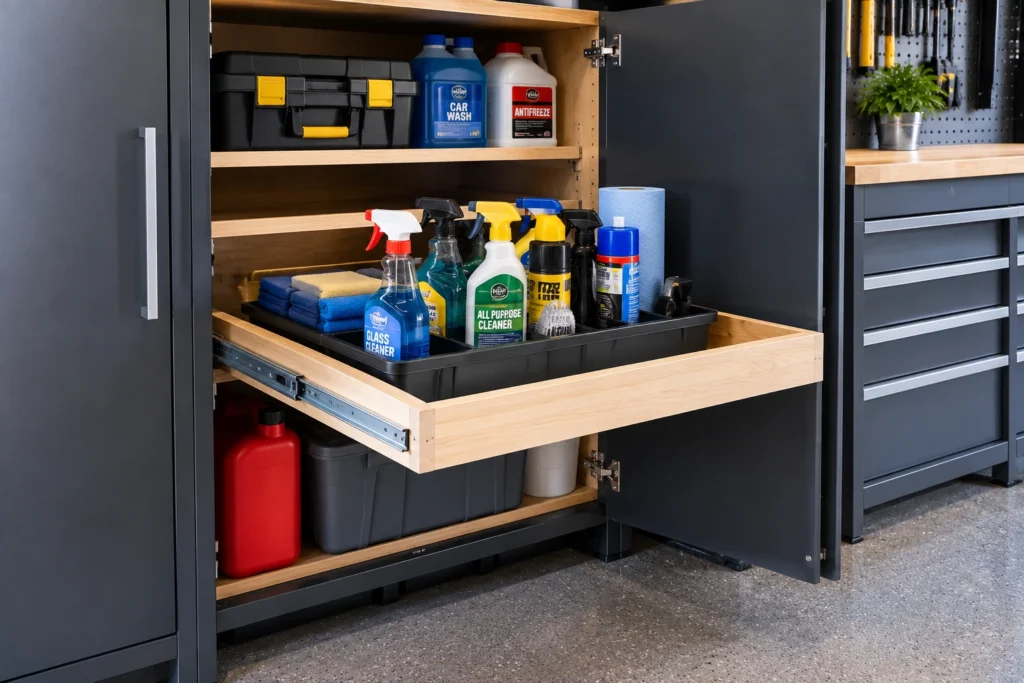
Deep cabinets can create a hidden problem: storage capacity increases while accessibility decreases.
Items at the back can become forgotten simply because they’re difficult to reach.
Pull-out shelves or bins bring that back section toward you.
They’re especially useful for:
- Cleaning supplies
- Tool cases
- Automotive products
- Paint supplies
- Large containers
A pull-out system essentially turns a deep cabinet into a more accessible drawer.
Current woodworking/storage examples continue to use pull-out shelves specifically to make deep cabinet contents visible and reachable.
4. Organize Hardware in Clear Containers
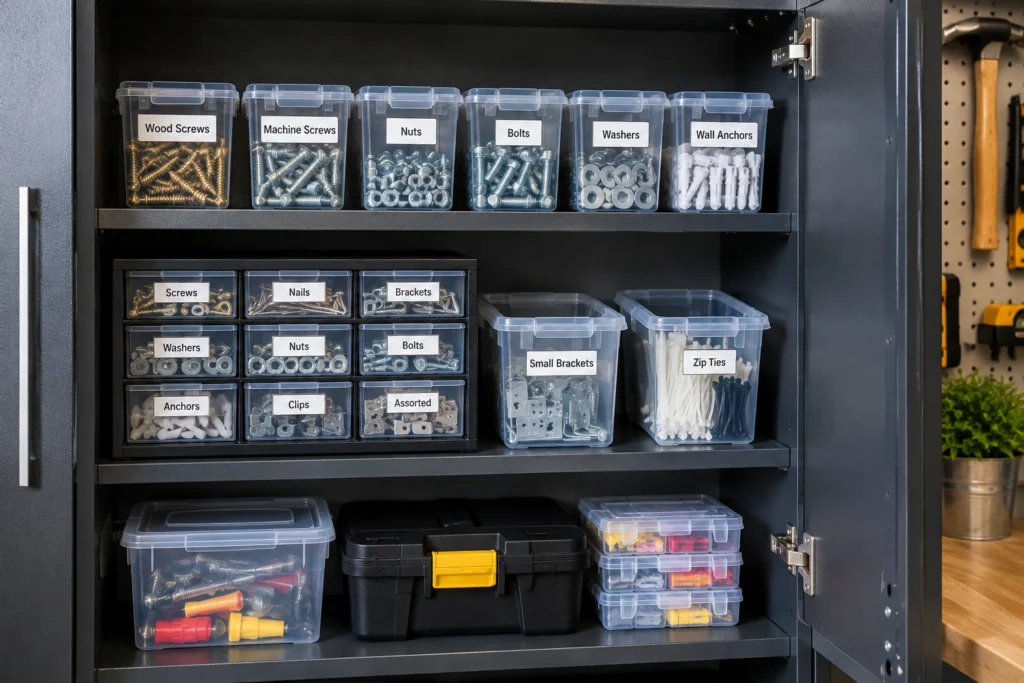
Small hardware can consume an entire shelf while still being difficult to find.
Separate:
- Wood screws
- Machine screws
- Nuts
- Bolts
- Washers
- Wall anchors
- Small brackets
Clear containers let you identify contents without opening every box.
A modular small-parts system is even better when you frequently add or remove hardware.
5. Dedicate One Cabinet to Automotive Supplies
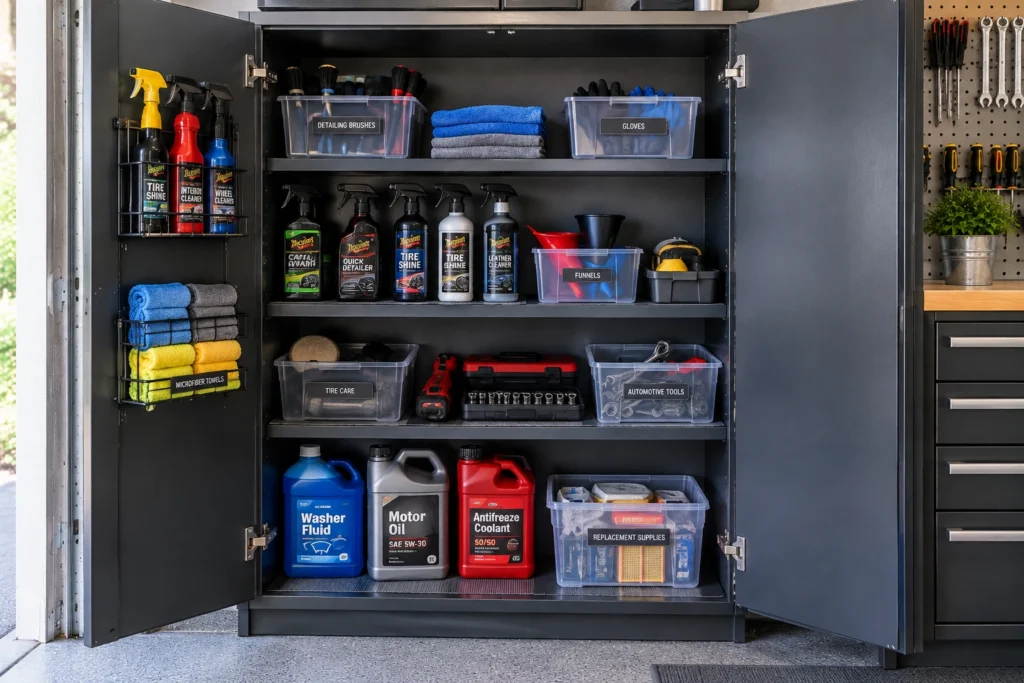
If your garage also functions as an automotive workspace, give car-care products their own cabinet.
Store:
- Microfiber towels
- Detailing brushes
- Car cleaners
- Gloves
- Funnels
- Tire-care accessories
- Automotive tools
- Replacement supplies
Use trays for products that could leak and keep heavier containers on lower shelves.
This prevents automotive products from spreading across multiple unrelated storage zones.
6. Create an Easy-to-Reach Cleaning Cabinet
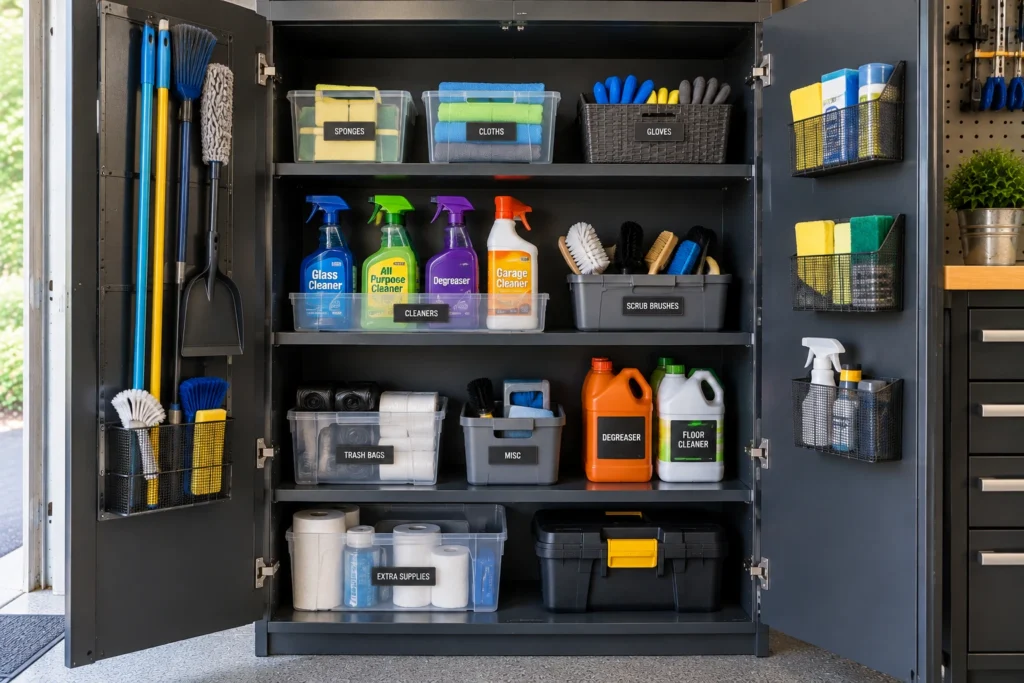
Use one cabinet for garage and household cleaning supplies.
It might contain:
- Brushes
- Sponges
- Cleaning cloths
- Degreasers
- Garage cleaners
- Gloves
- Trash bags
Keep frequently used products toward the front.
For hazardous products, follow the product label and appropriate storage requirements rather than simply grouping everything together because it fits.
7. Use the Inside of Cabinet Doors
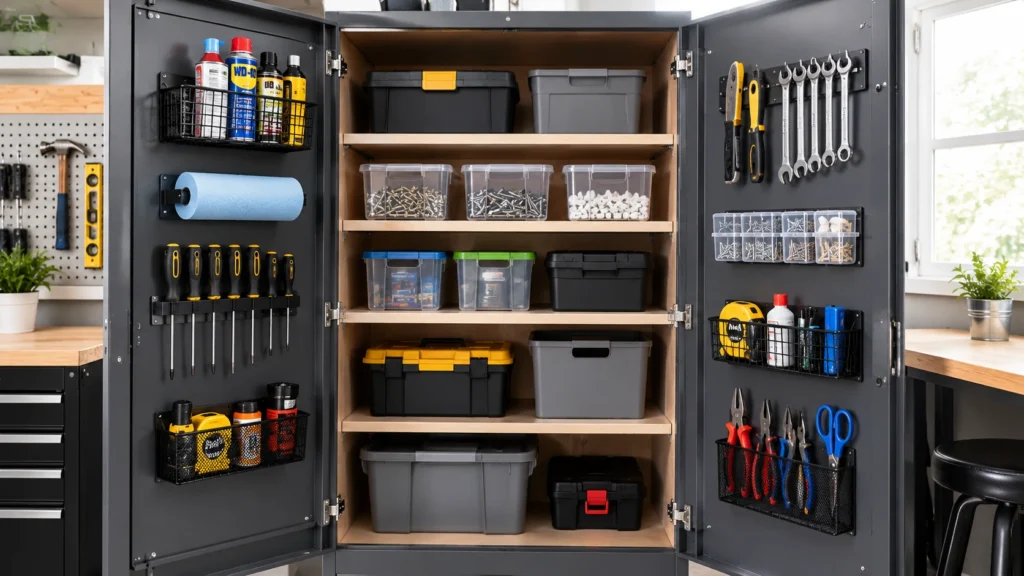
The inside of a cabinet door is often completely unused.
Depending on the cabinet and available clearance, you can add:
- Narrow baskets
- Small hooks
- Magnetic strips
- Lightweight tool holders
- Small accessory organizers
Before installing anything, check:
- Door clearance
- Hinge capacity
- Organizer weight
- Whether stored items interfere with shelves
Door storage is a useful way to recover otherwise unused space, but clearance should always be checked before adding an organizer.
8. Create a Dedicated Power Tool Cabinet
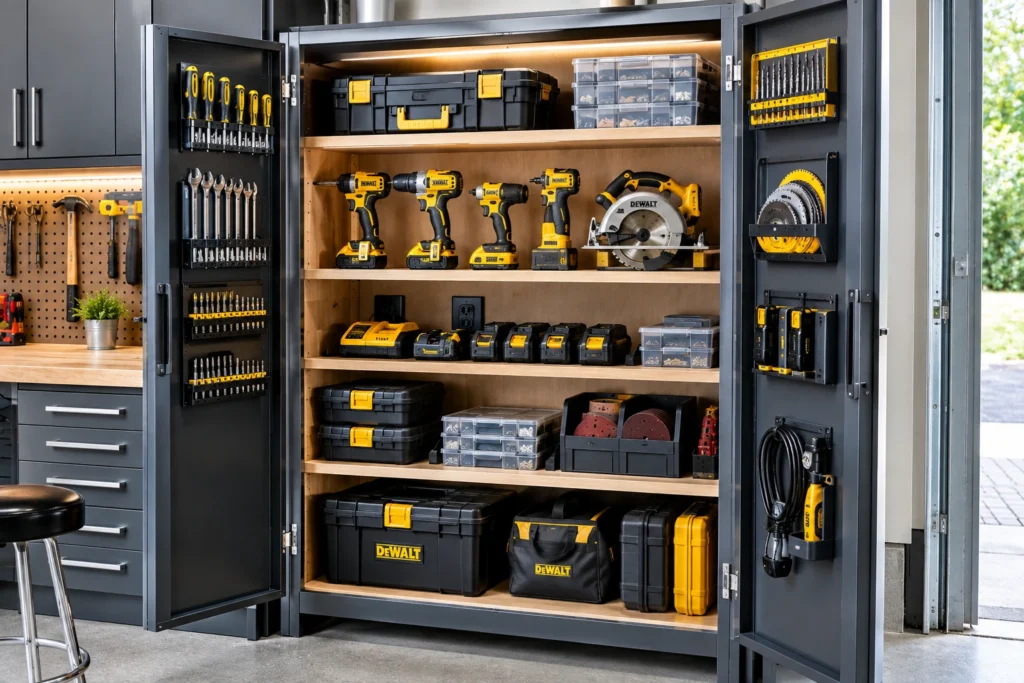
Power tools often come with accessories that create secondary clutter.
Instead of storing the drill in one place, charger somewhere else, and batteries in another cabinet, create a connected power-tool zone.
For example:
Drill → batteries → charger → drill bits
Sander → sanding discs → replacement pads
Saw → blades → accessories
This turns a cabinet into a working system rather than simply a container.
9. Use Small Drawer Organizers for Tiny Items
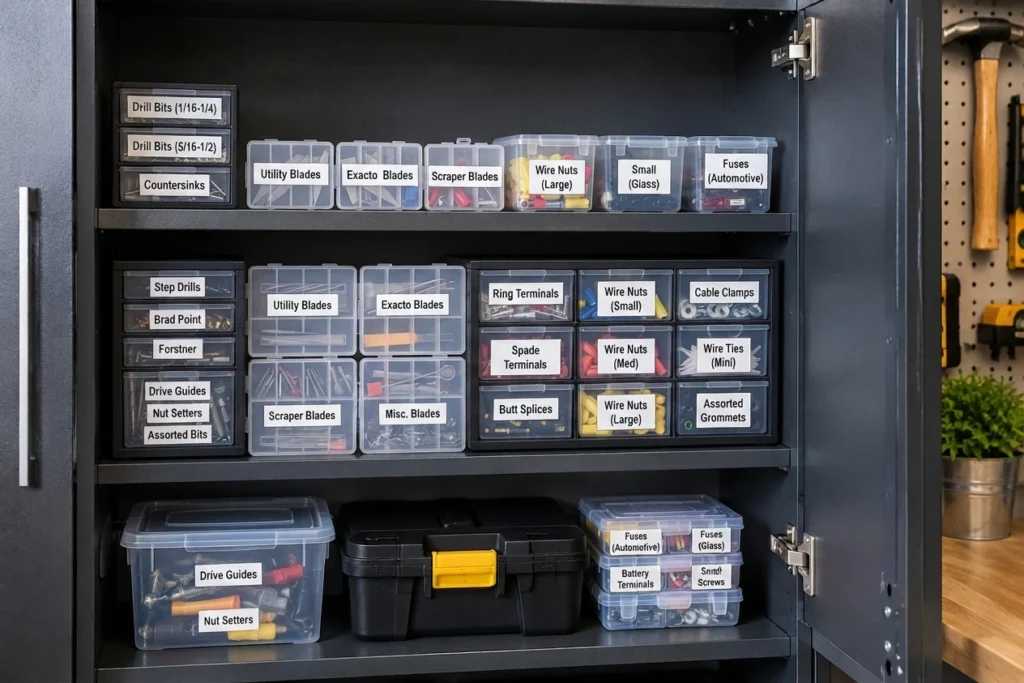
Large shelves aren’t ideal for small components.
Use compact organizers for:
- Drill bits
- Utility blades
- Electrical connectors
- Replacement parts
- Small fasteners
- Measuring accessories
The purpose isn’t to fill your cabinet with organizers.
It’s to stop small items from becoming one large mixed pile.
10. Create a Dedicated Garden Supply Cabinet
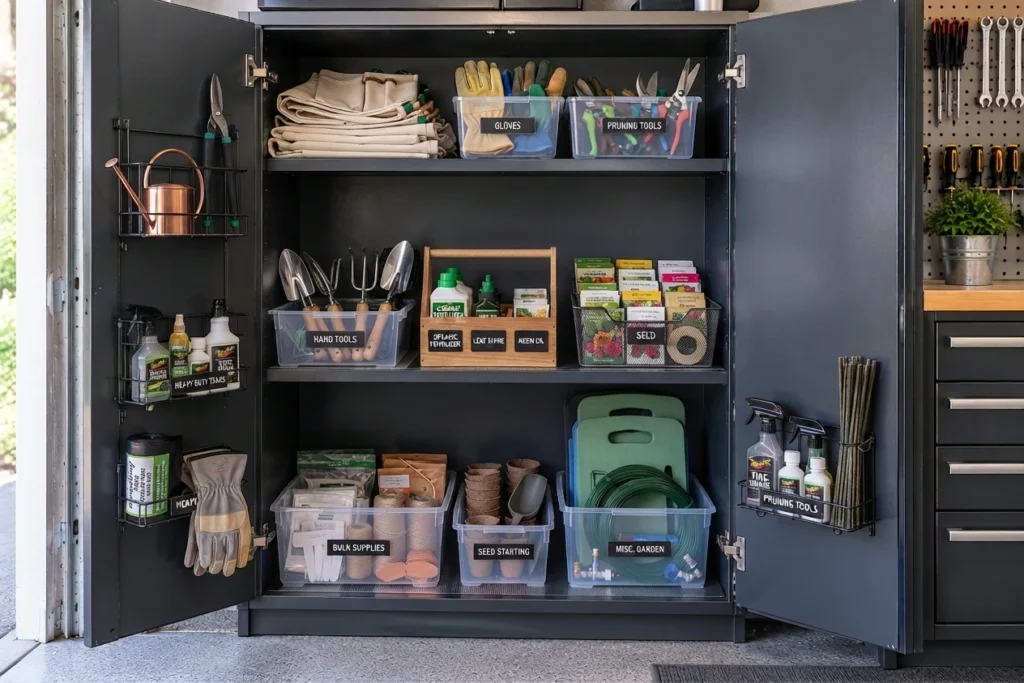
Use cabinets for compact gardening accessories rather than large long-handled tools.
Store:
- Gardening gloves
- Pruning tools
- Plant ties
- Seeds
- Hand trowels
- Small plant-care supplies
Keep shovels, rakes, and long-handled equipment on appropriate wall storage.
Why it works: Cabinets are better suited to compact categories than awkward oversized objects.
11. Organize Cabinets by Access Frequency
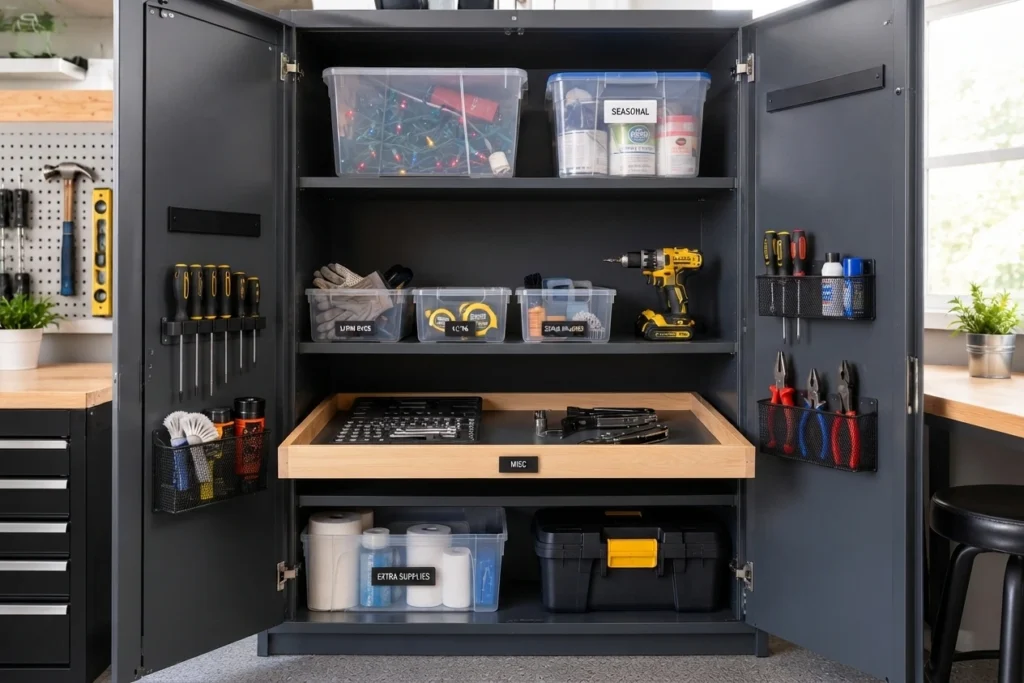
This is one of the simplest ways to make cabinet storage feel dramatically better.
Use this hierarchy:
Daily-use: Eye level/front
Weekly-use: Middle shelves
Monthly-use: Lower or secondary areas
Seasonal: Upper shelves
For example, a cordless drill used every week deserves a better location than a Christmas-decoration bin used once a year.
The principle is simple:
Prime storage space should go to the things you use most.
12. Label Cabinet Zones, Not Every Individual Item
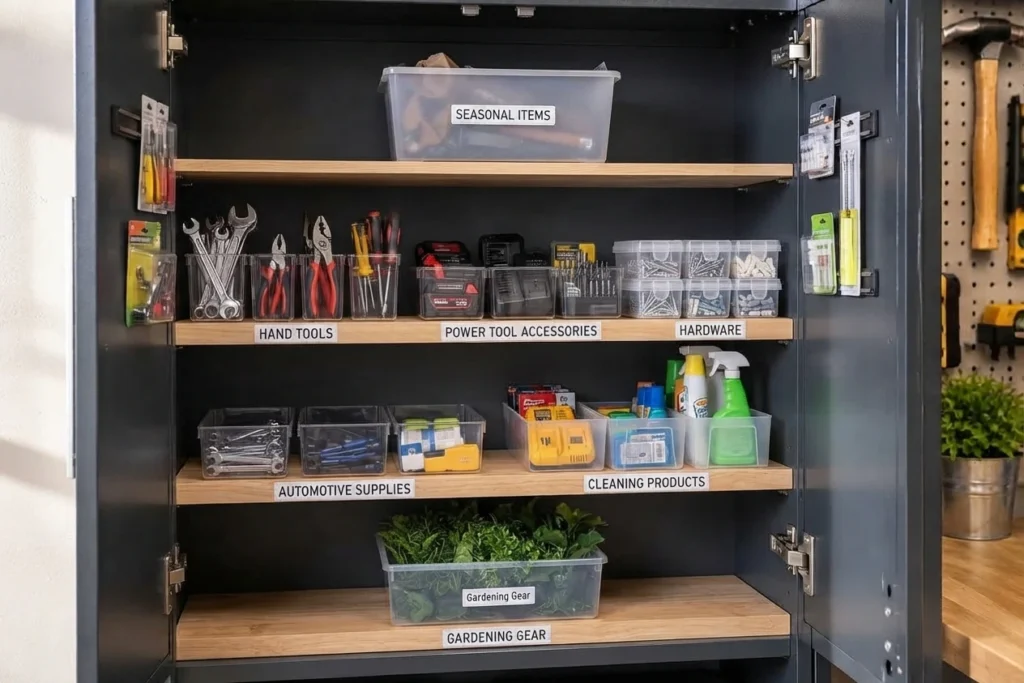
Labels can help shared garages stay organized.
Useful cabinet labels include:
- Hand Tools
- Power Tools
- Hardware
- Automotive
- Cleaning
- Garden
- Hobby
- Seasonal
You don’t need to label every single container.
Too many labels can actually make a cabinet visually noisy.
Use labels to make the destination obvious.
13. Use Vertical Dividers for Flat Items
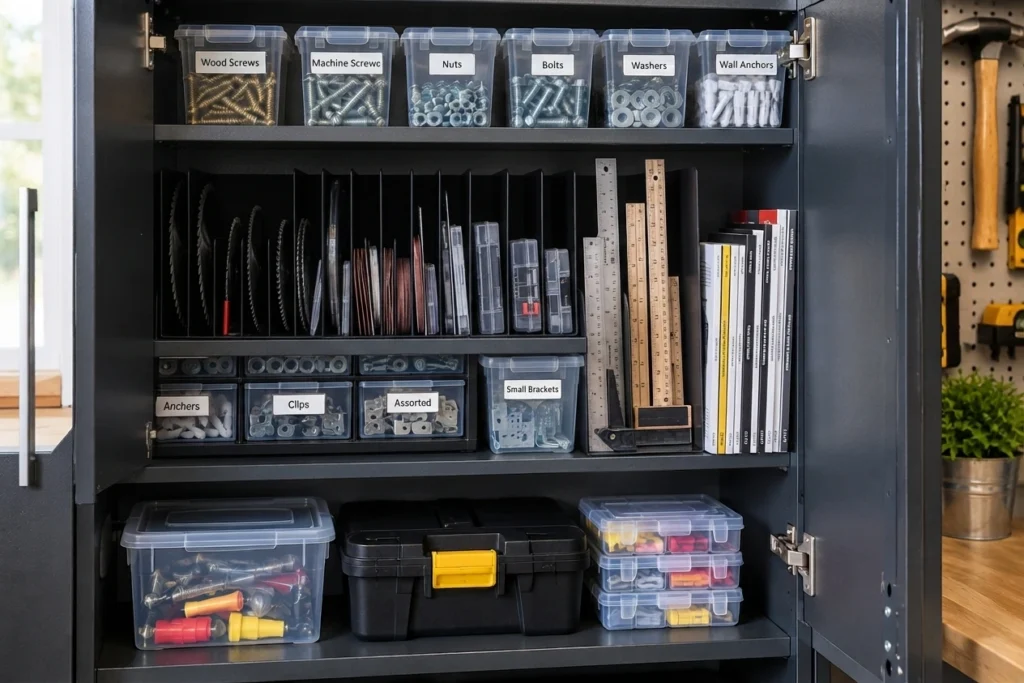
Some items shouldn’t be stacked horizontally.
Use vertical dividers for:
- Saw blades
- Sanding discs
- Flat cases
- Small trays
- Measuring equipment
- Manuals
- Thin accessories
Vertical storage makes individual items easier to remove without disturbing everything around them.
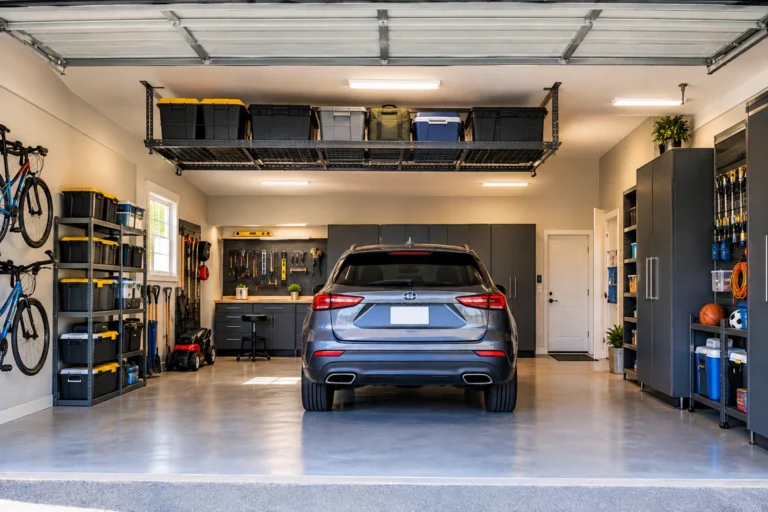
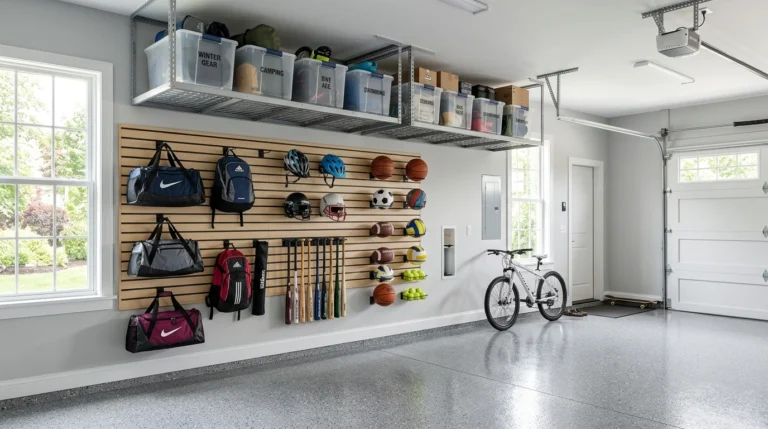
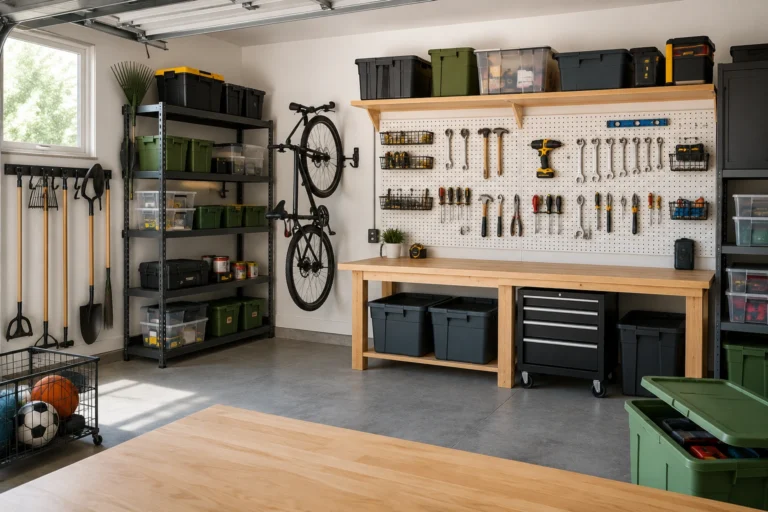
14. Combine Garage Cabinets With Wall Storage
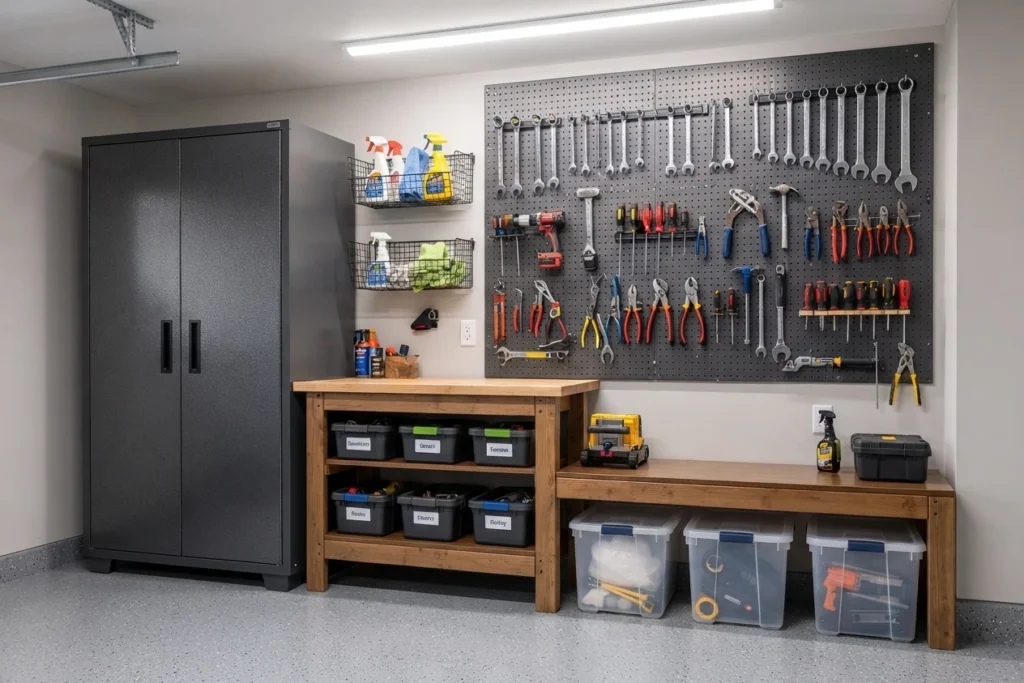
Cabinets don’t need to store everything.
A more functional garage often combines:
- Cabinets for enclosed storage
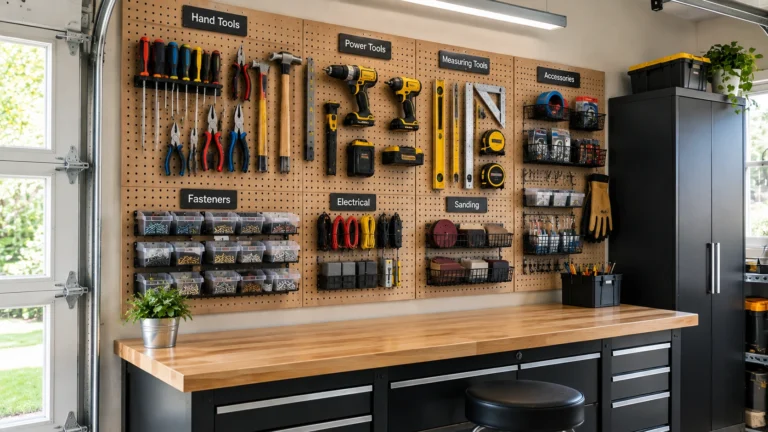
- Pegboards for frequently used hand tools
- Shelves for bins
- Hooks for equipment
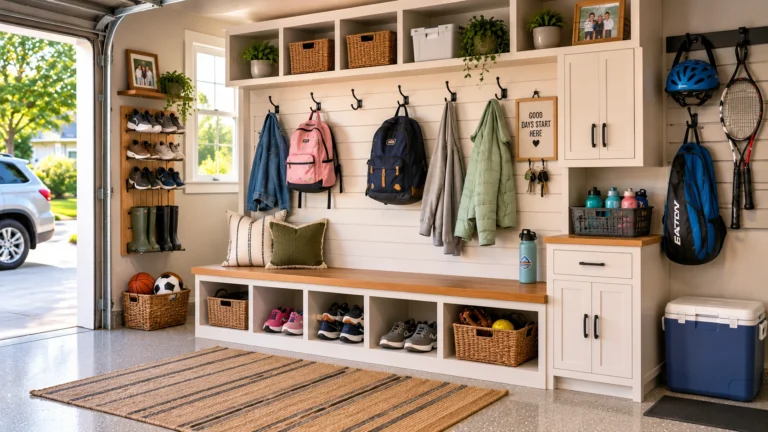
- Racks for bicycles or sports gear
Combining cabinets with practical garage pegboard ideas lets you keep frequently used tools visible while larger equipment and supplies stay enclosed.
Current garage-storage guides likewise recommend combining cabinets with pegboards, magnetic strips, shelving, and other storage systems rather than relying on cabinets alone.
15. Leave a Little Empty Space in Every Cabinet
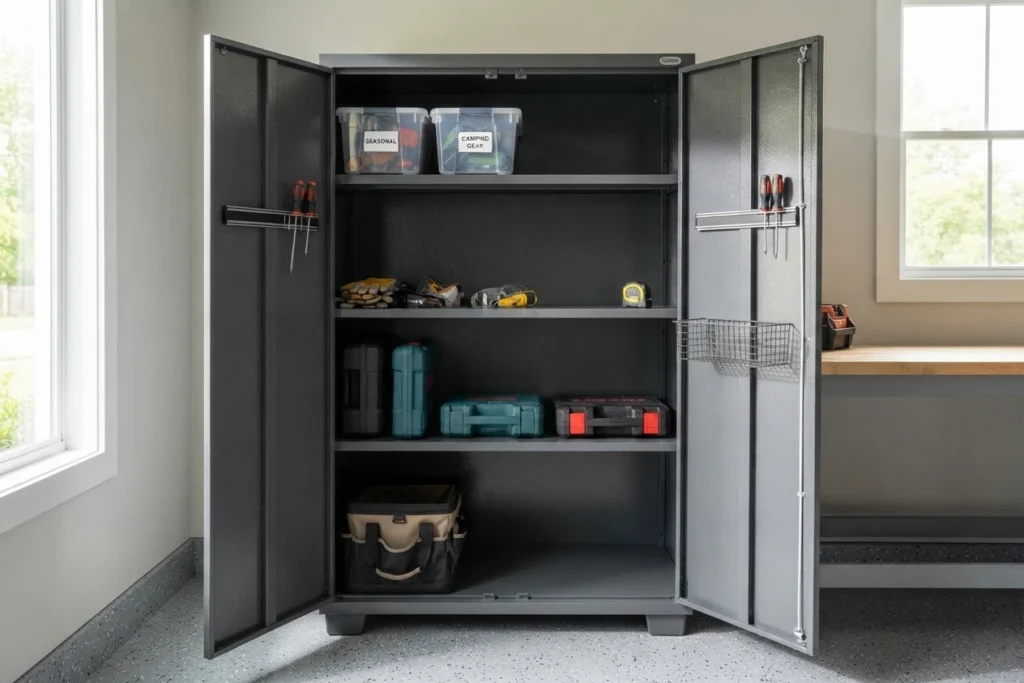
An entirely full cabinet isn’t necessarily an efficient cabinet.
Leave enough room to:
- Remove containers easily
- Add new tools
- Move categories around
- Handle future purchases
A good target is usable space, not maximum density.
If every shelf requires rearranging three other things just to retrieve one item, the cabinet is over-organized.
16. Create a Dedicated Hobby or Project Cabinet
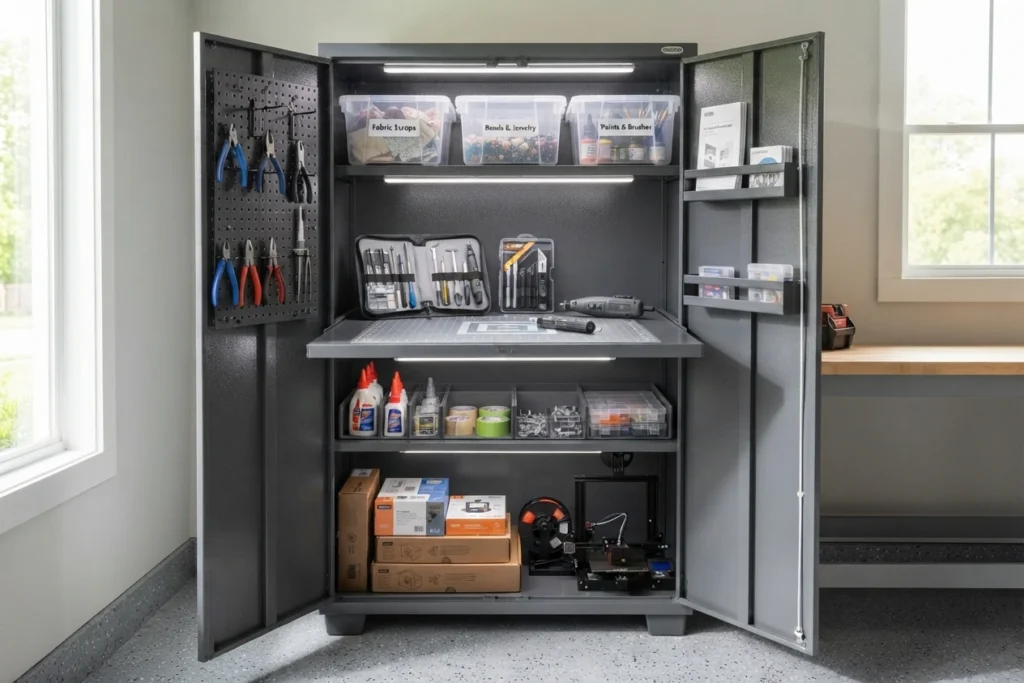
If your garage supports multiple hobbies, give major activities their own zones.
For example:
Woodworking: Sanding supplies, measuring tools, accessories
Automotive: Detailing and vehicle-care supplies
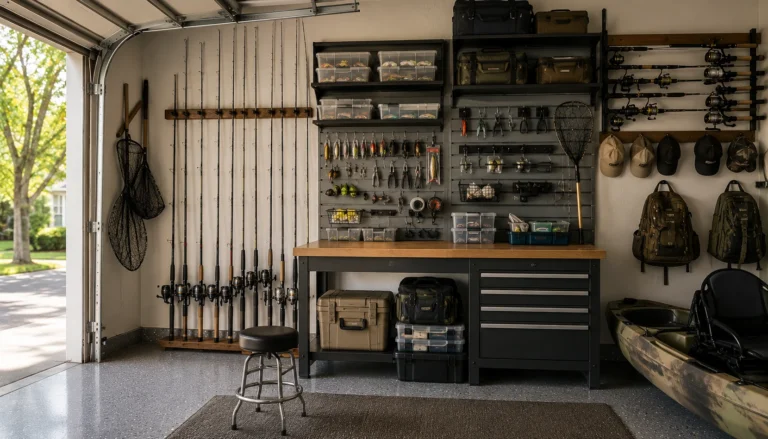
Fishing: Tackle accessories and smaller gear
Crafting: Adhesives, cutting tools, project materials
If fishing is one of your garage hobbies, these fishing gear storage ideas can help keep rods and related equipment organized without taking over your main cabinet space.
17. Keep Heavy Items on Lower Shelves
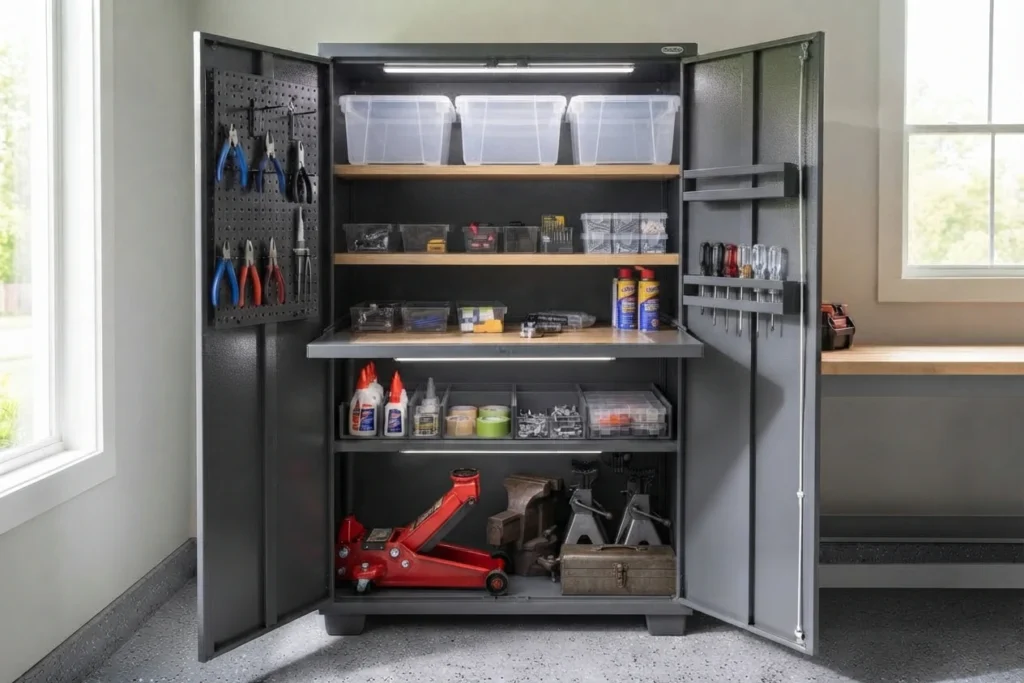
Heavy objects generally belong lower in the cabinet.
Examples include:
- Tool cases
- Large containers
- Bulk hardware
- Automotive products
- Heavy power tools
Upper shelves are better suited to lightweight items.
This also makes the cabinet more comfortable to use because you’re not repeatedly lifting heavy objects overhead.
18. Add a Small Parts Organizer Inside a Larger Cabinet
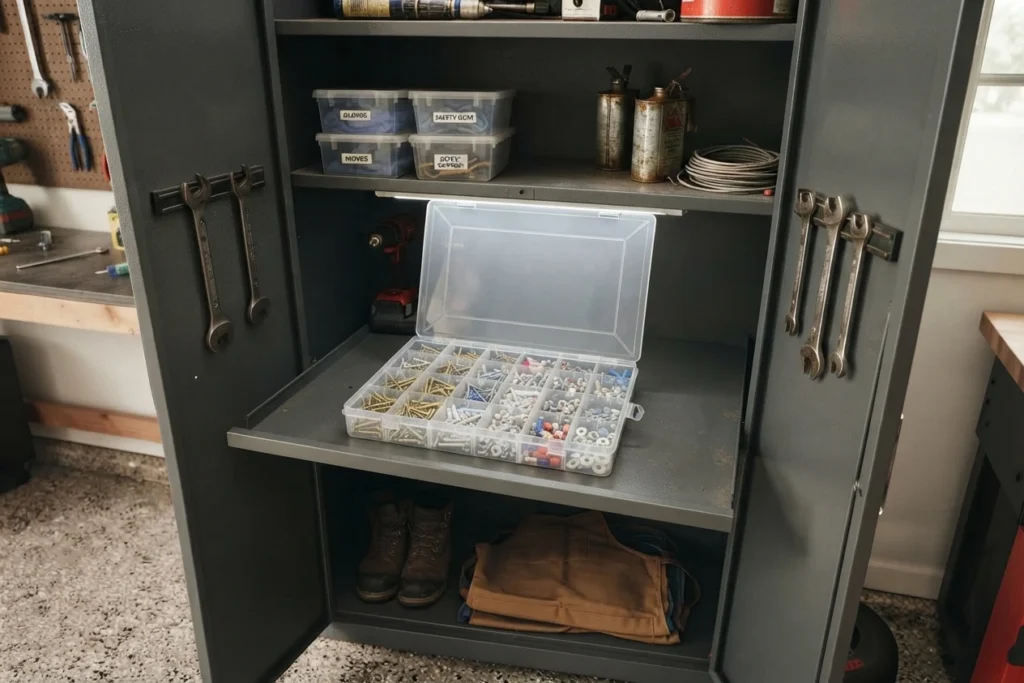
A large cabinet doesn’t mean every item needs a full shelf.
Put a compact parts organizer inside a larger cabinet for:
- Screws
- Nuts
- Bolts
- Washers
- Anchors
- Electrical components
This creates a dedicated small-parts station without allowing tiny pieces to spread across the entire cabinet.
19. Create a “Daily Use” Cabinet
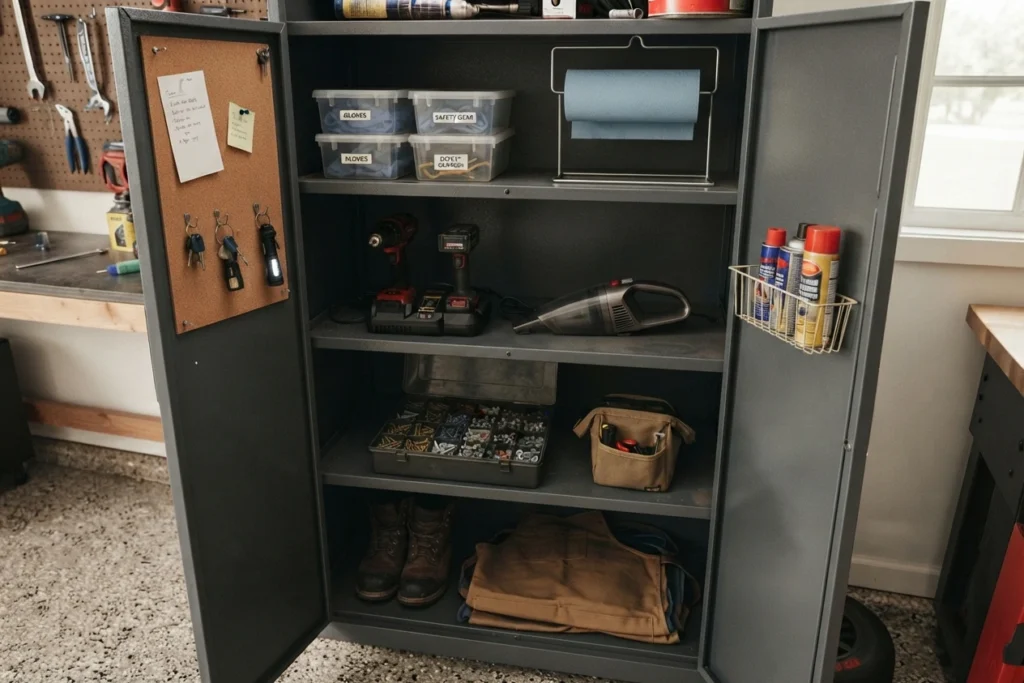
A dedicated daily-use cabinet can dramatically reduce everyday clutter.
Keep items such as:
- Tape measure
- Screwdrivers
- Pliers
- Work gloves
- Utility knife
- Flashlight
- Basic repair supplies
Place it near the workbench or primary garage work area.
The less effort it takes to return an item, the more likely you’ll actually put it away.
20. Keep Room for the System to Grow
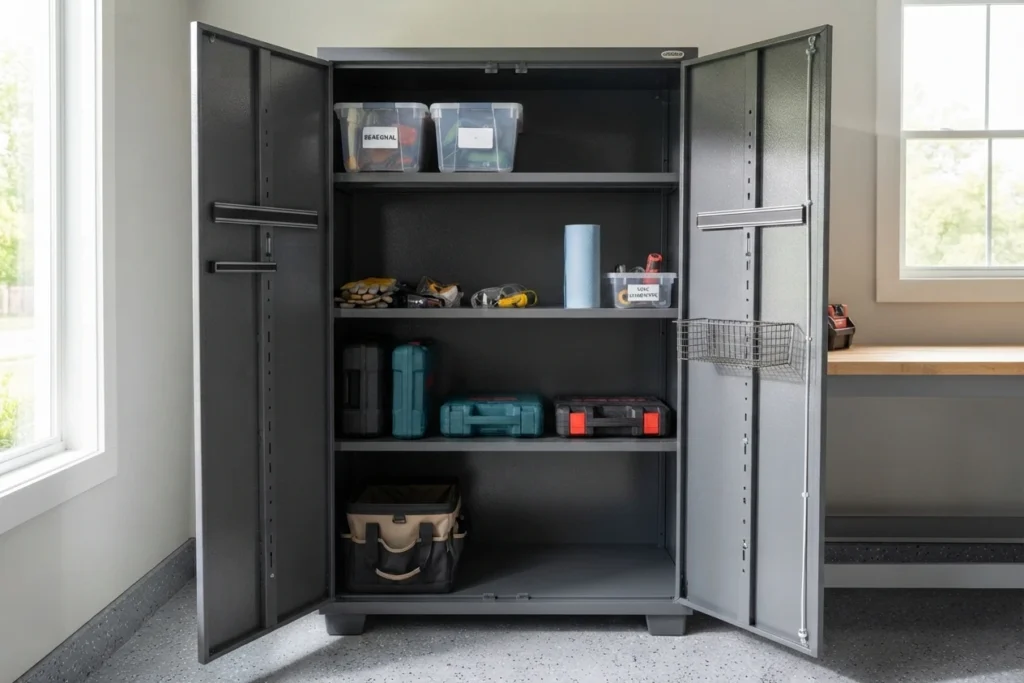
Garage storage needs change.
You may:
- Buy new tools
- Start a hobby
- Change vehicles
- Add gardening equipment
- Take up woodworking
- Accumulate seasonal gear
Don’t design your cabinets so tightly that one new item destroys the organization.
A little empty space today gives you flexibility tomorrow.
How to Maximize Every Inch of Garage Cabinet Storage?
If maximizing storage is the main goal, think in terms of usable capacity, not simply cubic volume.
Use the full cabinet height
Adjust shelf spacing to minimize unused vertical gaps.
Use cabinet doors
Move lightweight accessories to the door when clearance allows.
Use pull-outs for depth
Make the back of deep cabinets accessible.
Use vertical dividers
Store flat objects upright instead of stacking them.
Keep heavy items low
This improves accessibility and makes the cabinet easier to use.
Keep frequent-use items near the front
A storage system is only efficient if retrieving something is easy.
Leave clearance
Containers should slide out without hitting the shelf above them.
The most important principle is:
Maximize accessibility, not just capacity.
Garage Cabinets vs. Open Shelving: Which Is Better?
This is not really an either-or decision.
Current garage-storage content increasingly frames cabinets and shelving as complementary systems because they solve different problems. Cabinets are useful for concealed, protected, or secured storage, while open shelving excels at visibility and quick access.
Choose garage cabinets when you want:
- A cleaner appearance
- Concealed storage
- Protection from dust
- More controlled categories
- Lockable storage
- Less visual clutter
Choose open shelving when you want:
- Fast access
- Visibility
- Storage for bulky items
- Lower-cost capacity
- Easy rearrangement
Use both when:
- Tools need quick access
- Seasonal bins need open visibility
- Chemicals or valuable tools should be enclosed
- Bulky equipment doesn’t fit conveniently inside cabinets
- You want both function and a cleaner appearance
A hybrid system is often the most practical solution.
Example:
Cabinets → tools and supplies
Open shelves → labeled storage bins
Pegboard → daily hand tools
Hooks/racks → bikes and long equipment
Overhead → lightweight seasonal items
This lets each storage type do the job it handles best.
Which Type of Garage Cabinet Is Best for Organization?
| Cabinet Type | Best For |
| Wall-mounted cabinets | Small garages and preserving floor space |
| Freestanding cabinets | Flexible general storage |
| Base cabinets | Workbench and countertop areas |
| Tall cabinets | Bulky or mixed-size equipment |
| Rolling cabinets | Tools that need to move |
| Lockable cabinets | Valuable tools and restricted supplies |
Current garage cabinet guides recommend considering wall-mounted, freestanding, rolling, and other configurations according to the garage layout and storage requirements.
Don’t automatically choose the biggest cabinet.
Choose the cabinet configuration that fits your storage behavior and your garage layout.
Before Installing More Cabinets, Check Your Garage Clearance
This is especially important in a garage that still needs to function as a parking area.
Before installing a cabinet system, consider:
- Vehicle width
- Vehicle door-opening space
- Walking paths
- Cabinet depth
- Workbench clearance
- Garage-door movement
- Access to electrical panels
- Utility equipment
- Water heaters or other service areas
- Clearance around the garage entry
A beautiful cabinet wall isn’t useful if opening your car door becomes difficult.
A simple rule
Plan the garage around movement first, then storage.
Measure the space with the vehicles parked where they normally sit.
Then identify the walls and zones where storage can be added without creating bottlenecks.
This is one reason current garage-storage guidance emphasizes planning and measuring before purchasing cabinets.
Garage Cabinet Organization Ideas for a Small Garage
Small garages require more deliberate storage decisions.
Choose Vertical Storage
Tall cabinets can use wall height without consuming as much floor space.
Consider Wall-Mounted Cabinets
They can preserve floor area where appropriate.
Put Cabinets Around a Workbench
A base-cabinet/workbench combination can provide both workspace and enclosed storage.
Keep the Floor Clear
Don’t use floor space for items that can safely move onto walls, shelves, or cabinets.
Avoid Excessively Deep Storage
A very deep cabinet can create accessibility problems if its contents aren’t organized carefully.
Move Seasonal Items Higher
Rarely used equipment shouldn’t consume your easiest-to-reach cabinet positions.
A Simple Garage Cabinet Organization Layout
If you’re starting from scratch, consider a layout like this:
| Cabinet | Purpose | Ideal Position |
| 1 | Everyday tools | Closest to workbench |
| 2 | Power tools + batteries | Near work area |
| 3 | Hardware | Easy-to-reach |
| 4 | Automotive | Near vehicle area |
| 5 | Cleaning | Secondary access |
| 6 | Garden + hobbies | Secondary zone |
| Upper storage | Seasonal | Least-accessible position |
Then use wall storage for:
- Bicycles
- Garden tools
- Sports equipment
- Pegboard tools
- Kayaks
- Ladders
- Other oversized equipment
This keeps cabinets from becoming overloaded.
What Should You Store in Garage Cabinets?
Garage cabinets are particularly useful for:
- Hand tools
- Power tools
- Hardware
- Automotive supplies
- Cleaning supplies
- Gardening accessories
- Hobby supplies
- Seasonal items
- Household overflow
But not everything belongs in a cabinet.
Large bicycles, kayaks, ladders, long-handled garden tools, and oversized sports equipment may use wall, ceiling, or floor storage more efficiently.
Use cabinets where enclosed storage provides a genuine advantage.
DIY Garage Cabinet Organization Ideas
You don’t have to replace your entire cabinet system.
Simple upgrades can include:
- Building removable dividers
- Adding adjustable shelves
- Creating custom drawer inserts
- Installing pull-out trays
- Adding door organizers
- Building vertical separators
- Creating small-parts compartments
- Adding labels
If you enjoy building your own storage upgrades, these DIY garage storage ideas can give you additional ways to customize your garage without replacing the entire system.
DIY cabinet modifications can be especially useful when standard organizers don’t match your cabinet dimensions.
What Should You Consider Storing More Carefully?
Garage storage often includes products and equipment that require more attention than ordinary household items.
Chemicals and cleaning products
Follow product-label storage instructions and keep incompatible substances separated.
Flammable products
Store them according to their labels and applicable safety guidance, away from ignition sources.
Sharp tools
Keep blades and sharp equipment contained and positioned so they cannot accidentally cause injury.
Heavy containers
Keep them low where practical.
Valuable tools
Consider lockable storage if security is important.
Child-accessible areas
Keep hazardous or inappropriate products securely stored away from children.
Organization should make the garage safer and more controlled, not simply more attractive.
How to Keep Garage Cabinets Organized Long Term?
Put Things Back Immediately
Every item should have an obvious destination.
Do a 10-Minute Reset
Every few weeks, return misplaced items to their correct zones.
Remove Duplicates
If you find multiple versions of the same item, decide whether you actually need all of them.
Reorganize When Your Needs Change
Your garage isn’t static.
A new hobby or new equipment may justify creating a new zone.
Don’t Buy Organizers Before Understanding the Problem
More bins don’t automatically mean better organization.
Sometimes the correct solution is simply removing unused items or changing shelf placement.
10 Useful Products for Garage Cabinet Organization
These products work best when they solve a specific storage problem:
1. Adjustable Shelf Organizers
For shelves with inefficient spacing.
2. Pull-Out Cabinet Shelves
For deep cabinets.
3. Clear Storage Bins
For visible category storage.
4. Stackable Bins
For using vertical cabinet space.
5. Small-Parts Organizers
For screws, bolts, washers, and similar pieces.
6. Cabinet-Door Organizers
For recovering unused door space.
7. Shelf Dividers
For flat or narrow items.
8. Drawer Organizers
For small tools and accessories.
9. Label Makers
For shared or multi-category garages.
10. Battery and Tool Organizers
For cordless-tool systems.
Garage Cabinet Organization Mistakes to Avoid
Filling Every Shelf Completely
Dense isn’t always efficient.
Buying Organizers Before Measuring
Always measure the actual cabinet interior.
Ignoring Cabinet Depth
Deep storage needs a plan for accessing the back.
Putting Daily Items in Difficult Locations
Prime storage should go to frequently used items.
Putting Heavy Items High
Keep heavy equipment low where practical.
Mixing Too Many Categories
A cabinet containing tools, chemicals, cleaning products, and gardening supplies becomes difficult to maintain.
Ignoring Vehicle Clearance
Don’t sacrifice parking and walking space just to gain storage.
Organizing Only for Appearance
A beautiful cabinet isn’t useful if finding one screwdriver requires moving six containers.
Convenience should come before visual perfection.
Which Garage Cabinet Organization Ideas Should You Start With?
If your cabinets are currently chaotic, don’t reorganize the entire garage at once.
Start with the cabinet you use most.
Step 1: Empty it.
Step 2: Group everything.
Step 3: Remove duplicates.
Step 4: Apply Category + Frequency + Location.
Step 5: Adjust shelf heights.
Step 6: Solve deep-storage problems.
Step 7: Use door space where appropriate.
Step 8: Label major zones.
Step 9: Leave some empty capacity.
Step 10: Repeat with the next cabinet.
This approach is much easier than buying a huge collection of organizers and hoping they solve the problem.
Frequently Asked Questions
What is the best way to organize garage cabinets?
Assign each cabinet a clear purpose, group similar items, then organize those items by frequency of use and location. Keep daily-use items accessible, heavy items low, and seasonal items higher or farther away.
How do I maximize space inside garage cabinets?
Use adjustable shelves, pull-out storage, vertical dividers, stackable containers, cabinet-door organizers, and compact drawer systems. The key is maximizing usable space rather than simply filling the cabinet.
How do I organize deep garage cabinets?
Use pull-out shelves, sliding bins, drawers, or removable containers so the back remains visible and accessible.
Should I choose garage cabinets or open shelving?
Neither is automatically better. Cabinets are useful for concealed, protected, or secure storage, while shelving works well for bulky or frequently accessed items. Many garages benefit from combining both.
How do I organize a small garage with cabinets?
Prioritize vertical storage, wall-mounted cabinets where appropriate, shallow or accessible storage, and careful vehicle clearance. Keep seasonal items higher and everyday items within easy reach.
What should go on the top shelf of a garage cabinet?
Lightweight and infrequently used items are generally better candidates. Seasonal decorations and backup supplies are common examples.
Should tools be stored in garage cabinets?
Yes. Larger or less frequently used tools can work well inside cabinets, while frequently used hand tools may be more convenient on a pegboard or wall system.
How often should garage cabinets be reorganized?
Do a quick reset every few weeks and perform a larger reorganization whenever your storage needs change.
Final Thoughts
The best garage cabinet organization ideas aren’t about fitting the maximum number of objects behind every cabinet door.
They’re about creating a system that works with the way your garage is actually used.
Start with Category + Frequency + Location.
Then assign each cabinet a clear purpose. Put everyday items where they’re easiest to reach, heavy items lower, and seasonal supplies in less convenient locations. Use adjustable shelves to eliminate wasted height, pull-outs to solve deep-cabinet access, and cabinet doors for appropriate lightweight storage.
And don’t force everything into cabinets.
A well-organized garage usually combines cabinets with shelving, pegboards, hooks, racks, and other storage systems. Current garage-storage guidance increasingly supports this hybrid approach because each system solves a different problem.
Most importantly, plan around movement before storage. Your car doors, walking paths, workbench, utilities, and everyday activities all need room.
When you can find an item quickly, return it easily, and still have room for the garage to evolve, your cabinet system is doing its job.