15 Garage Ball Storage Ideas for a Clutter-Free Garage
Affiliate Disclosure: This article contains affiliate links. If you purchase through one of these links, we may earn a commission at no additional cost to you. As an Amazon Associate I earn from qualifying purchases.
A basketball rolling under the car, soccer balls collecting beside the garage door, and smaller balls scattered across the floor can make an otherwise organized garage feel messy. The problem usually isn’t the number of balls—it’s that none of them has a convenient place to go after playtime.
The best garage ball storage system keeps balls contained, easy to reach, and simple to put away. Depending on your space, that might mean a wall-mounted rack, a DIY bungee organizer, a low basket for children, or a dedicated shelf for seasonal equipment.
Before choosing a solution, consider how many balls you own, which ones your household uses most often, and how much wall and floor space is available. These 15 ideas can help you create a system that fits your garage instead of adding another bulky organizer to it.
Table of Contents
Before You Choose a Garage Ball Storage Solution
Take a few minutes to assess your collection and available space. This small step can prevent you from buying a rack that is too narrow or a storage container that makes everyday balls difficult to retrieve.
- Count and group your balls. Separate basketballs, soccer balls, footballs, volleyballs, and smaller balls such as tennis or baseballs.
- Measure the available space. Check the width and height of the wall, the depth of any proposed storage unit, and the floor area you can spare.
- Consider who uses the equipment. Balls used by children should be reachable without climbing or pulling down heavy containers.
- Think about access frequency. Everyday equipment benefits from open storage, while seasonal balls can be stored farther away.
- Check the installation requirements. Wall-mounted racks need suitable support and hardware. Renters may prefer freestanding options or systems that can be installed with permission.
Keep the garage door tracks, vehicle doors, walkways, and electrical equipment clear. A storage solution is only useful if it fits safely into the way your garage operates.
1. Install a Wall-Mounted Ball Rack
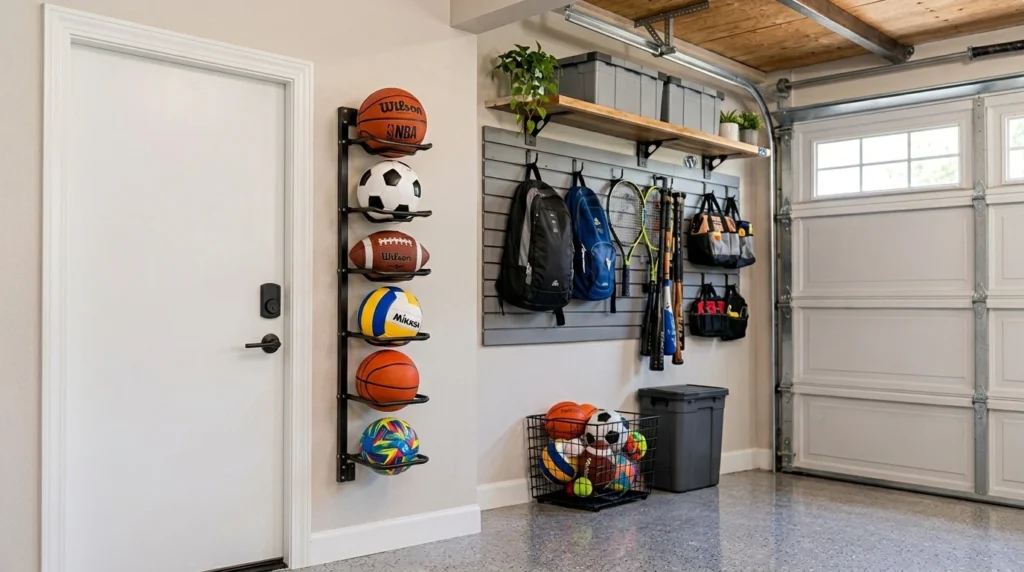
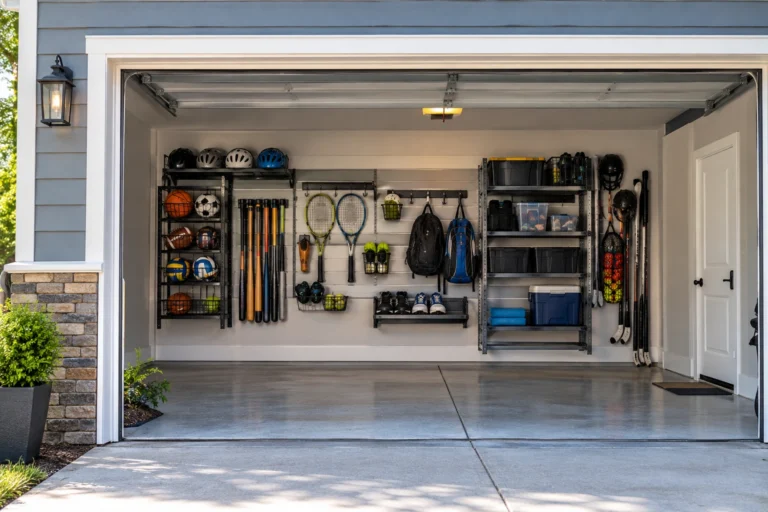
A wall-mounted ball rack is one of the most straightforward options for a household with several basketballs, soccer balls, or volleyballs. It keeps balls together, reduces floor clutter, and makes it easier to see what is available.
If you want to organize more than just sports balls, these garage wall storage ideas can help you make better use of vertical space for tools, equipment, and everyday items.
Choose a rack designed for the types and sizes of balls you own. Check its dimensions, capacity, mounting instructions, and weight rating rather than assuming every rack will accommodate every sport.
Place frequently used balls at a convenient height near the garage entry or the route leading to the yard. Before drilling, locate suitable structural support and confirm that the rack will not interfere with vehicle doors or other stored equipment.
Best for: Families with several regularly used balls who want a permanent, easy-access solution.

Keep basketballs, soccer balls, and other sports balls off the garage floor. It helps free up walking space while keeping frequently used balls organized and easy to grab. [#CommissionEarned]
View Latest Price on Amazon →
2. Build a DIY Bungee-Cord Ball Organizer
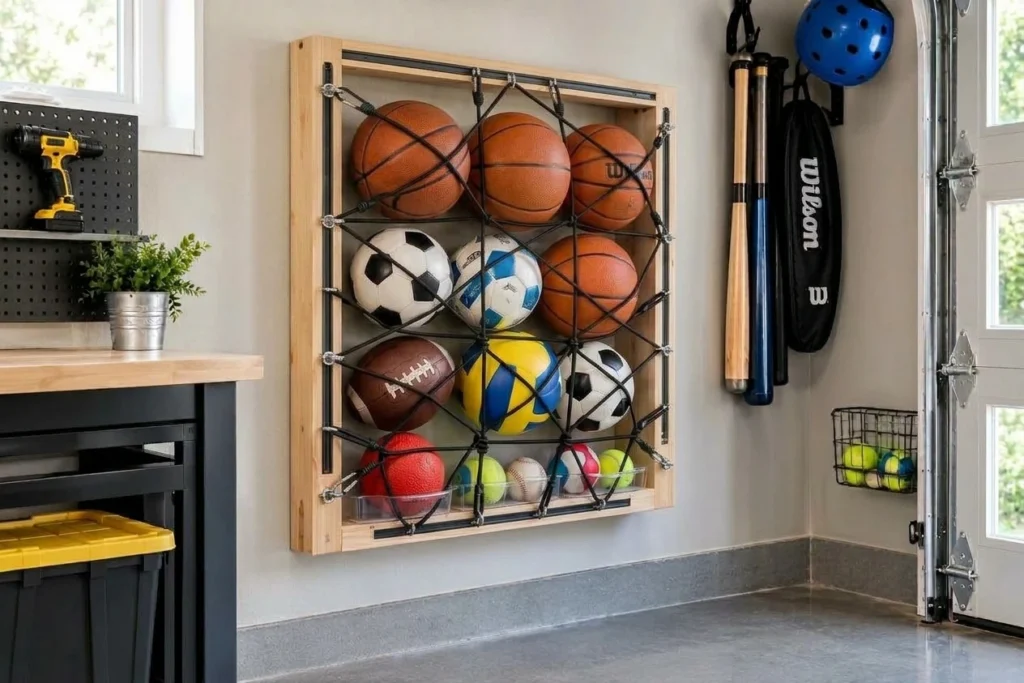
If you enjoy simple DIY projects, a bungee-cord organizer can provide flexible storage without requiring a separate shelf for every ball.
One design uses a sturdy wooden frame with elastic cords stretched across its opening. Balls can be pushed through the cords for storage and pulled out when needed. A similar arrangement can be adapted to a suitable existing cabinet or box.
The important part is building the frame securely. Attach it to appropriate structural support, use compatible fasteners, and choose cords designed for the intended application. Avoid exposed hooks or stretched cords that could snap back toward someone’s face.
Plan the opening around your largest balls, not just the smaller ones. Leave enough space to remove a ball without forcing the frame or stretching the cords excessively.
Best for: DIY-minded homeowners who want a customizable organizer and have suitable tools and mounting options.
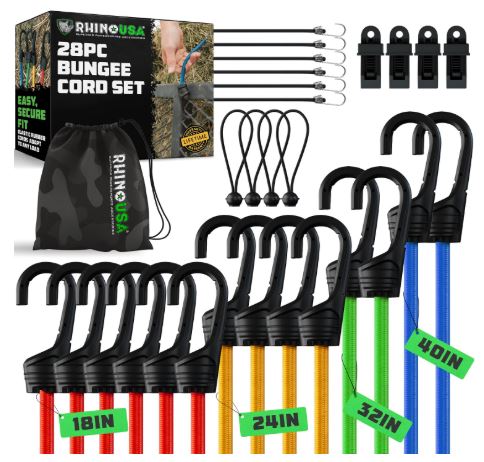
Use heavy-duty bungee cords to create a simple DIY ball organizer that keeps sports balls contained in one designated spot. This budget-friendly approach can help reduce floor clutter while keeping balls accessible for everyday play. [#CommissionEarned]
Read Details on Amazon →
3. Use a Corner Ball Hammock
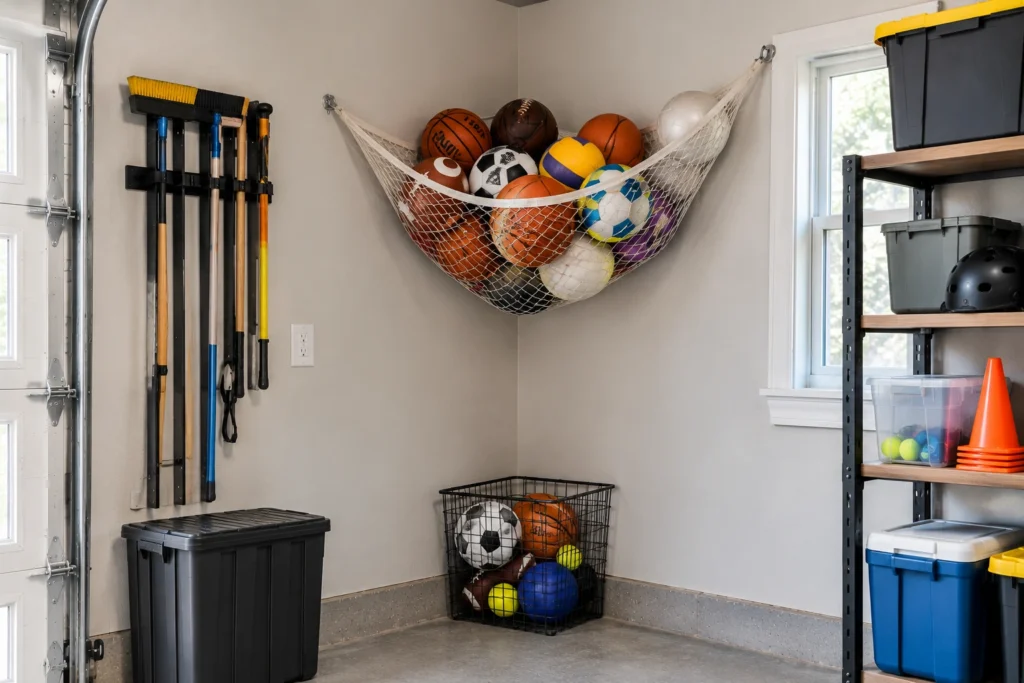
A corner hammock makes use of space that often goes unused. The net stretches across a corner and holds several balls above the floor, leaving the area below available for other equipment.
This can work well in a garage where the walls are already occupied by shelving, bicycles, or tools. It is also a useful option when you want a relatively simple storage area without installing a full rack.
The main trade-off is accessibility. Balls placed at the back or top may be harder to retrieve, and a heavily loaded net can sag if it is unsuitable for the load. Follow the manufacturer’s mounting and capacity instructions, and avoid positioning it where a falling ball could hit a vehicle or obstruct a walkway.
Best for: Households with limited uninterrupted wall space and a suitable, otherwise unused corner.
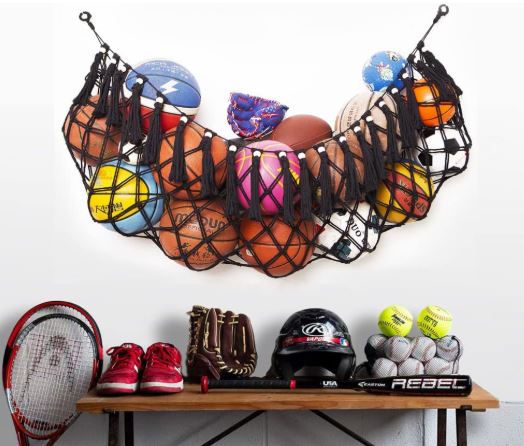
Turn an unused garage corner into practical sports storage with a corner ball net. It keeps balls together and off the floor, making it easier to maintain a tidy garage without using valuable wall or shelf space elsewhere. [#CommissionEarned]
View More on Amazon →
4. Mount a Wire Basket for Frequently Used Balls
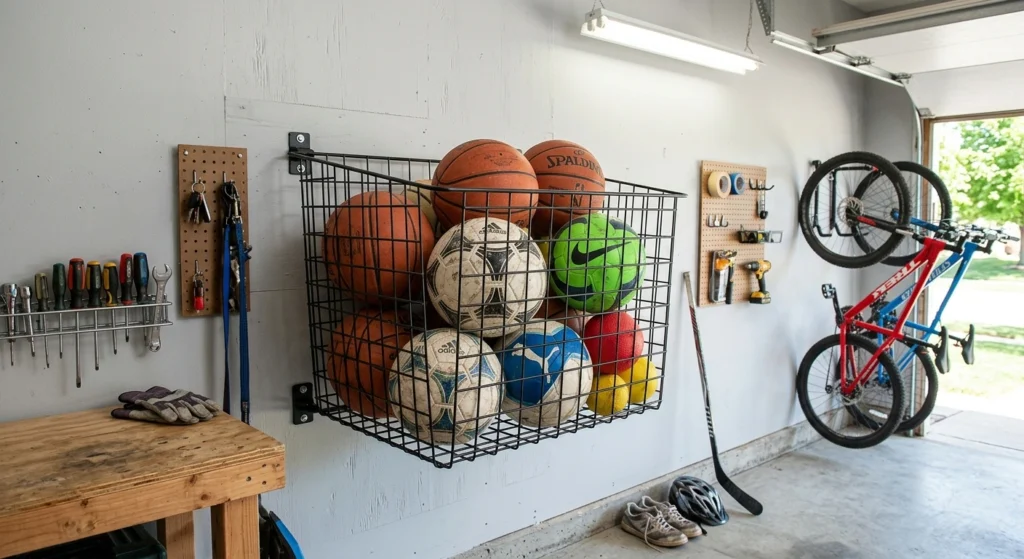
A wall-mounted wire basket is useful when your priority is quick access rather than keeping each ball in a separate holder.
Unlike individual racks, a basket lets family members drop balls into one contained space. Its open construction also makes the contents visible and allows more airflow than a closed plastic container.
Choose a basket with enough depth and an opening that prevents balls from rolling out easily. Check that its mounting system is appropriate for the wall and intended load. If the basket will hold balls of several sizes, confirm that smaller ones cannot slip through the wire gaps.
To keep it from becoming a mixed-equipment dumping area, reserve it for balls and give other gear its own location.
Best for: Busy families who want a simple, open storage area for everyday sports balls.
5. Set Up a Low, Open Bin for Kids
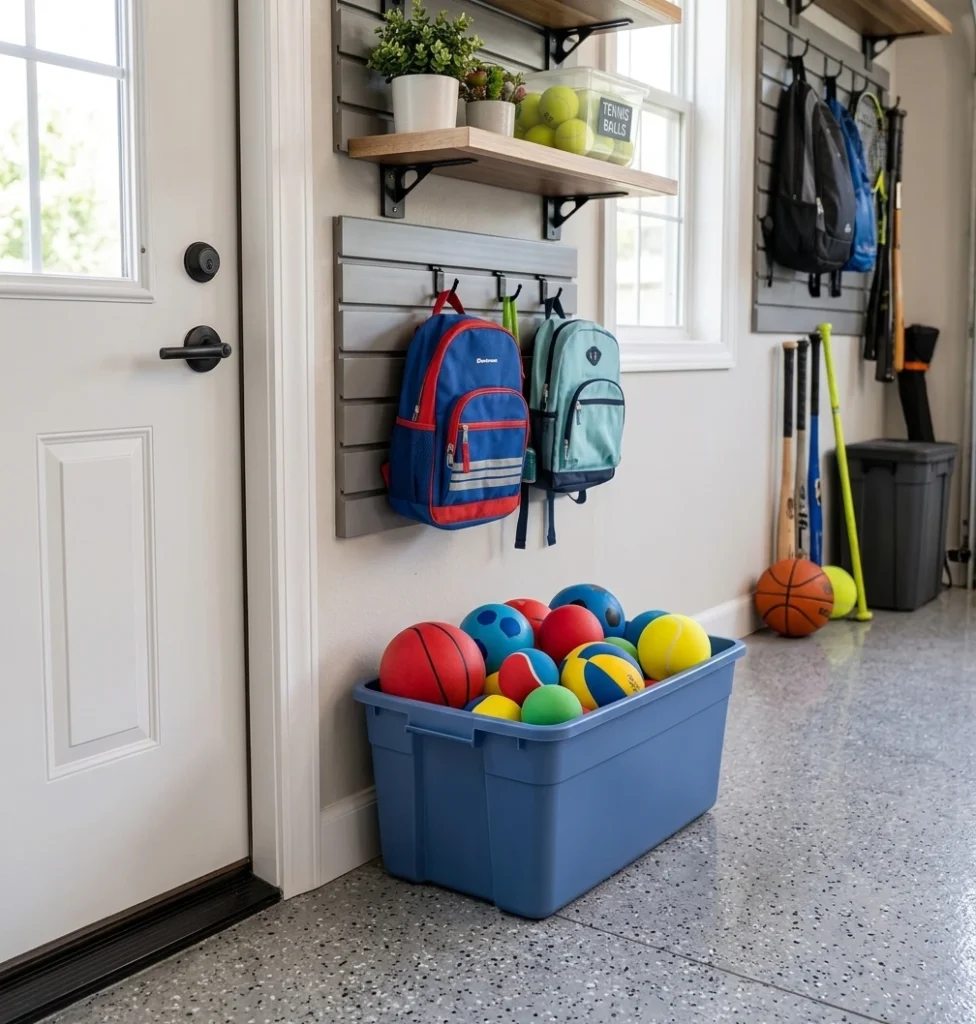
When children are responsible for putting their own equipment away, accessibility can matter more than appearance. A low, open bin gives them a clear target without requiring them to lift a lid or reach overhead.
Choose a container with a stable base and enough room to remove balls without tipping the whole bin over. If it is placed directly on the floor, position it outside the vehicle’s path and away from the garage door’s movement.
This option is especially practical for foam balls, playground balls, and other lightweight equipment. If you mix large and small balls, consider a divider or separate small container so the smaller items don’t disappear beneath the larger ones.
Best for: Families with young children and a small collection of lightweight balls.
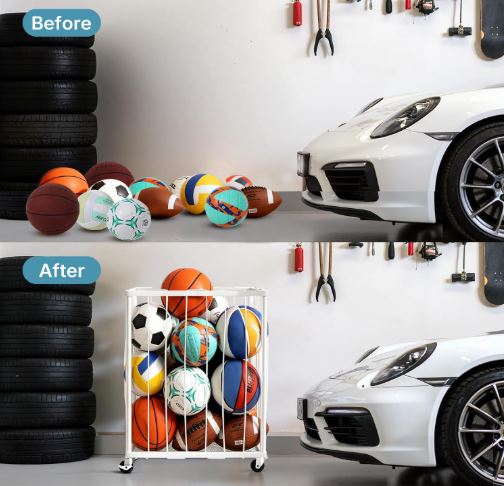
The ball storage cart can holds 12-15 full-size basketballs. This ball holder can adapt to various indoor and outdoor environments. The bottom is equipped with a metal wire mesh, which makes the load-bearing more stable, effectively avoids collapse, and can be used for a longer time. [#CommissionEarned]
Buy on Amazon →
6. Dedicate One Section of Adjustable Shelving to Balls
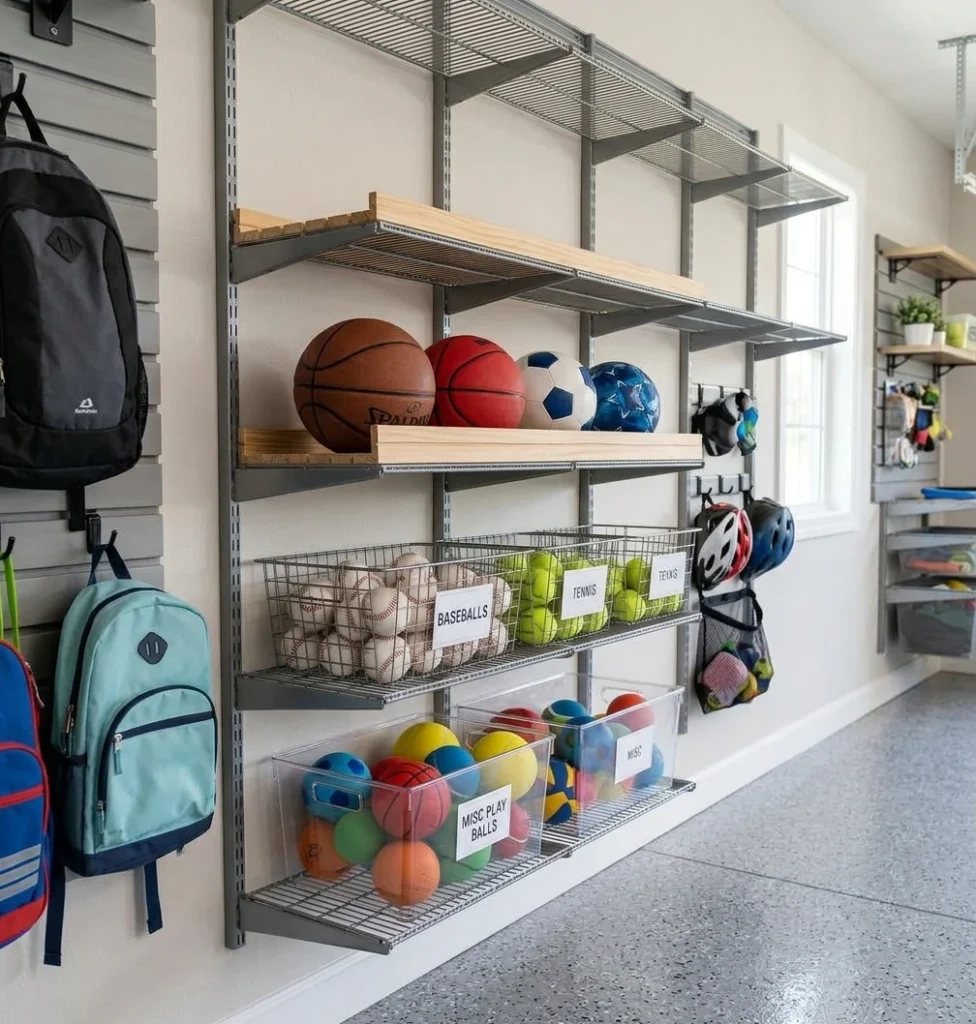
Adjustable garage shelving can be useful when balls are only one part of a larger sports collection. A shelf can hold everyday balls, while nearby levels accommodate helmets, gloves, water bottles, or labeled equipment bins.
Reserve a shelf or a clearly defined section for balls instead of mixing them with unrelated items. A shallow-sided shelf or suitable basket can help stop round objects from rolling off.
If you need to store smaller sports accessories out of sight, these garage cabinet organization ideas can help keep less frequently used items contained.
Check the shelving unit’s load rating and keep heavier items on lower levels. If the shelf is deep, avoid stacking balls so far back that you have to move several items to reach the one you need.
Best for: Garages that need one coordinated storage area for balls and other sports equipment.
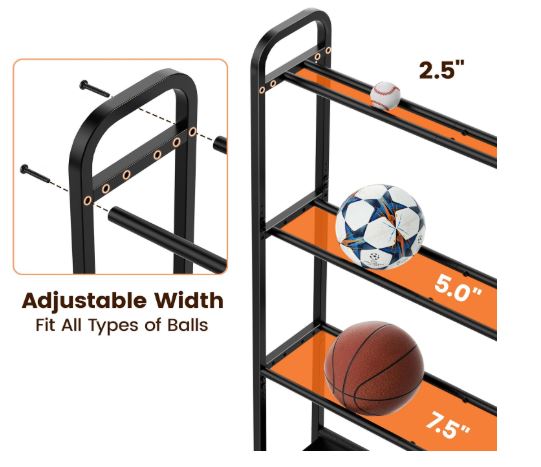
Designed to hold basketballs, footballs, volleyballs, soccer balls, and even larger training balls. With adjustable shelf spacing from 2.5 to 7.5 inches, it securely fits a wide range of sizes—no more wobbling or rolling off. [#CommissionEarned]
Read Reviews on Amazon →
7. Add Ball Baskets to an Existing Slatwall System
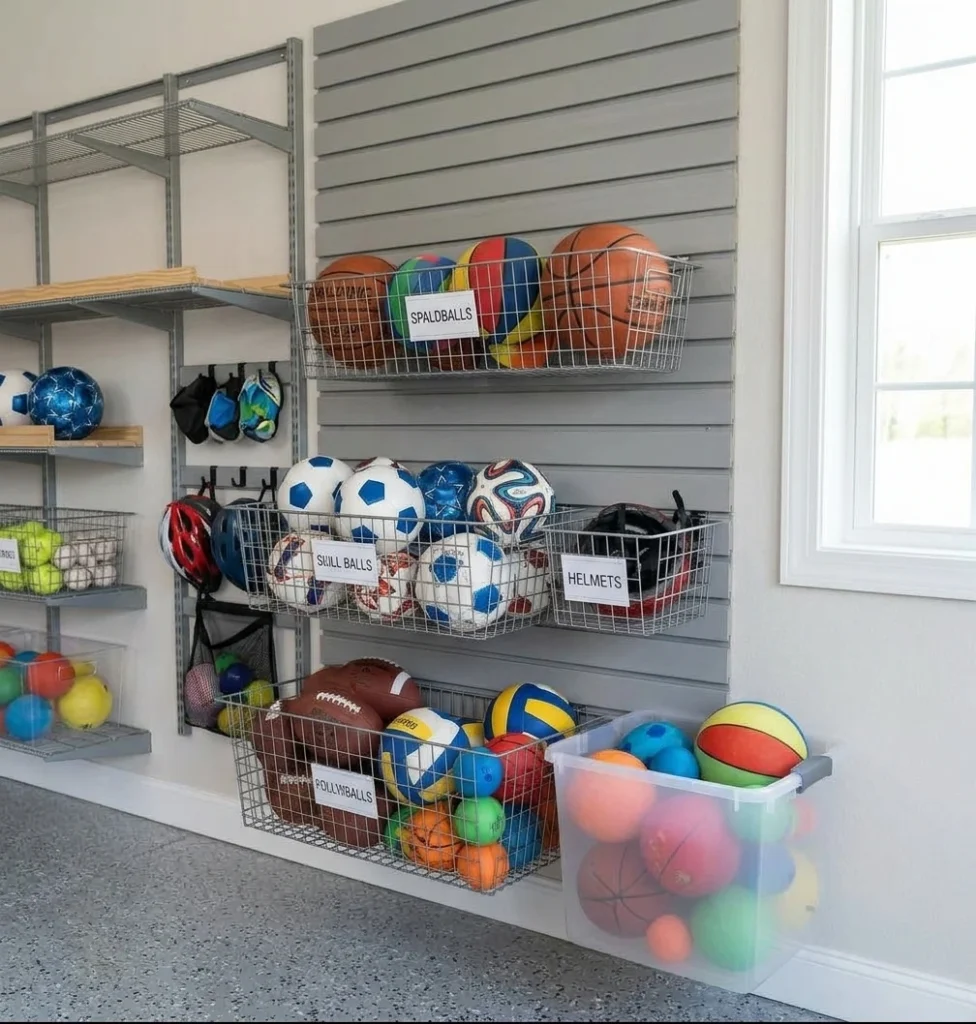
If your garage already has slatwall, compatible baskets or ball holders can expand your storage without requiring an entirely new wall system.
The benefit is flexibility. Depending on the system, accessories can be rearranged when your household changes sports or needs a different layout. A basket can hold several balls, while nearby hooks or shelves accommodate other gear.
Compatibility matters: slatwall accessories are not universally interchangeable. Check the panel and accessory specifications, installation instructions, and load limits before adding a loaded basket.
Keep everyday equipment at an accessible height and place less frequently used items elsewhere on the wall.
Best for: Homeowners who already use slatwall and want to adapt their existing storage.
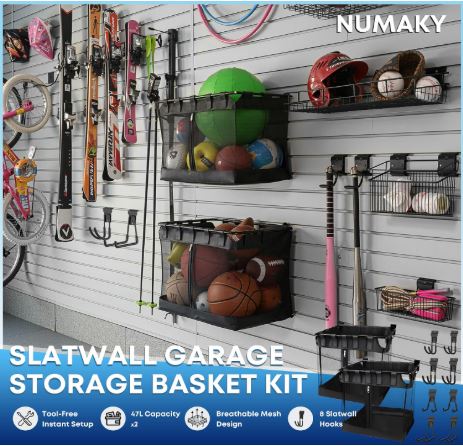
Add a sports ball basket to your existing garage slatwall system to keep balls organized and within easy reach. This setup makes use of vertical space while leaving more of the garage floor open for parking and other activities. [#CommissionEarned]
Check Ratings on Amazon →
8. Choose a Freestanding Vertical Ball Tower
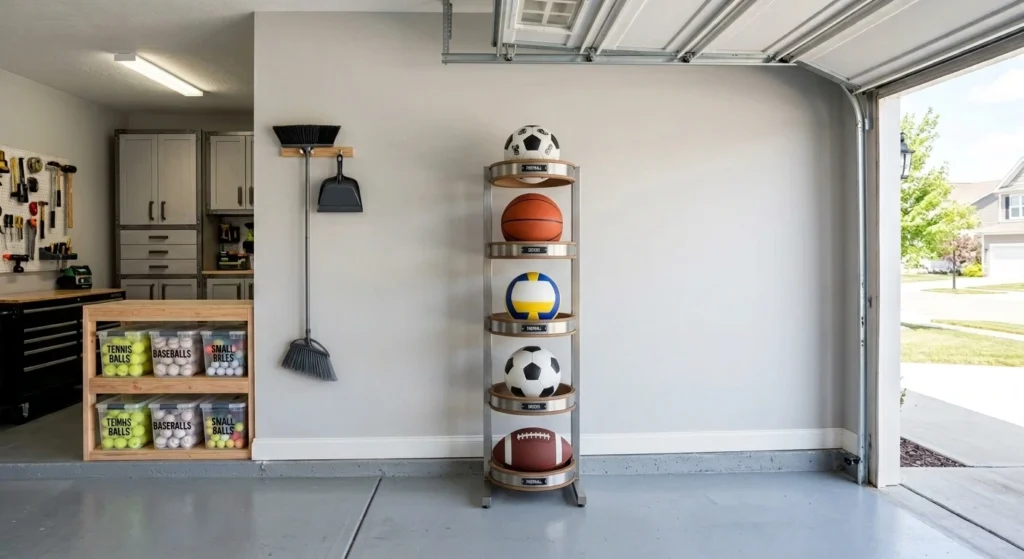
A vertical ball tower can group several balls in a relatively narrow footprint. It may be useful when wall mounting is impractical, drilling is not allowed, or you want a storage unit that can be moved when the garage layout changes.
Look for a stable base, secure ball-retaining sections, and a design suitable for your collection. A tall, narrow unit can become unstable if it is overloaded or if its contents are unevenly distributed, so follow the manufacturer’s instructions for placement and loading.
Measure the full footprint, including any space needed to remove balls. A unit that fits in a corner but blocks a vehicle door or walking route is not a good fit.
Best for: Garages that need a freestanding alternative to wall-mounted storage.
9. Sort Smaller Balls Into Labeled Containers
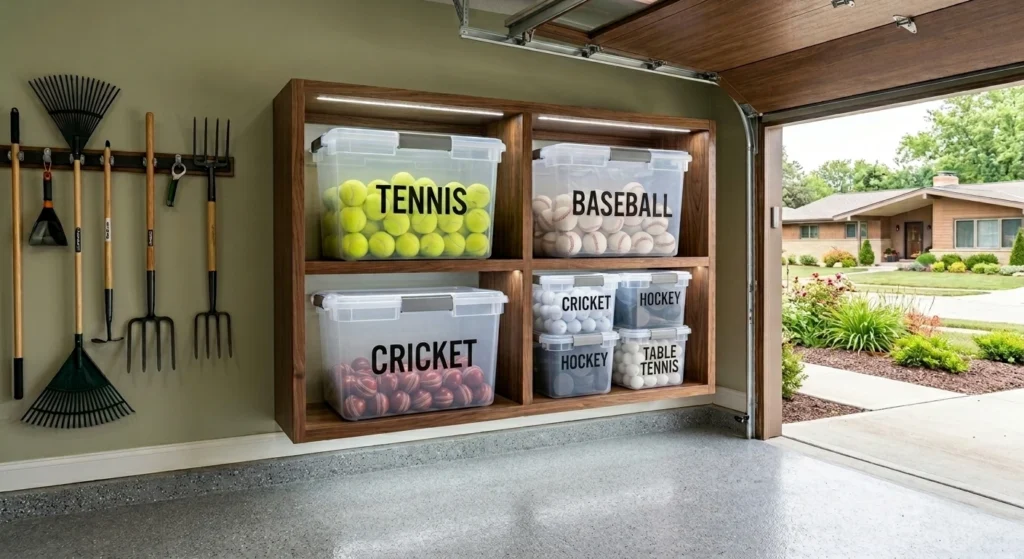
Tennis balls, baseballs, practice balls, and other small sports balls can easily disappear among larger equipment. Small containers keep these items together and prevent them from rolling into corners or underneath shelves.
Use a separate container for each useful category, such as “Tennis,” “Baseball,” or “Playground Balls.” Clear containers make the contents visible, while opaque bins can create a more uniform look when stored on shelving.
Choose containers that are easy to open and lift. Avoid filling a large, deep bin with every small ball you own; the items at the bottom can become difficult to find.
If the balls are used regularly, keep the containers at an accessible height rather than placing them on a high shelf.
Best for: Small balls and accessories that are easily lost or mixed together.
10. Use a Rolling Cart for Flexible Storage
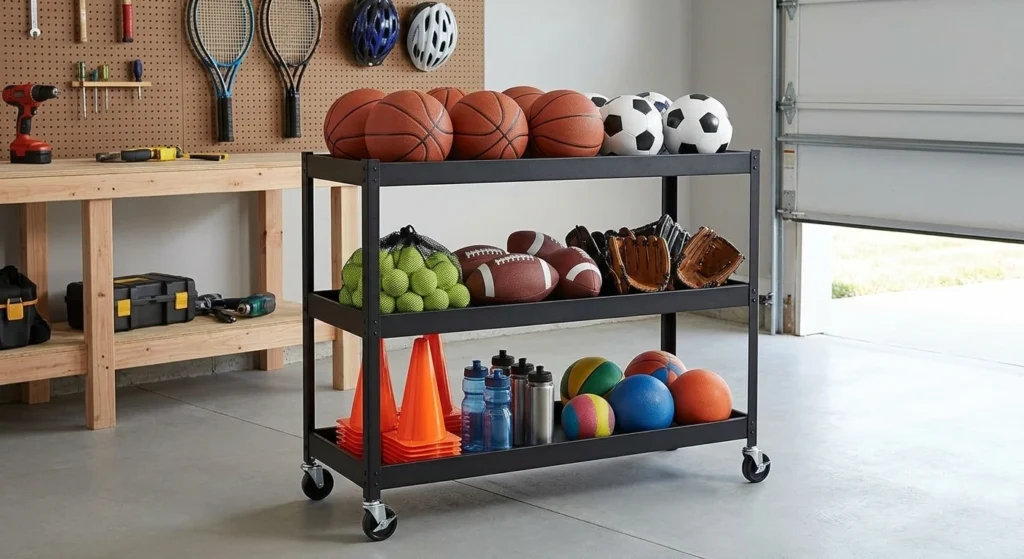
A rolling cart can turn a collection of balls into a portable sports station. This is useful if equipment moves between the garage, driveway, backyard, or a nearby playing area.
Choose a cart with secure sides, suitable wheels, and enough capacity for the equipment you intend to carry. Locking wheels can help keep the cart stationary while someone retrieves a ball.
Give the cart a defined parking spot so it does not become an obstacle when it is not in use. In a smaller garage, measure the cart’s footprint and the space needed to maneuver it before purchasing.
In a tight garage, choosing compact or movable storage can make a real difference. These small garage storage ideas offer more ways to use limited space efficiently.
A cart is particularly useful when you want to transport balls together, but it may not be the best option if every inch of floor space is already needed for parking.
Best for: Families who regularly move sports equipment between locations.
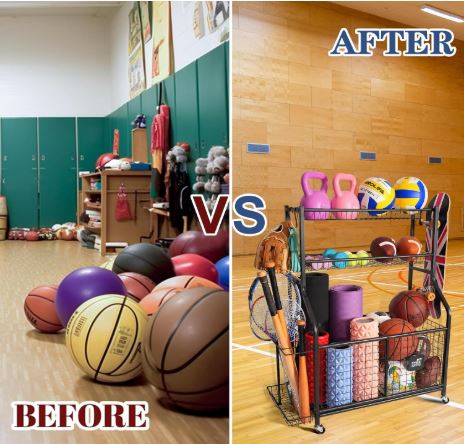
A rolling sports equipment cart keeps balls together and makes them easy to move between the garage and play area. Roll it out when the family needs sports gear, then move it back into its designated storage spot to keep the garage organized. [#CommissionEarned]
Check Price on Amazon →
11. Use a Deep, Open-Front Storage Crate
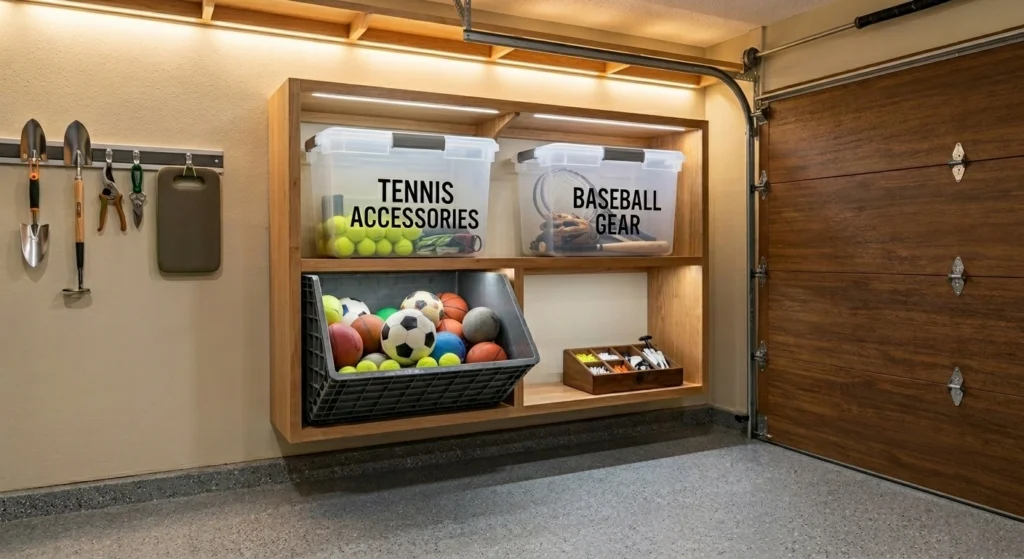
A sturdy open-front crate provides contained storage without the access steps associated with a lidded bin. Balls can be placed inside quickly, and the open front makes it easier to see and retrieve them.
This is different from a low children’s bin: a crate can be placed on a suitable shelf or inside a dedicated sports station, making it useful for older children and adults too.
Choose a crate that will not deform under the intended load and whose openings are appropriate for the smallest balls stored inside. If it sits on a shelf, make sure the shelf can support both the container and its contents.
Avoid stacking heavy items on top of the crate if that would make retrieving balls awkward or unsafe.
Best for: A compact, defined ball-storage area within a larger garage organization system.
12. Install Individual Holders for Favorite Balls
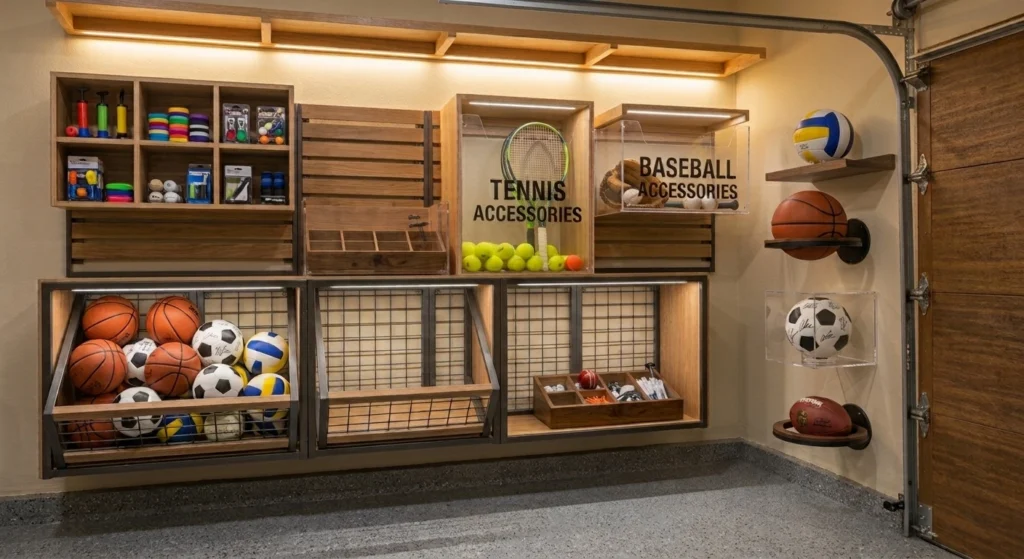
Some balls deserve their own location. A frequently used basketball, a signed soccer ball, or a ball that needs to remain separate from everyday play equipment may be better stored individually.
A single-ball wall holder can make a ball easy to identify and retrieve. For a display-worthy ball, choose a holder designed for its shape and surface rather than forcing it into a generic rack.
If you use several individual holders, arrange them where they will not interfere with vehicle movement or walking paths. Check the holder’s installation requirements and use appropriate mounting hardware.
This approach is not usually the most space-efficient choice for a large collection, but it can work well for a few frequently used or special balls.
Best for: A small number of favorite, frequently accessed, or display-worthy balls.
13. Repurpose a Garage Cabinet With an Open Ball Section
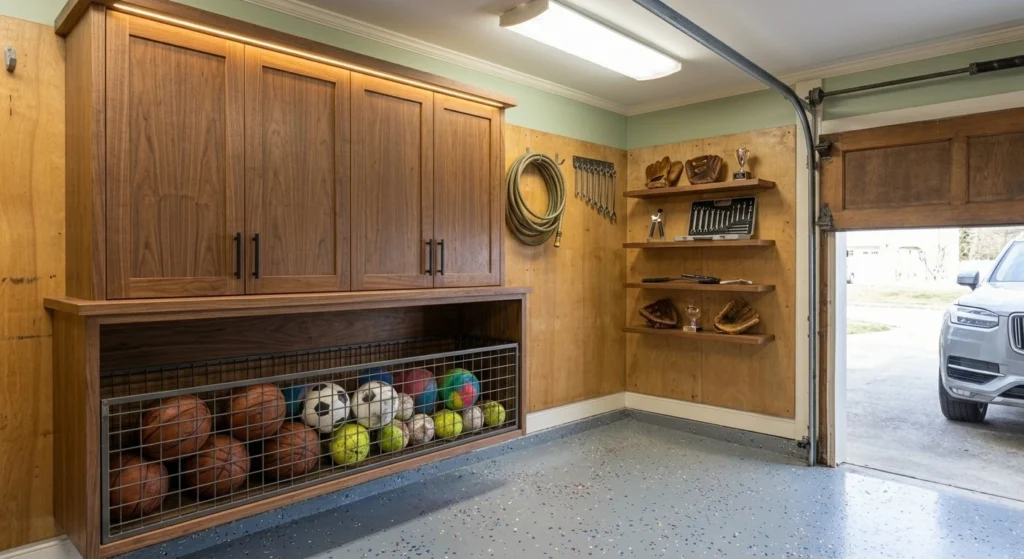
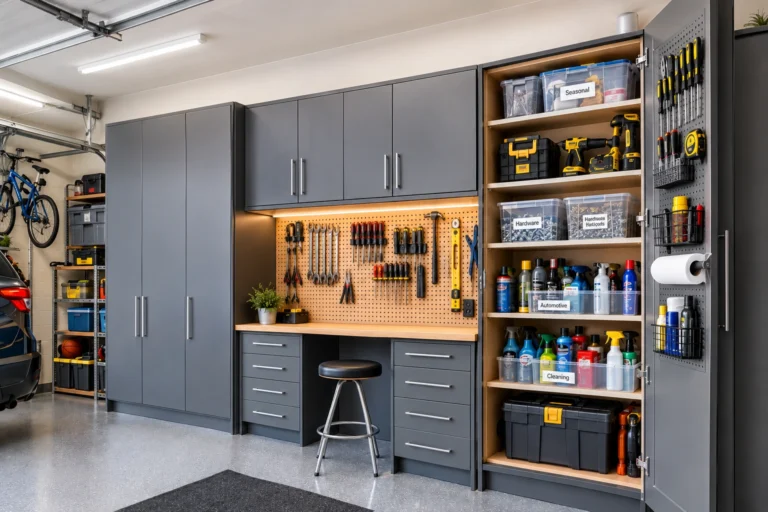
A cabinet can help create a visually tidy sports area, especially when the garage contains many unrelated items. However, balls can be inconvenient to store behind a door if family members need to access them several times a day.
One option is to reserve a suitable lower or open section of an existing cabinet for balls, using a compatible basket or organizer to keep them contained. Store less frequently used equipment behind closed doors and leave daily-use balls easy to reach.
Make sure the cabinet shelves and interior dimensions suit the ball sizes. If you modify a cabinet or add cords or dividers, ensure that the changes are secure and do not create sharp edges or snagging hazards.
Best for: Garages where visual neatness matters and a suitable cabinet is already available.
14. Reserve Overhead Storage for Seasonal Balls
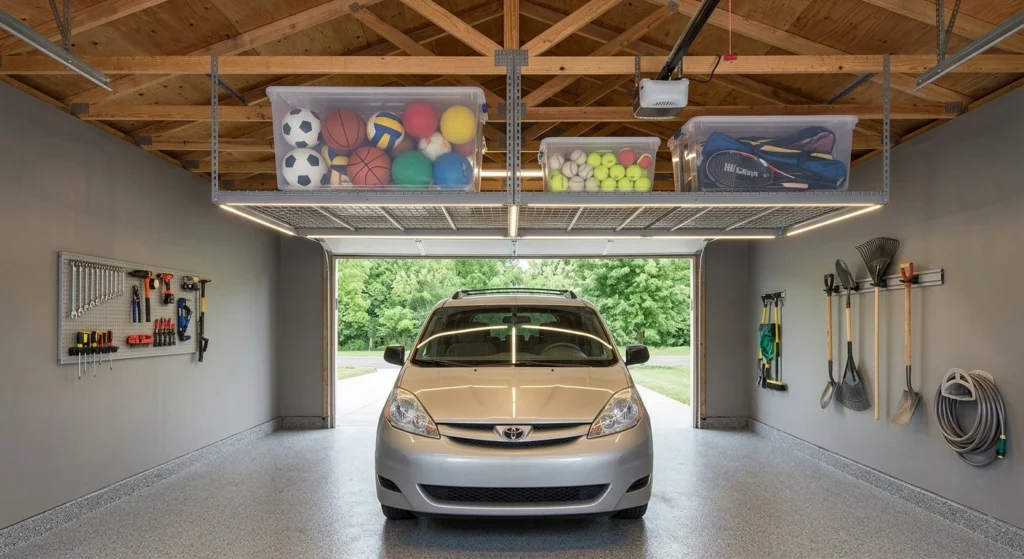
Overhead storage can free up useful wall and floor space, but it is generally better for equipment that does not need to be retrieved every day.
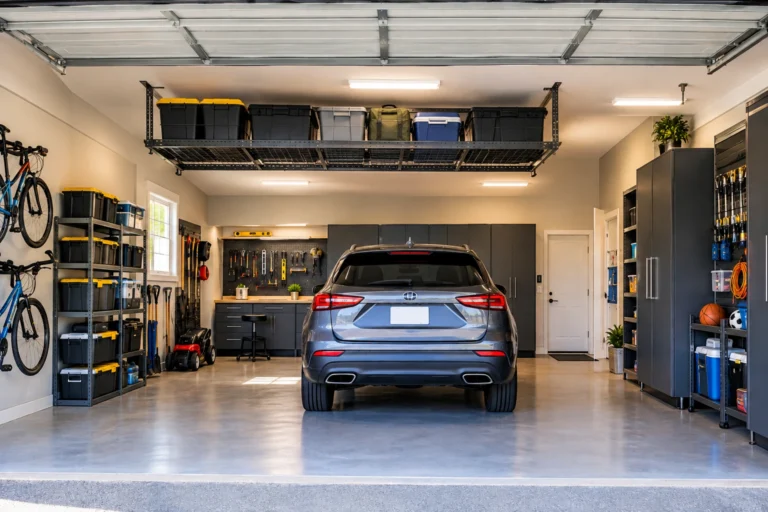
A suitable overhead rack or storage net may accommodate seasonal balls and other lightweight sports equipment, depending on its design and rated capacity. Use only a system intended for the application and follow its installation instructions. Mounting must be secured to appropriate structural members, not simply to drywall.
Keep stored items clear of the garage door, tracks, opener, lights, and any vehicle below. Do not place overhead storage where a dropped ball could strike someone or damage property.
For equipment used every afternoon, a wall rack or open basket is usually more convenient than reaching overhead.
Best for: Seasonal or infrequently used balls when the garage has safe, suitable overhead space.
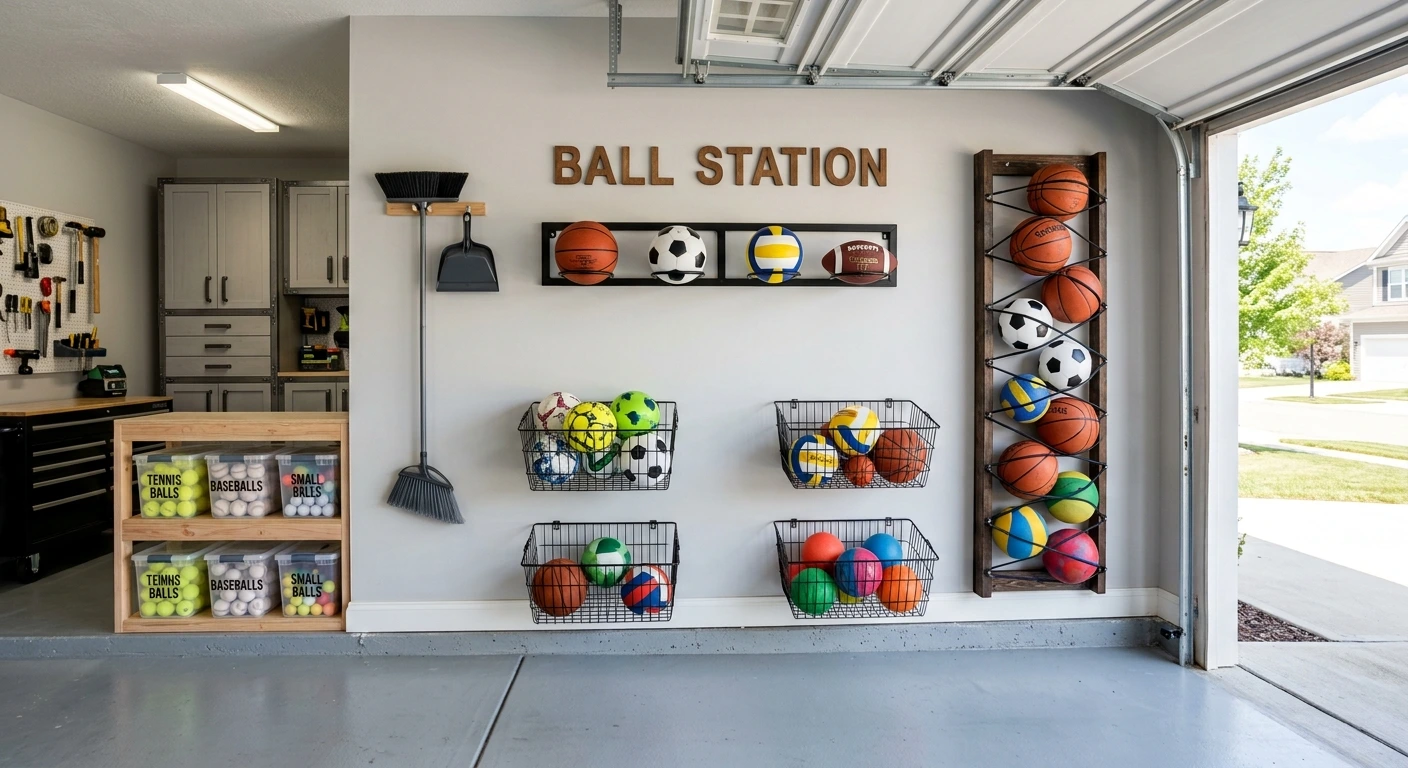
15. Create a Dedicated Sports Ball Zone
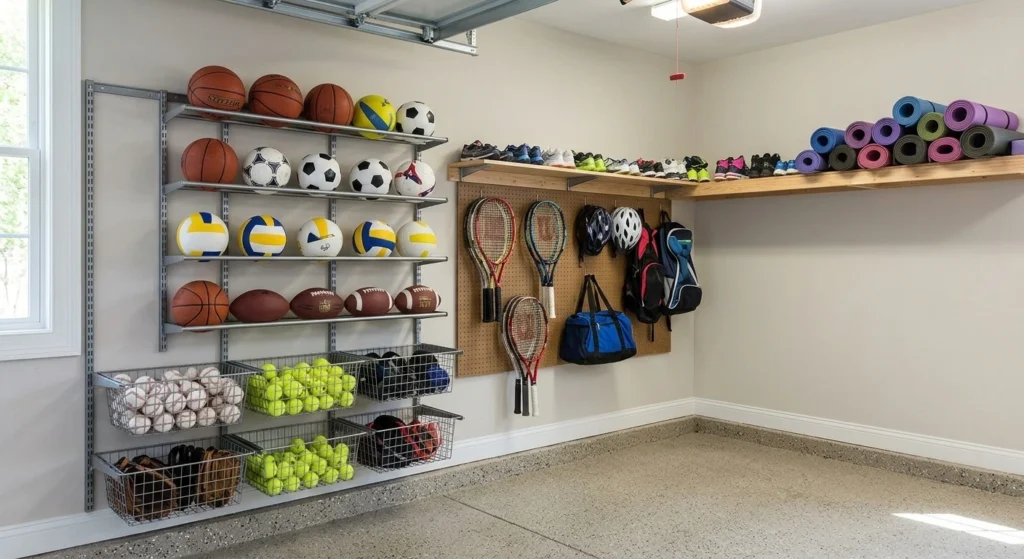
If balls keep spreading across the garage, the problem may be the lack of a clear destination rather than the type of organizer. A dedicated sports ball zone gives every ball category a predictable home.
For example, use a wall rack for basketballs and soccer balls, a low basket for children’s playground balls, and labeled containers for tennis balls or baseballs. Keep related equipment nearby, but avoid mixing helmets, shoes, bags, and balls in one oversized container.
Place the zone near the route family members use to leave for outdoor play, provided it remains clear of vehicle doors and walking paths. Put the most frequently used equipment at a convenient height and reserve higher or less accessible areas for seasonal items.
This approach can combine several of the ideas in this article without buying a single large storage system. Start with the equipment you already own, then add a product only if it solves a specific problem.
For a broader look at organizing balls alongside bats, rackets, helmets, and other gear, see our guide to garage sports equipment storage ideas.
Which Garage Ball Storage Idea Should You Choose?
The best option depends on how much equipment you have, how often it is used, and whether you can mount storage to the wall.
| Storage solution | Best suited for | Main consideration |
| Wall-mounted ball rack | Several everyday balls | Mounting support and rack capacity |
| DIY bungee organizer | Custom storage on a budget | Secure construction and cord safety |
| Corner hammock | Unused corner space | Sagging and access to stored balls |
| Wall-mounted wire basket | Quick, open access | Basket depth and wire spacing |
| Low open bin | Children’s equipment | Stable placement and easy reach |
| Adjustable shelving | Balls plus other gear | Shelf depth and load rating |
| Slatwall baskets | Existing slatwall systems | Accessory compatibility |
| Vertical ball tower | Narrow floor footprint | Stability and loading |
| Labeled small containers | Tennis balls and other small items | Visibility and sensible grouping |
| Rolling cart | Portable sports equipment | Maneuvering and parking space |
| Open-front crate | Compact contained storage | Access and container strength |
| Individual holders | Favorite or display balls | Limited capacity |
| Cabinet section | A tidier visual appearance | Daily access and interior space |
| Overhead storage | Seasonal equipment | Secure installation and clearance |
| Dedicated sports zone | Mixed collections and family use | Consistent habits and clear categories |
If your family uses balls daily, start with an open wall rack or basket. If children need to put equipment away independently, prioritize low and easy-to-use storage. If you rent or cannot drill into the wall, consider a suitable freestanding unit or cart. For seasonal equipment, a properly installed overhead system may make better use of otherwise unused space.
Common Garage Ball Storage Mistakes to Avoid
Buying before measuring. A rack may look suitable online but still be too narrow, too deep, or incompatible with your ball sizes. Measure first and check the product specifications.
Choosing storage that is hard to use. A lidded container or high shelf may look tidy but can be frustrating for equipment used every day. Match accessibility to your household’s routine.
Mixing every type of equipment together. Balls, helmets, shoes, and small accessories can turn one large basket into another clutter zone. Give balls a defined area and separate other gear where necessary.
Ignoring mounting and load limits. Use the correct hardware and structural support for the storage system. Do not assume a wall, hook, shelf, or ceiling can support a load simply because it looks sturdy.
Blocking the garage’s working space. Check vehicle clearance, door movement, walking routes, and access to other equipment before installing storage.
Putting damp or dirty balls straight away. Wipe off visible dirt and allow wet equipment to dry appropriately before placing it in closed storage. Open or ventilated storage can help equipment dry, but it does not replace proper cleaning and care.
Creating a system nobody maintains. The best organizer is one family members can use quickly. If returning a ball takes too many steps, simplify the arrangement.
Frequently Asked Questions
What is the best way to store balls in a garage?
For several frequently used balls, a wall-mounted rack or open wire basket is a practical starting point. It keeps balls contained and visible while freeing up floor space. The best choice depends on your ball sizes, available wall space, and installation options.
How do I stop sports balls from rolling around the garage?
Give them a defined storage location, such as a rack, deep basket, suitable crate, or ball holder. Avoid leaving round objects loose on shelves or near vehicle parking areas where they can roll into walkways or under cars.
Can I store basketballs and soccer balls together?
Yes, provided the storage system accommodates both sizes and keeps the balls secure. Check rack openings, basket depth, and the manufacturer’s specifications. If smaller balls are mixed with larger ones, a separate compartment can make retrieval easier.
What is the best ball storage option for a small garage?
Wall-mounted racks and baskets often preserve the most floor space when installed safely. If wall mounting is not practical, consider a compact freestanding tower or a small open container that fits outside the vehicle’s path.
Is it safe to mount a ball rack on drywall?
Do not rely on drywall alone unless the product’s instructions specifically allow that mounting method and the correct hardware is used. Follow the rack manufacturer’s requirements and secure the system to suitable structural support where required.
Should sports balls be stored in a closed container or an open rack?
Open racks and baskets are generally more convenient for everyday equipment because balls are visible and easy to retrieve. Closed containers may suit seasonal storage, but clean and dry equipment before putting it away, and avoid containers that make frequently used balls difficult to reach.
Final Thoughts
A clutter-free garage does not require a complicated ball-storage system. Start by grouping your balls, measuring the available space, and deciding which equipment needs the quickest access.
Choose a wall rack or basket for everyday use, an accessible bin for children’s equipment, or a suitable freestanding solution if wall mounting is not an option. Keep seasonal balls separate and make sure the arrangement leaves the garage’s walking and vehicle areas clear.
The goal is simple: every ball should have a place that is easy to use and easy to maintain. When putting equipment away becomes effortless, the floor is much more likely to stay clear.